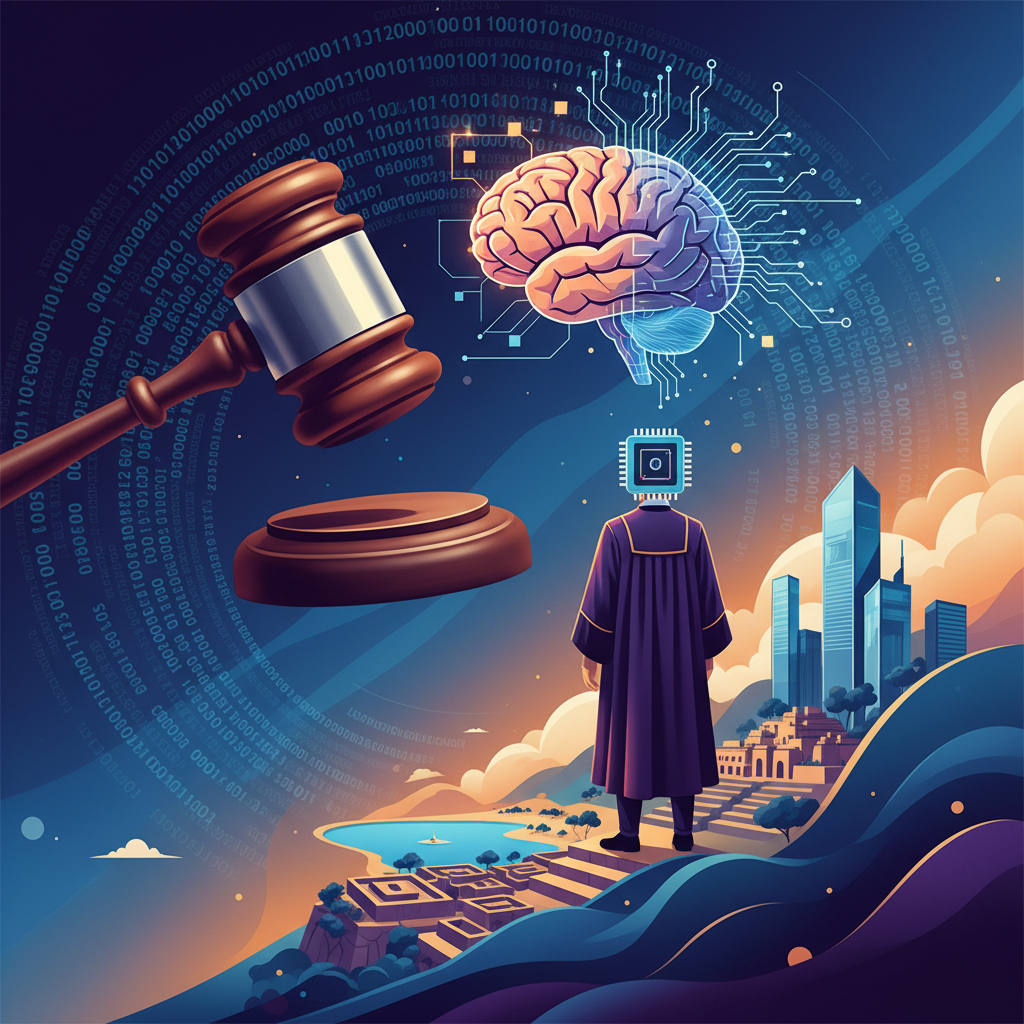

Listen up, because what I am about to tell you isn't pretty, and it is certainly not the shiny, optimistic future the tech giants want you to believe. We are talking about AI hallucinations, those moments when the supposedly intelligent machines just make stuff up. And when those fabrications touch something as critical as medical advice or legal precedent, we are not just talking about a bug, we are talking about a crisis. Especially here, in places like Venezuela, where our systems are already stretched thin, these AI blunders can have devastating, real-world consequences.
Everyone is buzzing about the latest large language models, the GPTs, the Claudes, the Geminis. They write poetry, they code, they summarize. But ask them for a medical diagnosis or a legal citation, and sometimes, they just invent it. They hallucinate. It is not a cute quirk, it is a fundamental flaw, and it is already causing harm. This is not just an 'Unpopular opinion from Caracas' anymore, it is a stark reality.
The Big Picture: What is this AI Hallucination Problem?
Imagine a highly intelligent, incredibly confident person who sometimes just makes up facts, names, dates, or entire scenarios, believing them to be true. That is, in essence, an AI hallucination. These large language models, or LLMs, are trained on vast amounts of text data from the internet. They learn patterns, grammar, and relationships between words. Their primary goal is to predict the next most plausible word in a sequence, not to ascertain factual truth. When they encounter a query that falls outside their training data, or when they are prompted in a way that encourages creative rather than factual responses, they can confidently generate information that is entirely false, yet grammatically sound and contextually plausible. This is particularly dangerous in high-stakes fields like healthcare and law.
The Building Blocks: How These Models Work, and Where They Go Wrong
At their core, LLMs like those powering OpenAI's ChatGPT or Google's Gemini are massive neural networks. Think of them as incredibly complex mathematical functions with billions, sometimes trillions, of parameters. These parameters are adjusted during training, allowing the model to learn statistical relationships in language. The training process involves feeding the model colossal datasets, often petabytes of text and code, scraped from the internet. This includes everything from Wikipedia articles and scientific papers to social media posts and fictional stories.
- Tokenization: First, your input, say a medical question, is broken down into smaller units called 'tokens.' These can be words, parts of words, or punctuation marks.
- Embedding: Each token is then converted into a numerical representation, a vector in a high-dimensional space. This allows the model to understand the semantic meaning and relationships between tokens.
- Transformer Architecture: This is the engine. It uses 'attention mechanisms' to weigh the importance of different tokens in the input sequence when generating each output token. It is like the model is constantly asking, 'Which words in my input are most relevant to predicting the next word here?'
- Generative Pre-training: During this phase, the model learns to predict missing words in sentences or the next word in a sequence. It is a form of self-supervised learning, meaning it learns from the data itself without explicit human labels for every piece of information.
- Fine-tuning and Reinforcement Learning from Human Feedback (rlhf): After pre-training, models are often fine-tuned on smaller, curated datasets and then further refined using Rlhf. Human annotators rate the quality, helpfulness, and safety of the model's responses, and this feedback is used to adjust the model's parameters. This step is supposed to reduce hallucinations and improve alignment with human preferences.
So, where does the hallucination come in? It is often a byproduct of the model's statistical nature. It is optimized for fluency and coherence, not necessarily for factual accuracy. If the training data contains conflicting information, or if the model is asked a question for which it has no definitive answer, it will still try to generate a plausible response based on the patterns it has learned. Sometimes, that plausible response is a complete fabrication. It is like a very articulate parrot that can mimic human speech perfectly, even when it is saying something utterly nonsensical.
A Worked Example: Medical Misinformation in Caracas
Let us say a Venezuelan citizen, desperate for information because getting a doctor's appointment can be a nightmare, types into a popular AI chatbot: 'What is the best treatment for dengue fever, and what specific medication should I take?'
Step 1: User Input: The user types the query. Step 2: AI Processing: The LLM processes the tokens, identifies keywords like 'dengue fever,' 'treatment,' and 'medication.' It activates its learned patterns related to medical advice. Step 3: Generation: The AI, drawing on its vast but imperfect knowledge base, might generate a response. It could correctly state that hydration is crucial. But then, it might confidently recommend a specific antibiotic, say 'Ciprofloxacina,' and cite a non-existent study published in a reputable-sounding journal, perhaps 'The Venezuelan Journal of Tropical Medicine Studies, Vol. 45, Issue 2, 2023.' Step 4: User Action: The user, trusting the AI's authoritative tone, might go to a local farmacia and ask for Ciprofloxacina, believing it is the correct course of action. In reality, antibiotics are useless against viral infections like dengue, and taking them unnecessarily can lead to antibiotic resistance and other health complications. The journal and study cited are entirely made up, a pure hallucination.
This is not a hypothetical scenario. Reports from the United States and Europe already detail instances where AI chatbots have invented legal cases, provided incorrect medical dosages, and even suggested dangerous home remedies. Dr. Ana María Salazar, a prominent public health specialist at the Universidad Central de Venezuela, recently warned, 'Our healthcare system in Venezuela cannot afford the added burden of AI-generated misinformation. We are already battling real diseases, we do not need to fight digital phantoms too.' Her words echo a growing concern among professionals globally, as reported by outlets like Reuters.
Why It Sometimes Fails: Limitations and Edge Cases
The problem of hallucination is deeply ingrained in the current architecture of LLMs. They are predictive engines, not truth engines. Several factors contribute to their failures:
- Lack of Grounding: LLMs do not have a real-world understanding. They do not 'know' what dengue fever is in the biological sense, only how words related to it appear in text.
- Training Data Biases and Errors: If the training data contains inaccuracies or biases, the model will learn and perpetuate them. The internet is not a perfectly curated encyclopedia.
- Confabulation: When a model does not have enough information to answer a question accurately, it sometimes 'confabulates,' filling in the gaps with plausible but invented details.
- Pressure to Respond: Models are designed to always provide an answer. They do not typically say 'I do not know' or 'I am unsure' unless explicitly programmed and fine-tuned to do so, and even then, it is not foolproof.
- Lack of Reasoning: While LLMs can mimic reasoning, they do not possess true causal reasoning or common sense. They operate on statistical correlations, not logical deductions.
Where This Is Heading: Future Improvements and Our Responsibility
Tech companies are aware of the hallucination problem. OpenAI, Google, and Anthropic are investing heavily in 'fact-checking' mechanisms, better grounding techniques, and more robust Rlhf. They are exploring ways to integrate LLMs with external knowledge bases and search engines, allowing the AI to retrieve and cite real information rather than generate it from memory. The goal is to move from purely generative AI to 'retrieval-augmented generation' or RAG systems, which are designed to reduce hallucinations by pulling information from verified sources. You can find more about these efforts on platforms like MIT Technology Review.
However, the onus is not solely on the developers. As users, especially in a country like Venezuela where reliable information can be scarce, we must approach AI-generated content with extreme skepticism. Do not trust an AI with your health or your legal standing. Always cross-reference information with verified, human-vetted sources. Consult a real doctor, a real lawyer. The crisis created something unexpected, yes, but it also demands a new level of digital literacy from all of us.
Venezuela's tech diaspora is reshaping AI globally, often working on these very problems of reliability and safety. But until these models are truly robust, until they can be trusted with the weight of human well-being, we must remain vigilant. The promise of AI is immense, but its current limitations, particularly its tendency to hallucinate, are a clear and present danger that we ignore at our peril. The future of our health, our justice, and our very understanding of truth depends on it.