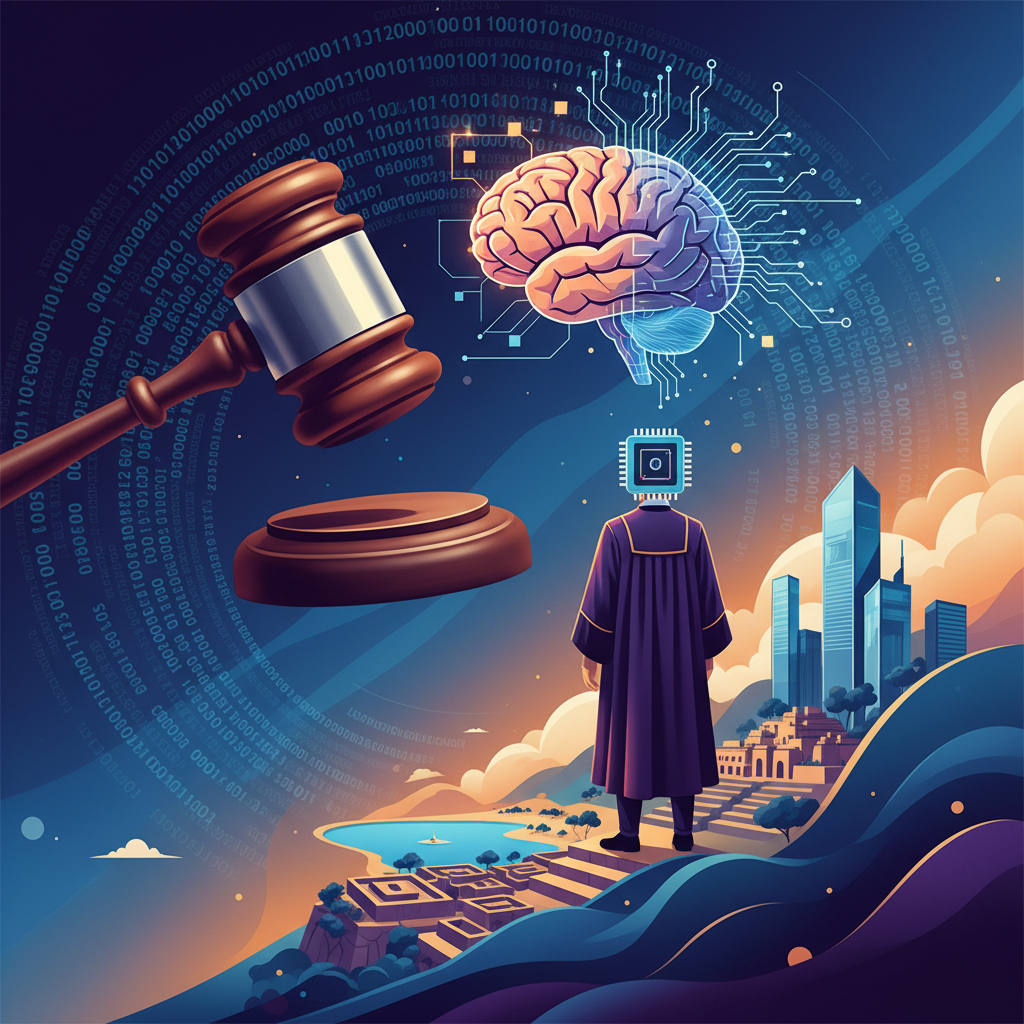

The sun rises over the Andes, painting the peaks in hues of gold and crimson, much like it has for thousands of years. In the highlands of Peru, life moves with a rhythm tied to the earth, to ancient traditions, and to community. Yet, even here, the digital tide of artificial intelligence is reaching, promising to reshape everything, including our most fundamental institutions: our justice systems.
I have been watching the discussions around AI in legal tech with a mix of fascination and apprehension. The headlines from Silicon Valley speak of revolutionary tools: algorithms that can sift through millions of documents in seconds, predict case outcomes with startling accuracy, and automate legal research that once took days. Companies like Thomson Reuters and LexisNexis are investing heavily, integrating advanced AI models into their platforms, and startups are emerging, promising to democratize legal access and streamline processes. It sounds like progress, doesn't it? A faster, more efficient justice system, free from human error and bias.
But as a journalist from Peru, I see a different landscape, one where the promise of AI often clashes with the complex realities of our diverse societies. My concern is not with the technology itself, but with the uncritical adoption of tools designed for one context and applied blindly to another. The legal systems in countries like Peru are not merely collections of statutes and precedents; they are deeply interwoven with cultural norms, historical injustices, and a profound human element that algorithms, however sophisticated, struggle to comprehend.
Consider contract analysis. AI tools can indeed identify clauses, flag anomalies, and summarize lengthy documents. For large corporations dealing with standardized international agreements, this is a clear efficiency gain. But what about a small farmer in the Sacred Valley, whose land rights might be tied to ancestral customs not explicitly codified in modern law, or whose understanding of a contract is shaped by oral traditions and community agreements? Can an algorithm truly grasp the nuances of a communal land title, or the unwritten social contracts that govern disputes in indigenous communities? I think not.
This is a story about ancient wisdom meeting modern AI, and the challenges that arise when the two collide. The legal tech industry, dominated by giants like Google and Microsoft, often frames its innovations as universally beneficial. Microsoft's Copilot, for instance, is being integrated into various professional services, promising to enhance productivity across the board. But productivity for whom, and at what cost to existing structures of justice and fairness? The danger is that these tools, built on data predominantly from Western legal traditions, will impose a singular, often alien, framework on legal problems in places like Peru.
Case prediction is another area where the allure of AI is strong. Imagine an algorithm that can tell you the likely outcome of a court case based on past rulings, judge's tendencies, and evidence presented. This could help lawyers advise clients better and manage expectations. However, our legal system, like many in Latin America, is often characterized by significant discretion, evolving interpretations, and a judicial process that is not always perfectly predictable through data alone. The human element of a judge's empathy, a witness's demeanor, or the socio-economic context of the parties involved can sway a decision in ways that current AI models simply cannot capture. Moreover, if AI is trained on historical data, it risks perpetuating existing biases. If certain communities have historically faced harsher sentences, an AI trained on that data might predict similar outcomes, thereby embedding and reinforcing systemic inequalities rather than correcting them.
Anticipating counterarguments, some might say that AI will free up lawyers from mundane tasks, allowing them to focus on the human aspects of law. They argue that these tools are merely assistants, not replacements for human judgment. They might point to the increasing adoption of AI in legal departments across the globe, citing efficiency gains and cost reductions. Indeed, the global legal tech market is projected to reach over $30 billion by 2027, indicating a strong industry belief in its transformative power, according to reports from Reuters.
My rebuttal is this: while efficiency is desirable, it must never come at the expense of justice, especially in a country grappling with its own complex history of legal and social inequality. The promise of AI in legal tech often feels like a solution looking for a problem, without fully understanding the depth of the human problem it purports to solve. We need to ask: who benefits most from this increased efficiency? Is it the marginalized communities seeking justice, or the powerful entities seeking to streamline their legal operations?
I remember speaking with Dr. Elena Vásquez, a prominent Peruvian legal scholar and advocate for indigenous rights, about this very topic. She showed me something that changed my understanding. She spoke of the jurisdicción especial indígena, a system of justice recognized by the Peruvian constitution, where indigenous communities resolve disputes according to their own ancestral laws and customs. “How can an algorithm, trained on Western common law or civil law, ever truly understand the spirit of restorative justice practiced in an Andean community?” she asked me, her voice firm but gentle. “It cannot. It would be like trying to measure the wind with a ruler.” Her point resonated deeply: the data that feeds these AI models is inherently biased towards dominant legal paradigms, often marginalizing or entirely ignoring alternative forms of justice that are vital to our cultural tapestry.
Furthermore, the cost of implementing and maintaining these sophisticated AI systems is not trivial. For many legal aid organizations or smaller law firms in Peru, the investment is simply out of reach. This creates a digital divide, potentially exacerbating the existing gap between those who can afford high-tech legal services and those who cannot. Justice, in this scenario, risks becoming a luxury item, further concentrating power in the hands of the few.
We need a more nuanced approach. Instead of simply importing ready-made AI solutions from Silicon Valley, we should be investing in developing AI tools that are culturally sensitive, contextually aware, and built with the specific needs of Peruvian communities in mind. This means involving local legal experts, anthropologists, and community leaders in the development process. It means prioritizing fairness and accessibility over mere speed. It means recognizing that our legal landscape is not a blank slate for algorithms to write upon, but a rich, complex tapestry woven over centuries.
As Professor Juan Carlos Rivero, a specialist in legal informatics at the Pontificia Universidad Católica del Perú, recently stated, “The true innovation in legal AI for countries like ours lies not in replicating foreign models, but in adapting and creating systems that respect our unique legal pluralism and social realities. We must be the architects of our own digital future in law, not just consumers.” His words echo a sentiment I hear often: that technology must serve humanity, not the other way around.
My call to action is clear: let us not be dazzled by the glittering promises of efficiency without scrutinizing the underlying assumptions and potential consequences. Let us demand that AI in legal tech be developed with a deep understanding of human justice, cultural diversity, and equitable access. Let us remember that justice is not just about speed; it is about wisdom, empathy, and a profound respect for the human story behind every case. Otherwise, we risk building a legal system that is efficient, yes, but fundamentally devoid of the very humanity it is meant to serve. For more insights on the broader implications of AI, you might find interesting discussions on MIT Technology Review. The future of justice in Peru, and indeed across the globe, depends on this critical discernment. We must ensure that the algorithms we invite into our courtrooms are not just smart, but also wise and just. And for a deeper dive into current AI developments, The Verge often provides excellent coverage.