
The digital world, much like the rainforests we protect here in Costa Rica, is a complex ecosystem. It is beautiful, full of life, and constantly evolving, but also harbors unseen dangers. For years, we've watched from the sidelines as global enterprises grappled with increasingly sophisticated cyber threats. Then, in 2022, the jungle came alive for us in a way we never expected, when a major ransomware attack crippled vital government systems, costing an estimated 100 billion colones, or roughly 1.6% of our GDP. It was a harsh lesson, one that forced us to look inward and ask: how do we protect our digital sovereignty?
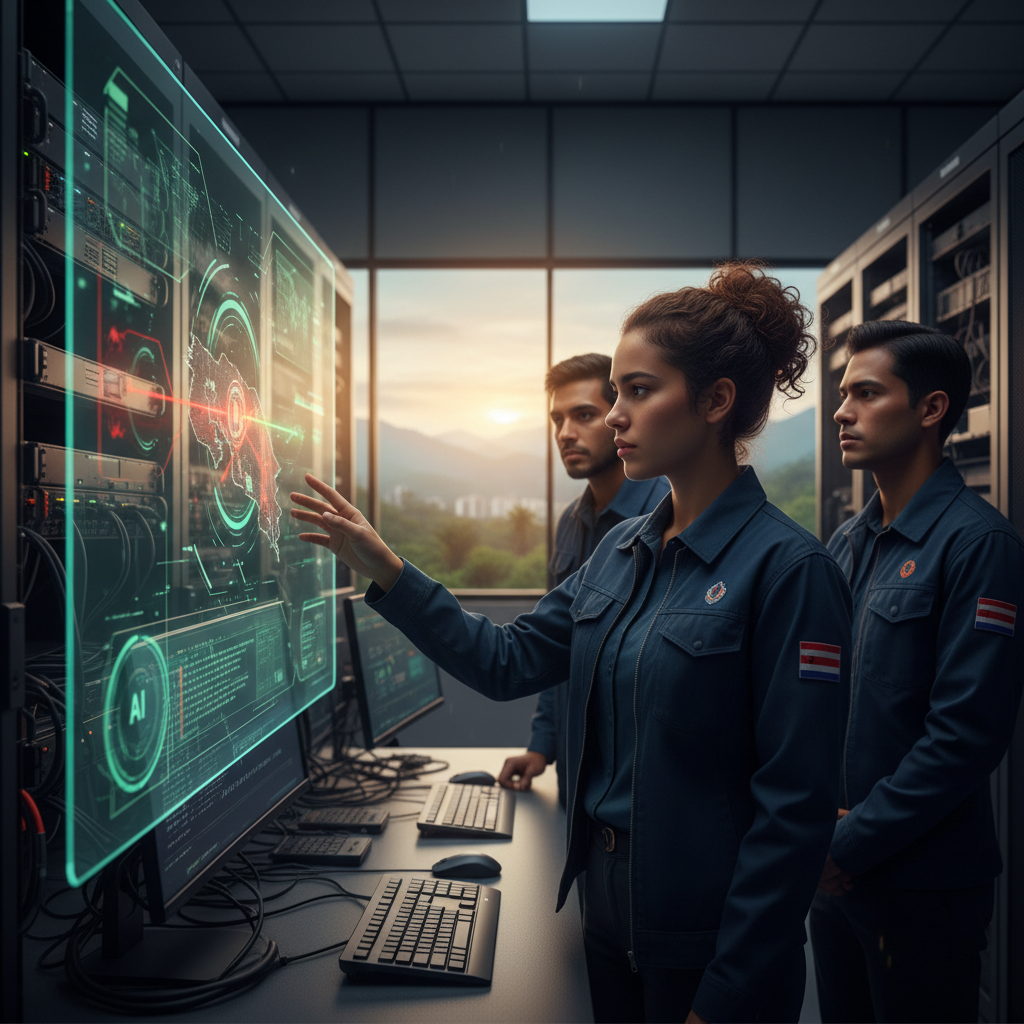
That experience, as painful as it was, became a crucible for innovation. It highlighted a critical need for real-time threat detection, a domain where artificial intelligence is now proving indispensable. We are not talking about futuristic, abstract concepts here. We are talking about practical tools that learn the normal rhythm of a network, identifying anomalies that signal trouble long before a human analyst ever could. Think of it like the forest rangers who know the sounds of the jungle so intimately they can spot a poacher from a rustle of leaves.
Globally, the landscape of AI in cybersecurity is exploding. Companies like Palo Alto Networks, CrowdStrike, and Fortinet are integrating advanced machine learning models into their platforms to analyze vast streams of network traffic, endpoint data, and user behavior. These systems are designed to detect everything from zero-day exploits to subtle phishing attempts with a speed and scale impossible for traditional rule-based systems. According to a recent report by Reuters, the AI in cybersecurity market is projected to reach over $60 billion by 2030, growing at a compound annual growth rate exceeding 20%. This is not just a trend; it is a fundamental shift in how we defend our digital borders.
Here in Costa Rica, our approach is less about building billion-dollar AI models from scratch and more about intelligently deploying and adapting existing technologies. We are seeing a concerted effort from both government agencies and private sector firms to leverage AI for predictive analytics and automated response. For example, the Costa Rican Institute of Technology, TEC, has been working on projects that use machine learning to identify malware signatures unique to our regional threat landscape. This practical innovation in paradise is about tailoring solutions to our specific needs, not just importing off-the-shelf products.
José Vargas, a cybersecurity analyst with the Costa Rican Ministry of Science, Innovation, Technology, and Telecommunications, or Micitt, emphasized this point recently. “After 2022, we understood that passive defenses were not enough,” Vargas stated. “We needed active, intelligent systems that could learn and adapt. AI allows us to move from reactive defense to proactive threat hunting. It is about understanding the adversary's patterns before they can execute their full plan.” This sentiment resonates deeply with the pura vida approach to AI we are cultivating: a focus on sustainable, effective, and community-oriented solutions.
One of the biggest challenges, however, is the sheer volume of data required to train these AI models. Enterprise networks generate petabytes of information daily. Processing this locally can be resource-intensive. This is where cloud-based AI cybersecurity solutions, offered by giants like Microsoft with their Azure Sentinel or Google Cloud's Chronicle Security Operations, come into play. These platforms offer scalable compute power and pre-trained models that can be fine-tuned for specific organizational needs. However, for a small nation, data sovereignty and privacy remain paramount concerns. We want the benefits of AI without compromising the trust of our citizens.
This leads to a fascinating local development: the rise of specialized, smaller firms focusing on niche AI applications for cybersecurity. These companies, often founded by local talent educated at our national universities, are developing solutions that are more attuned to the nuances of Central American cyber threats. They are not trying to compete with OpenAI or Google directly, but rather to provide targeted, cost-effective defenses. TechCrunch has highlighted similar trends in other emerging markets, where local ingenuity fills gaps left by global players.
Consider the work being done at the University of Costa Rica's School of Computer Science. Researchers there are exploring federated learning techniques for cybersecurity, where AI models are trained on decentralized datasets without the data ever leaving its source. This could be a game-changer for protecting sensitive government or financial data while still benefiting from collective intelligence. It is a testament to the fact that Costa Rica proves you do not need Silicon Valley to foster cutting-edge research and development.
Of course, the arms race continues. As AI gets better at detecting threats, attackers are also leveraging AI to craft more sophisticated attacks. This means continuous learning and adaptation are non-negotiable. The human element, the skilled cybersecurity professionals, remains crucial. AI is a powerful tool, but it is not a silver bullet. It augments human capabilities, allowing analysts to focus on complex, strategic problems rather than sifting through endless logs.
Looking ahead, our focus must remain on collaboration, both domestically and internationally. Sharing threat intelligence, developing common standards, and investing in continuous education for our cybersecurity workforce are vital. The 2022 attack was a wake-up call, but it also showed us our resilience. We are building a digital fortress, not with walls of concrete, but with intelligent algorithms and the unwavering spirit of innovation that defines us. The goal is not just to survive the next cyber storm, but to emerge stronger, more secure, and more self-reliant in our digital future.