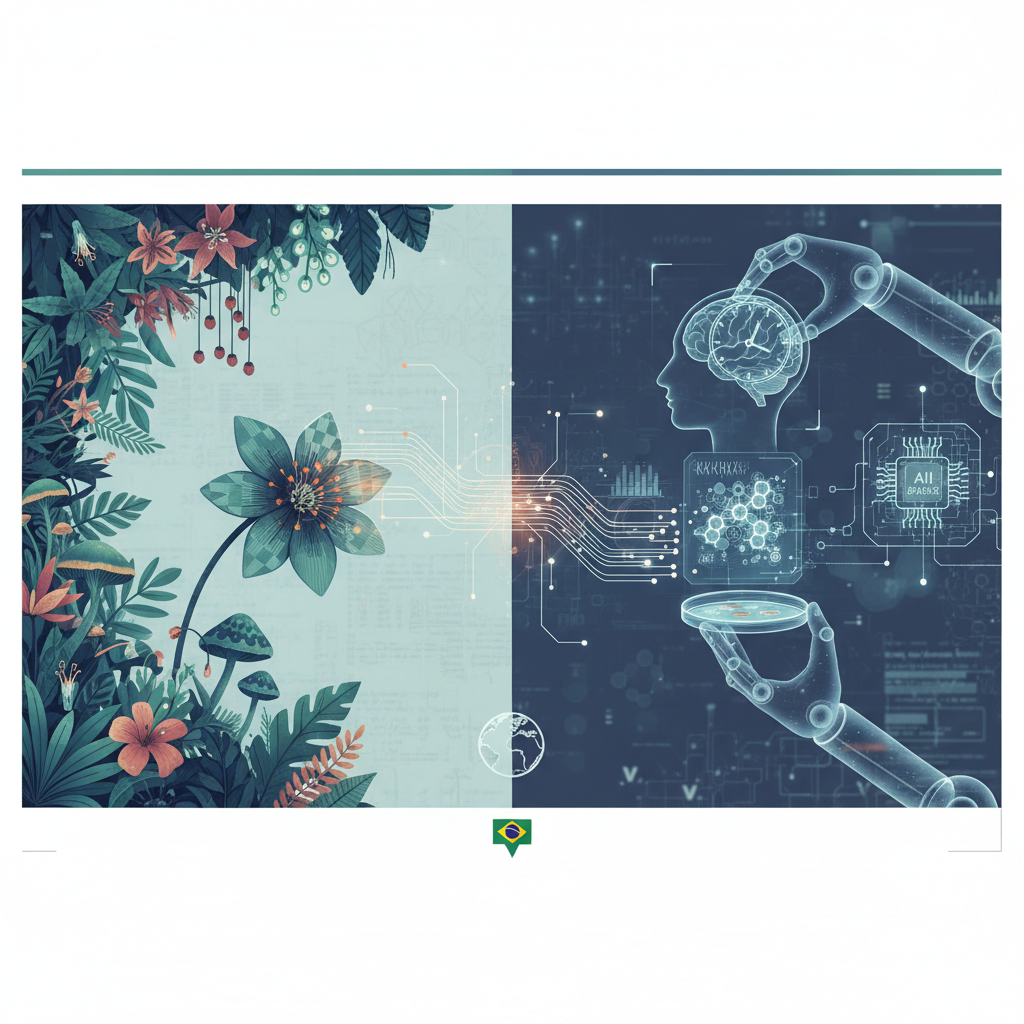

In Brazil, we understand the rhythm of life, the slow, deliberate growth of the Amazon rainforest, and the vibrant, rapid pulse of our cities. Drug discovery, for too long, has mirrored the rainforest's pace: a slow, arduous process, often taking over a decade and costing upwards of a billion dollars. But imagine if we could accelerate that, not just by a little, but by an order of magnitude. This is not science fiction anymore, my friends, it is the reality being forged by AI, and it is a game changer for humanity, particularly for nations like ours.
For years, the pharmaceutical industry has been locked in a seemingly intractable problem. Identifying a novel compound, validating its efficacy, navigating clinical trials, and finally bringing it to market is a journey fraught with failure. The statistics are brutal: only about one in ten thousand compounds that enter early discovery ever make it to patients. This inefficiency translates directly into higher drug costs and, more critically, delayed access to life-saving treatments, a challenge acutely felt in our public health system, the SUS, which serves millions across our vast country.
Enter the era of artificial intelligence, a force that is fundamentally reshaping this landscape. We are talking about AI not just as a tool, but as a co-pilot, a brilliant, tireless researcher capable of sifting through chemical space with unprecedented speed and precision. The breakthrough I want to discuss today is how AI is cutting pharmaceutical research and development timelines from years to months, a feat once considered impossible.
The Breakthrough in Plain Language: AI as a Molecular Matchmaker
Think of it like this: traditional drug discovery is like trying to find a specific key to a specific lock by randomly trying millions of keys from a massive, unorganized pile. It is slow, expensive, and mostly involves guesswork. Now, imagine you have an incredibly intelligent assistant, an AI, that can instantly analyze the shape and properties of every lock, then design the perfect key from scratch, or at least narrow down the pile to a handful of highly probable candidates. That is what AI is doing in drug discovery.
Companies like Insilico Medicine, co-founded by the visionary Alex Zhavoronkov, are at the forefront of this revolution. They are using generative AI models, much like the ones that create stunning images or write compelling text, but instead, these models are generating novel molecular structures. They are not just predicting which existing molecules might work, they are creating new ones that have never been seen before, designed specifically to target a disease. This is a profound shift from a reactive search to a proactive design.
Why It Matters: A New Hope for Patients and Economies
The implications of this acceleration are staggering. For patients, it means faster access to treatments for diseases that currently have limited or no options. Think of neglected tropical diseases, which disproportionately affect populations in developing nations, including parts of Brazil. If drug discovery can be expedited, the economic incentive to develop these drugs increases, and the suffering they cause can be alleviated sooner.
For economies, particularly emerging ones like Brazil, this could mean a significant boost to our nascent biotechnology sector. Imagine our brilliant researchers, armed with these AI tools, being able to contribute to global drug development at a pace previously reserved for the world's largest pharmaceutical giants. Brazil's developer community is massive and talented, and this is an area where our expertise in data science and machine learning can truly shine, creating high-value jobs and fostering innovation right here.
The Technical Details: Beyond Brute Force
Let me explain the architecture. At its core, this AI-driven approach leverages several advanced machine learning techniques. First, there is generative AI, often using Generative Adversarial Networks (GANs) or variational autoencoders (VAEs). These models learn the complex patterns of existing drug-like molecules and then generate new ones that adhere to those desirable properties, but with novel structures. It is like an artist learning the rules of painting and then creating a masterpiece that is entirely original.
Second, reinforcement learning plays a crucial role. The AI designs a molecule, then a simulated environment or a predictive model evaluates how well that molecule would bind to a specific protein target associated with a disease. Based on this feedback, the AI refines its design, iteratively improving until it finds an optimal candidate. It is a continuous learning loop, much faster and more efficient than human trial and error.
Third, predictive modeling using deep learning algorithms helps in assessing various properties of these generated molecules, such as toxicity, solubility, and metabolic stability, before they are even synthesized in the lab. This drastically reduces the number of compounds that need to be physically tested, saving immense time and resources. The code tells the real story here, revealing the intricate dance between algorithms and chemical properties.
Insilico Medicine, for instance, has demonstrated this with its lead drug candidate, a treatment for idiopathic pulmonary fibrosis (IPF). They identified a novel target, generated a new molecule, and completed preclinical validation in a fraction of the time typically required. Their first AI-discovered and AI-designed drug entered human clinical trials in February 2023, a monumental achievement that validates the entire approach. This is not just theoretical; it is happening now. You can read more about these advancements in publications like Nature Machine Intelligence or arXiv.
Who Did the Research: The Visionaries and the Algorithms
While many labs globally are contributing to this field, Insilico Medicine stands out. Alex Zhavoronkov, their CEO, has been a vocal proponent and a driving force behind the integration of AI into every stage of drug discovery. His team, alongside collaborators at various academic institutions and pharmaceutical companies, has published extensively on their methods and results. Other major players like Google DeepMind, with its AlphaFold protein structure prediction, and various initiatives from pharmaceutical giants like Pfizer and Novartis, are also heavily investing in these AI capabilities. It is a global race, but one that promises immense benefits for all.
Implications and Next Steps: A Future Designed by Data
The future of medicine will be increasingly data-driven and AI-accelerated. What does this mean for us in Brazil? It means we must invest in the infrastructure, the talent, and the regulatory frameworks to participate fully in this new era. Our universities, like USP and Unicamp, are already producing world-class AI researchers. We need to foster stronger collaborations between academia, industry, and government to build our own AI-powered drug discovery ecosystem.
As Dr. João Gabriel, a leading biomedical researcher at Fiocruz, recently stated, “The potential for AI to democratize drug discovery is immense. It allows smaller teams, even in resource-constrained environments, to compete on a global scale by leveraging computational power.” This sentiment resonates deeply with our national aspirations.
We are also seeing a shift in how pharmaceutical companies operate. They are becoming more like technology companies, investing heavily in AI platforms and data science expertise. This trend is only going to accelerate, as evidenced by the increasing number of AI-driven drug discovery startups securing significant funding, often reported on TechCrunch.
However, challenges remain. The regulatory landscape needs to adapt to the speed of AI-driven discovery, ensuring safety and efficacy without stifling innovation. We also need robust ethical guidelines for AI in healthcare, a topic that resonates with our Brazilian values of social responsibility. The data used to train these models must be diverse and representative, avoiding biases that could lead to drugs effective only for certain populations.
This is not just about making drugs faster; it is about making them better, safer, and more accessible. It is about leveraging the incredible power of AI to tackle some of humanity's most pressing health challenges. As a journalist from Brazil, I see immense potential for our nation to not just be a consumer of these technologies, but a significant contributor to this global health revolution. The future of medicine, much like a well-designed algorithm, is being written line by line, and I believe Brazil will have a strong voice in that code. We are not just watching; we are preparing to build.