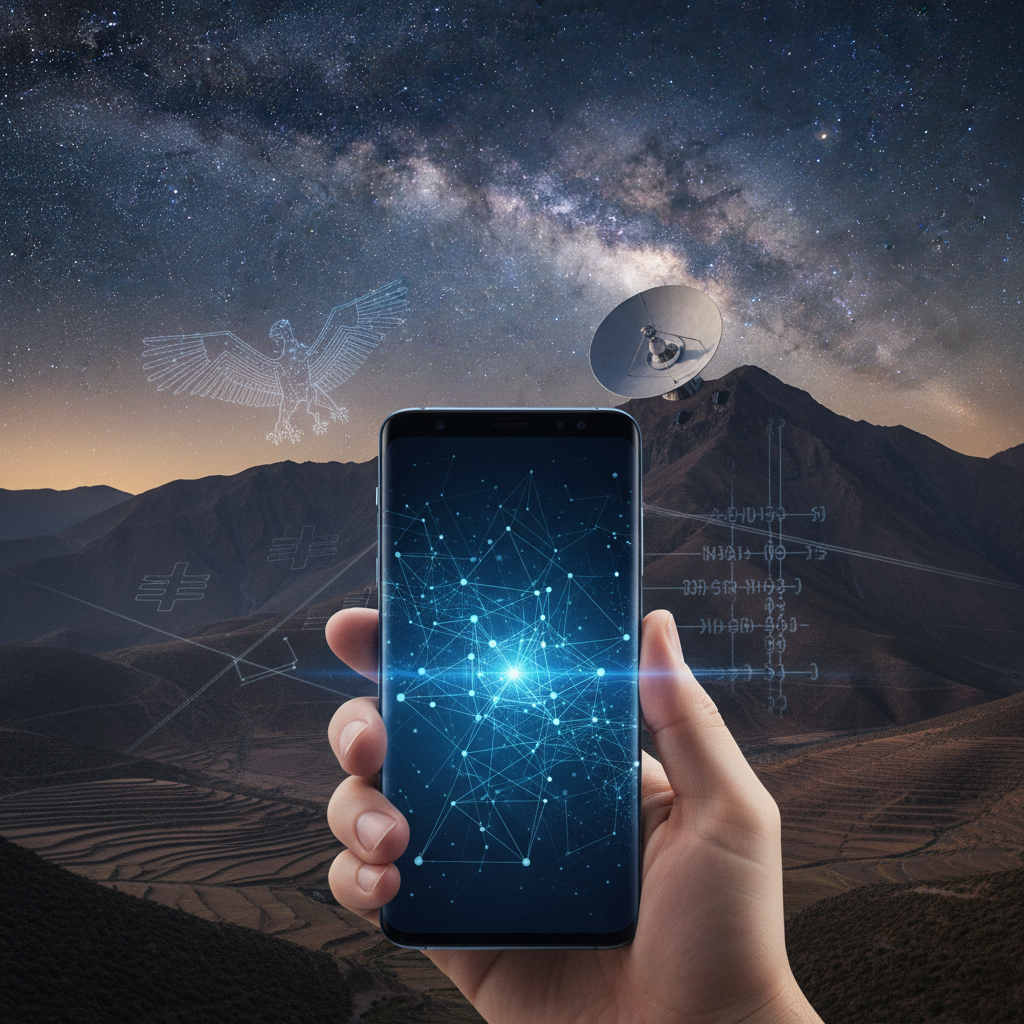

The air in Cusco, even in April, carries a crispness that awakens the senses, a stark contrast to the buzzing digital world I often navigate. Yet, even here, amidst the ancient stones and vibrant markets, the whispers of artificial intelligence are growing louder, echoing from the pockets of tourists and locals alike. This is a story about ancient wisdom meeting modern AI, specifically the unfolding drama of the smartphone AI arms race, and how Samsung's Galaxy AI features are making us rethink what a phone can truly be.
For months now, the tech world has been captivated by the relentless push to embed sophisticated AI directly into our everyday devices. It is no longer enough for a phone to simply connect us; it must anticipate, understand, and even create for us. Leading this charge is Samsung, with its suite of Galaxy AI features, turning the smartphone into a personal assistant, translator, and creative partner all at once. I have seen the demonstrations, read the reviews, and even held one of these new phones in my hand, marveling at its capabilities.
Circle to Search, Live Translate, Note Assist, Generative Edit: these are not just marketing terms, they are glimpses into a future where our phones are less tools and more companions. Imagine being in a bustling market in Pisac, trying to haggle for a beautiful alpaca sweater, and your phone instantly translates your Quechua phrases into Spanish, or vice versa, bridging a language barrier in real time. Or perhaps you are a small artisan, struggling to capture the intricate details of your craft for an online store, and a generative edit feature effortlessly enhances your photos, making them pop. These are not distant dreams; they are functionalities available today.
But what does this mean for us, here in Peru, a country rich in tradition and often cautious of rapid technological shifts? I think about the concept of ayni, a foundational principle in Andean culture that speaks of reciprocity, mutual aid, and community support. It is about giving and receiving, about working together for the collective good. When I look at these powerful AI features, I cannot help but wonder: can this technology truly embody ayni? Can it serve not just the individual user, but the broader community, helping to preserve culture, empower local economies, and bridge divides?
Take Live Translate, for instance. While it is certainly a boon for international travelers, its potential for local impact is immense. Imagine medical professionals in remote Andean villages, able to communicate more effectively with patients who speak indigenous languages, facilitated by a device in their hand. Or educators, using AI to create personalized learning materials that respect and integrate local dialects and cultural narratives. This is where the true power lies, beyond just convenience for the privileged few.
However, the rapid deployment of these features also raises questions. The smartphone AI arms race is not just about innovation; it is about market share, data, and influence. Companies like Samsung, Google, Apple, and Qualcomm are pouring billions into on-device AI capabilities, striving to differentiate their products in an increasingly crowded market. Google, with its Gemini models, is deeply integrated into many of these new AI experiences, including those on Samsung devices. This collaboration highlights a critical trend: the future of smartphone AI will likely be a blend of on-device processing for speed and privacy, and cloud-based AI for more complex tasks and up-to-date information.
According to a recent report by Counterpoint Research, AI-capable smartphone shipments are projected to reach over 500 million units by 2027, representing a significant portion of the total smartphone market. This massive adoption means that AI will become an invisible, yet integral, part of our daily lives faster than many anticipate. Reuters has covered extensively how this competition is heating up, with each major player vying for dominance.
I recently spoke with Dr. Elena Quispe, a Quechua linguist and cultural preservationist based in Ayacucho. She showed me something that changed my my understanding of this technology. She demonstrated how she uses a basic translation app, a precursor to today's advanced AI, to help transcribe and preserve oral histories from elders in her community. "The new AI features, if developed with sensitivity and local input, could be revolutionary," she told me, her eyes bright with a cautious optimism. "But we must ensure they are tools for empowerment, not for erasing our unique ways of knowing and communicating. The algorithms must learn from us, not just impose on us."
This sentiment is echoed by industry leaders. Cristiano Amon, CEO of Qualcomm, a key enabler of on-device AI with its Snapdragon platforms, has often emphasized the importance of making AI accessible and personal. "On-device AI brings immediate benefits in terms of privacy, personalization, and latency," Amon stated in a recent interview, highlighting the shift towards more capable processors within the devices themselves. This move reduces reliance on constant cloud connectivity, a crucial factor in areas with limited internet infrastructure, like many parts of rural Peru.
But the challenge remains: how do we ensure that these powerful, personalized AI experiences are not just for the urban elite or the tech-savvy? How do we make them relevant and beneficial for communities whose needs are vastly different from those imagined in Silicon Valley boardrooms? The answer, I believe, lies in listening. It lies in co-creation, in understanding that technology, like ayni, works best when there is a reciprocal exchange, when it is shaped by the very people it aims to serve.
Consider the generative AI features. While they can create stunning images or summarize lengthy documents, their application in cultural contexts needs careful thought. Could a generative AI, trained on vast global datasets, truly understand the nuances of a traditional Andean textile pattern or the symbolism in a pre-Columbian ceramic design? Or would it simply produce a generic imitation? This is where local knowledge, local artists, and local perspectives must guide the development and application of these tools. Wired often explores these ethical dilemmas, reminding us that technology is never neutral.
In the highlands of Peru, where ancient agricultural practices still thrive, I envision AI-powered phones helping farmers monitor crop health, predict weather patterns with greater accuracy, or even connect directly with markets, bypassing intermediaries. This is not about replacing traditional knowledge, but augmenting it, providing tools that respect and enhance existing wisdom. It is about using technology to strengthen the fabric of community, not unravel it.
The smartphone AI arms race is far from over. Each new generation of devices brings more sophisticated capabilities, faster processors, and more seamless integration of AI into our daily routines. As consumers, we are being offered unprecedented power in the palm of our hands. But as citizens of a global community, particularly those of us from nations rich in cultural heritage, we must demand more than just convenience. We must demand that this technology serves a higher purpose, that it embodies the spirit of ayni, fostering connection, understanding, and mutual flourishing. Only then will these intelligent devices truly live up to their potential, becoming not just smart, but wise.```