
You're going to want to sit down for this, because what I am about to tell you might just make you spill your nshima. We are living in an age where algorithms are hailed as the new gods, and artificial intelligence is the magic potion that will solve all our problems, from climate change to finding the perfect cup of coffee. But behind every dazzling AI breakthrough, every self-driving car, every chatbot that sounds eerily human, there is a mountain of data. And behind that mountain of data, there are often people, meticulously labeling, categorizing, and cleaning it. This, my friends, is the story of how Alexandr Wang, founder of Scale AI, became the world's youngest self-made billionaire, reportedly by the age of 25, largely on the back of this very process: data labeling.
Now, let us be clear, I am not here to begrudge anyone their success, especially not a young person with vision. Wang's achievement is remarkable, a testament to identifying a critical need in a burgeoning industry. Scale AI, founded in 2016, provides the essential infrastructure for AI development, offering services to companies like OpenAI, Microsoft, and General Motors. They take raw data, be it images, text, or audio, and process it, making it digestible for machine learning models. This is not glamorous work, but it is absolutely fundamental. Without accurately labeled data, AI models are like a student trying to pass an exam with blank textbooks: utterly useless. The company's valuation soared, reportedly reaching over $7 billion in 2021, cementing Wang's place in the exclusive club of billionaires.
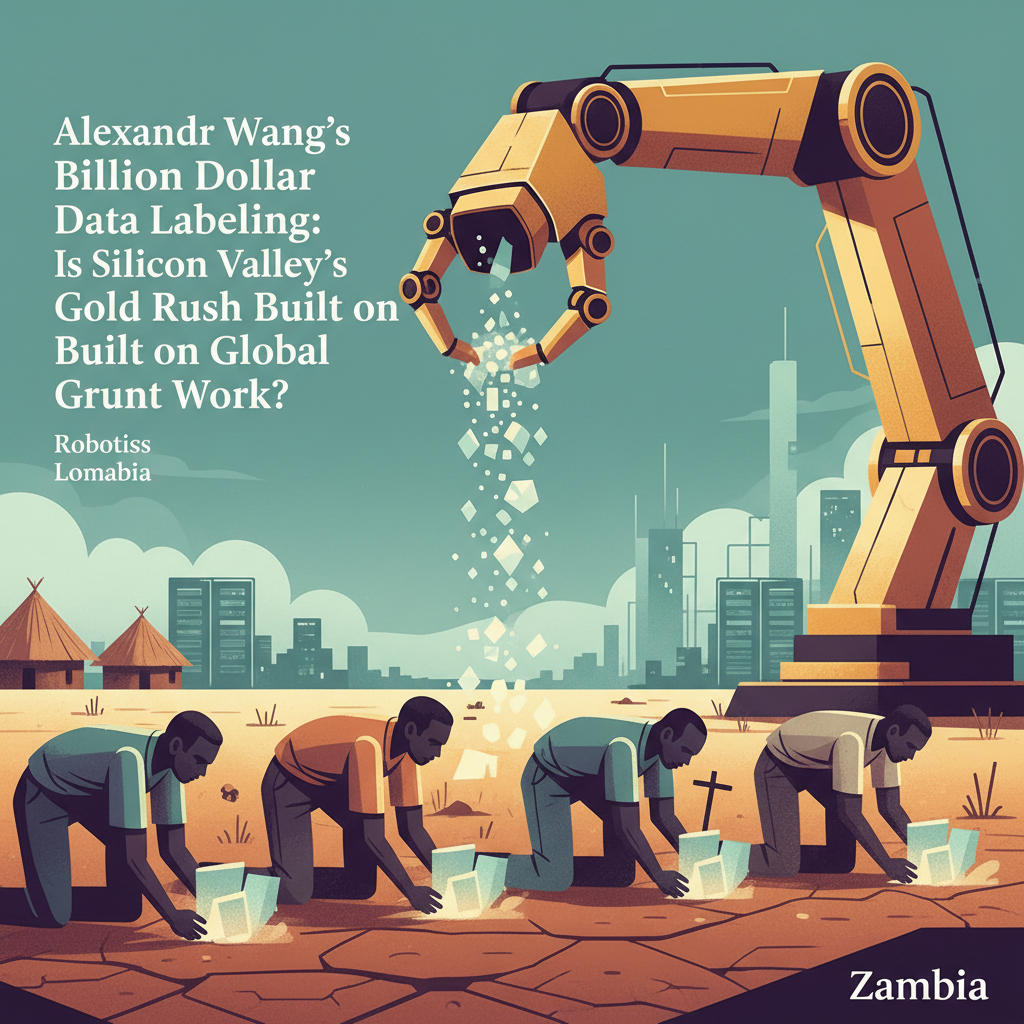
But here is where my Zambian sensibilities, honed by years of observing global economics from a different vantage point, kick in. The irony is almost too perfect. While Wang and his investors reap astronomical rewards in Silicon Valley, a significant portion of the actual data labeling labor, the repetitive, often low-wage work, is outsourced to countries where labor costs are significantly lower. We are talking about places like Kenya, the Philippines, India, and yes, even here in Zambia. These are individuals, often young, educated, and eager for work, who spend their days drawing bounding boxes around cars in images, transcribing audio, or identifying objects, all to 'teach' an AI how to see, hear, and understand the world. They are the invisible hands building the future, but their share of the future's wealth is, to put it mildly, disproportionately small.
Consider the average hourly wage for a data labeler in some of these outsourced locations. While exact figures vary wildly depending on the platform and country, it is often a fraction of what a minimum wage earner in the United States or Europe would make. Meanwhile, the AI industry itself is projected to be worth trillions. According to Reuters, the global AI market is expanding at an astonishing rate, with projections placing it well over a trillion dollars in the coming years. This vast wealth is being generated, in part, by the meticulous, often monotonous, work of people who may never even see the finished AI product, let alone benefit from its immense profitability.
Some might argue, and they often do, that this is simply the nature of global capitalism. They would say that these jobs, however humble, provide much needed income and opportunities in economies where formal employment is scarce. They might point out that companies like Scale AI are creating a global workforce, connecting people in Lusaka or Nairobi to the cutting edge of technology. And to a certain extent, they are not entirely wrong. For many young Zambians, a job as a data labeler, even if it pays modestly, represents a step up, a chance to earn a living and gain experience in the digital economy. It is better than no job at all, a sentiment I hear often from young people at the University of Zambia or Evelyn Hone College.
However, this argument, while pragmatic, sidesteps the fundamental issue of equitable value distribution. When a founder becomes a billionaire from a service that relies heavily on a global, low-wage workforce, it highlights a stark power imbalance. It is a modern-day digital plantation, if you will, where the raw materials, in this case, human intelligence applied to data, are extracted at minimal cost to fuel immense wealth creation elsewhere. This is not just about wages, it is about dignity, recognition, and the potential for upward mobility. Are these data labelers being trained and upskilled to eventually participate in higher value AI development, or are they simply cogs in a global machine, easily replaceable?
As Professor Mthuli Ncube, a respected economist and former Finance Minister of Zimbabwe, once observed,