
Let's be honest, folks. When we talk about AI, most people's minds jump to self-driving cars, super-smart robots, or maybe even those fancy chatbots that hallucinate more than a sadhu on a mountain retreat. But the real AI that's quietly reshaping our world, especially here in India, isn't some futuristic gadget. It's the invisible hand of Meta's recommendation algorithms, guiding what billions see, hear, and ultimately, believe.
I've been watching this play out for years, from the bustling tech corridors of Hyderabad to the remotest villages where a smartphone is often the only window to the world. Mark Zuckerberg and his empire, through Facebook, Instagram, and WhatsApp, have become the de facto gatekeepers of information for a significant chunk of humanity. Their AI isn't just showing you cat videos; it's a powerful engine of influence, and its effects on social cohesion and democratic discourse in a country as diverse and complex as India are, frankly, terrifying.
The Risk Scenario: Echo Chambers and Engineered Outrage
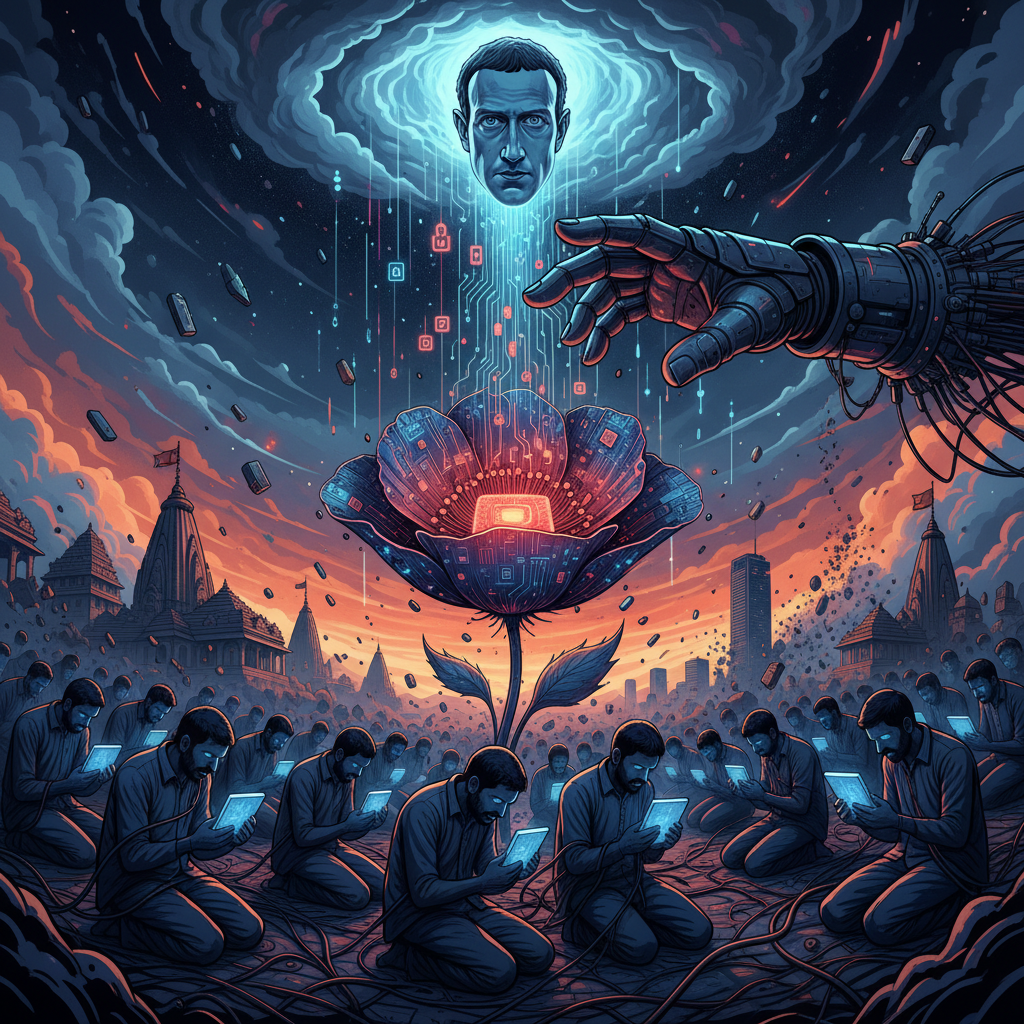
The core risk is simple: Meta's AI, designed to maximize engagement, inadvertently creates echo chambers and amplifies divisive content. Imagine a scenario where a local communal dispute, perhaps over a temple or a land boundary, is inflamed not by organic outrage but by an algorithm that identifies highly emotional, provocative content as 'engaging.' This content, often misinformation or hate speech, is then pushed to millions, bypassing traditional media gatekeepers and fact-checkers. The result is not just a heated debate, but real-world violence, mob lynching, or even widespread civil unrest. We've seen glimpses of this already, haven't we? The consequences for a nation like India, with its delicate social fabric and diverse religious and linguistic groups, are catastrophic.
The Technical Explanation: Engagement Above All Else
How does this happen? It's not some grand conspiracy, but a consequence of design. Meta's content recommendation systems, whether for your Facebook feed or Instagram Reels, are sophisticated machine learning models. They analyze billions of data points: what you click, what you share, how long you watch, who you follow, even your emotional reactions to content. Their primary objective is to keep you scrolling, to keep you engaged, because engagement translates directly into ad revenue. As Wired has often pointed out, these algorithms are incredibly effective at what they do.
These models learn that emotionally charged content, particularly that which evokes anger, fear, or strong tribal loyalty, tends to generate higher engagement. It's human nature, sadly. So, the AI, in its relentless pursuit of 'engagement optimization,' prioritizes and amplifies such content. It doesn't understand nuance, context, or the long-term societal implications. It just sees numbers going up. This creates a feedback loop: the more you engage with divisive content, the more the AI feeds you similar content, narrowing your worldview and making you more susceptible to manipulation. It's a digital version of the old panchayat gossip, but amplified to a billion people.
The Expert Debate: Profit vs. Public Good
This isn't just my opinion. Experts globally and here in India are sounding the alarm. "Meta's algorithms are not neutral arbiters of information," states Dr. Priya Sharma, a leading AI ethicist at the Indian Institute of Science, Bangalore. "They are powerful shapers of public opinion, and their current design incentivizes polarization. We need a fundamental shift from engagement-first to well-being-first metrics." She's right, of course, but changing the core business model of a trillion-dollar company is like asking the Ganges to flow uphill.
On the other hand, you have the tech optimists, often those within the industry itself. "These systems are constantly evolving and improving," argues Rohan Gupta, a former senior engineer at Meta India, now a consultant. "We deploy sophisticated models for hate speech detection and misinformation flagging. The scale is immense, and perfection is impossible. The benefits of connection and communication far outweigh the risks." While I appreciate the sentiment, it feels a bit like saying the benefits of a powerful car outweigh the risks of a faulty brake system. You can't ignore the brake system.
Even policymakers are grappling with this. "The Digital India Act, currently under discussion, aims to hold platforms accountable for the content they host and amplify," said a senior official from the Ministry of Electronics and Information Technology, speaking off the record. "But regulating an algorithm that constantly learns and adapts is like trying to catch smoke with your bare hands." This is the crux of the problem: the technology moves at light speed, while regulation crawls.
Real-World Implications for India
For India, the implications are profound. We are a young nation, digitally speaking, with hundreds of millions coming online for the first time, often directly onto Meta platforms. Their digital literacy might be low, making them highly vulnerable to algorithmic manipulation. Consider the spread of health misinformation during the pandemic, or the coordinated campaigns of hate speech that have targeted specific communities. These weren't isolated incidents; they were supercharged by the very algorithms designed to 'connect' us. The sheer scale is staggering. With over 400 million Facebook users and even more WhatsApp users, a small algorithmic tweak can have monumental real-world consequences.
Furthermore, the economic impact is subtle but significant. Small businesses, local artisans, and even political campaigns are increasingly reliant on Meta's platforms for reach. If the algorithm decides to deprioritize certain types of content or voices, it can effectively silence them, impacting livelihoods and democratic participation. This isn't just about what you see; it's about who gets to be seen.
What Should Be Done: A Call for Transparency and Accountability
So, what's the solution? It's not simple, but it starts with transparency and accountability. First, Meta needs to open its black box. Regulators, researchers, and independent auditors need access to how these algorithms work, how they are trained, and what metrics they optimize for. This isn't about revealing trade secrets; it's about understanding societal impact. There's a growing movement for 'algorithmic transparency' that needs to gain traction here in India. MIT Technology Review has published extensively on this, and it's time we paid closer attention.
Second, we need to push for a shift in design philosophy. The pursuit of 'engagement at all costs' is a dangerous path. Platforms should be incentivized, perhaps through regulation or public pressure, to prioritize healthy discourse, factual information, and diverse perspectives. This might mean optimizing for 'time well spent' rather than 'time spent,' a subtle but crucial difference.
Third, digital literacy programs must be scaled up aggressively, especially in rural and semi-urban areas. We need to equip our citizens with the critical thinking skills to navigate the algorithmic currents. This is a battle for the minds of the next generation, and it needs to be fought in schools, community centers, and even through public awareness campaigns.
Finally, India, with its massive digital population, has the leverage to demand change. We cannot simply be passive consumers of technology dictated by Silicon Valley. We need to shape these platforms to serve our unique societal needs, not just their bottom line. Forget Silicon Valley, look at Hyderabad. India will own the next decade of AI, but that ownership comes with the responsibility to ensure AI serves humanity, not just corporate profit. This is the inflection point, friends. We either demand better, or we risk being swept away by the digital tide. The choice, as always, is ours.