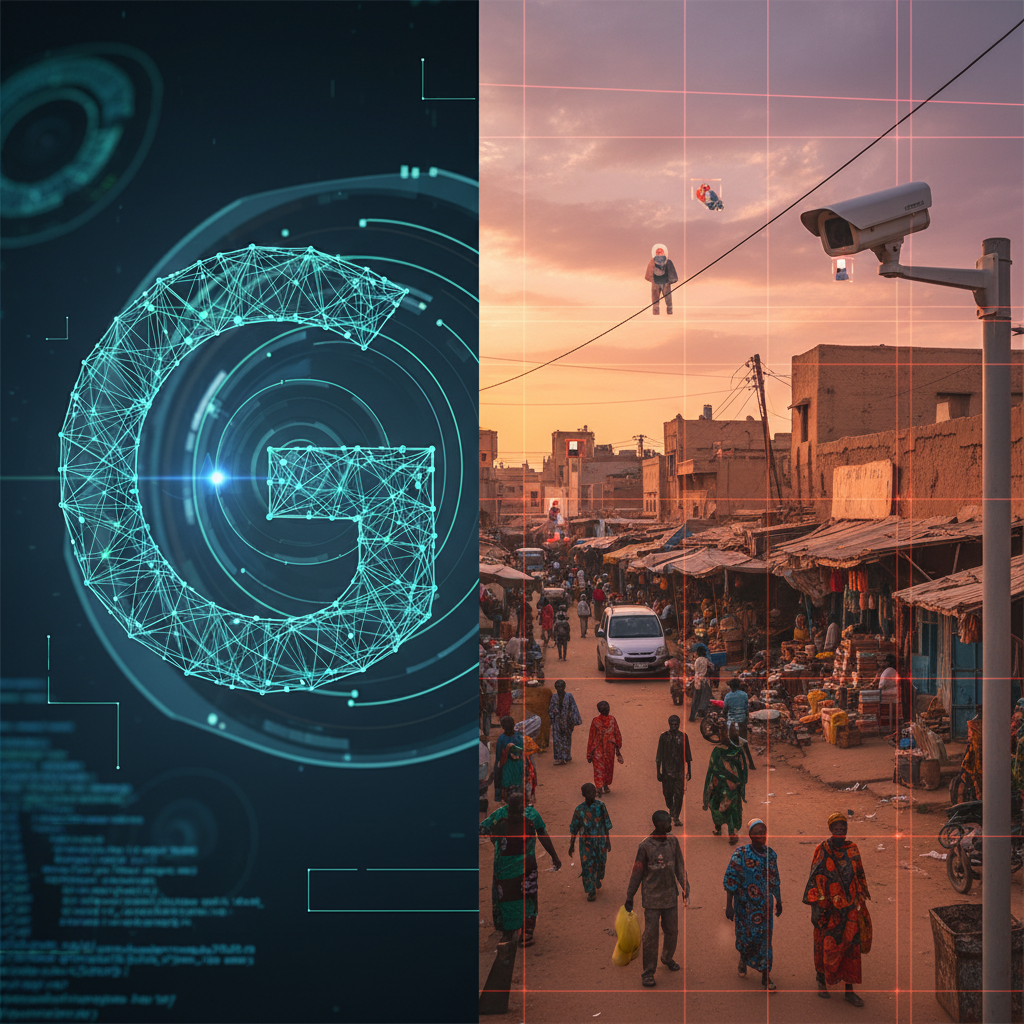

The promise of a 'smart city,' where technology seamlessly enhances urban living, often conjures images of efficiency and safety. In our corner of the world, particularly in burgeoning African cities like Bamako, this vision frequently includes AI-powered surveillance systems, touted as the ultimate solution to crime and disorder. Companies like Google, with its advanced computer vision capabilities, and others developing similar platforms, are often at the forefront of these discussions. But before we embrace these sophisticated tools, it is crucial to understand precisely how they function, what their limitations are, and what they truly demand from our societies. Let's be realistic about what these systems entail.
The Big Picture: A Digital Watchman for the City
At its core, AI-powered urban surveillance aims to transform raw visual data, primarily from cameras, into actionable intelligence. Imagine a network of interconnected eyes watching over public spaces, not merely recording events, but actively interpreting them. This digital watchman seeks to identify anomalies, track individuals, detect specific behaviors, and even predict potential incidents. The objective is often framed as enhancing public safety, improving emergency response times, and optimizing city management. From traffic flow analysis to identifying suspicious packages, the applications are broad, yet the underlying mechanism relies on a series of complex computational steps.
The Building Blocks: Components of the Surveillance Machine
To unravel how such a system operates, we must first identify its fundamental components. Think of it as a complex machine with several interconnected parts, each playing a vital role:
-
Data Collection Layer (The Eyes): This is the network of cameras, both traditional Cctv and advanced high-resolution sensors, strategically placed across the city. These cameras are the primary source of raw visual data. In many African cities, existing infrastructure might be limited, requiring significant investment in this initial layer.
-
Transmission Layer (The Nerves): Once data is captured, it must be sent to a central processing unit. This involves robust and secure communication networks, often fiber optic cables or high-speed wireless connections. The reliability and bandwidth of this layer are paramount, especially given the sheer volume of video data.
-
Data Ingestion and Storage (The Memory): The incoming video streams are massive. They need to be ingested efficiently and stored securely, often in cloud-based data centers, like those offered by Microsoft Azure or Amazon Web Services, or on powerful local servers. This storage must be scalable and capable of rapid retrieval.
-
AI Processing Layer (The Brain): This is where the 'intelligence' resides. It comprises powerful servers equipped with Graphics Processing Units (GPUs) from companies like NVIDIA, running sophisticated AI models. These models are typically deep neural networks, trained on vast datasets to perform specific tasks such as object detection, facial recognition, gait analysis, and anomaly detection.
-
Analytics and Alerting Layer (The Voice): After processing, the AI system generates insights. This could be a real-time alert about a detected incident, a statistical report on crowd density, or a tracked movement path of a person or vehicle. These insights are then presented to human operators via dashboards and interfaces.
-
Human Oversight and Response (The Hand): Crucially, human operators remain an indispensable part of the loop. They monitor the alerts, verify AI detections, and coordinate responses with law enforcement or emergency services. The quality of this human intervention determines the ultimate effectiveness and ethical deployment of the system.
Step by Step: How It Works From Input to Output
Let us trace the journey of a single video frame through an AI surveillance system:
-
Capture: A camera in, say, Bamako's Grand Marché, captures continuous video footage of the bustling activity. This footage is a stream of pixels, raw and unstructured.
-
Transmission: The video stream is encrypted and sent over a secure network to a central processing facility. For a city like Bamako, ensuring consistent, high-bandwidth connectivity across diverse urban landscapes presents a significant engineering challenge.
-
Pre-processing: Upon arrival, the video frames are often pre-processed. This might involve downscaling resolution to save computational power, stabilizing shaky footage, or enhancing image quality in low light conditions.
-
Object Detection: Specialized AI models, often convolutional neural networks (CNNs) developed by research labs like Google DeepMind or Meta AI, scan each frame. They are trained to identify and classify objects: people, vehicles, bags, weapons, etc. Each detected object is enclosed in a bounding box, and its type is labeled with a confidence score.
-
Feature Extraction: For identified objects, particularly people, further AI models extract unique features. For facial recognition, this involves identifying key facial landmarks. For gait analysis, it involves analyzing the pattern of movement. These features are converted into numerical vectors.
-
Behavioral Analysis/Anomaly Detection: Another set of AI algorithms continuously analyzes the extracted features and object movements over time. This layer looks for patterns. Is someone loitering in a restricted area? Is a crowd forming unusually quickly? Is a vehicle moving against traffic? These models are trained on vast datasets of 'normal' and 'abnormal' behaviors.
-
Comparison and Matching (Optional): If the system includes facial recognition or license plate recognition, the extracted features are compared against a database of known individuals or vehicles. This database might contain images of persons of interest or stolen vehicles. The system then calculates a similarity score.
-
Alert Generation: If a predefined threshold is met for an anomaly, a suspicious behavior, or a match with a person of interest, an alert is generated. This alert typically includes the timestamp, location, a snapshot or short video clip, and the reason for the alert.
-
Human Review: The alert is routed to a human operator in a control center. The operator reviews the evidence, assesses the situation, and decides on the appropriate course of action, which could range from dismissing a false alarm to dispatching security personnel.
A Worked Example: Identifying a Missing Child
Consider a scenario where a child goes missing in a busy public park in Bamako. The parents report the child missing, providing a recent photograph.
-
Input: The child's photograph is uploaded into the system as a 'person of interest.'
-
Search Parameters: The system is instructed to search for a child matching the description (age, clothing, facial features) across cameras covering the park and surrounding areas.
-
Real-time Analysis: AI models continuously process live video feeds. The facial recognition component extracts features from every child's face it detects. The clothing detection component identifies colors and patterns.
-
Matching: The system compares the extracted features against the uploaded photograph. When a high-confidence match is found, or a child fitting the description is seen in a specific area, an alert is triggered.
-
Location and Tracking: The alert provides the camera location and timestamp. The system can then, in theory, track the child's movement across different cameras, providing a trajectory.
-
Response: Human operators verify the match and trajectory, then direct security personnel to the child's last known location or current position, facilitating a rapid reunion. This is a practical application, but it relies heavily on the quality of the image and the robustness of the AI.
Why It Sometimes Fails: Limitations and Edge Cases
Despite the sophisticated technology, AI surveillance systems are far from infallible. The data tells a different story than the marketing brochures often suggest:
- Data Bias: AI models are only as good as the data they are trained on. If the training data lacks diversity, perhaps underrepresenting people with darker skin tones or specific cultural attire, the system's accuracy can plummet, leading to misidentification or missed detections. This is a well-documented issue with many facial recognition systems, as highlighted by researchers at institutions like MIT.
- Environmental Factors: Poor lighting, heavy rain, dust, fog, or obstructions can severely degrade camera feed quality, rendering AI models ineffective. In Mali, where dust storms are common, this is a significant practical concern.
- Occlusion and Disguise: If a person's face is partially covered, or they wear a hat and mask, facial recognition becomes challenging. Groupings of people can also make individual tracking difficult.
- Computational Load: Processing vast amounts of real-time video requires immense computational power. Scaling this for an entire city is incredibly expensive and energy-intensive, a factor often overlooked in developing nations with unreliable power grids.
- False Positives and Negatives: Systems can generate numerous false alarms, overwhelming human operators. Conversely, they can miss genuine incidents, providing a false sense of security. A high rate of false positives can lead to 'alert fatigue' among human monitors.
- Privacy Concerns: Perhaps the most significant limitation is the inherent trade-off with privacy. Constant monitoring, even if anonymized, raises profound ethical questions about individual freedoms and potential misuse by authorities. The potential for mission creep, where systems intended for one purpose are repurposed for another, is a constant worry. As Wired has often reported, the societal implications are vast.
Where This Is Heading: Practical Solutions, Not Moonshots
The future of AI-powered urban surveillance, especially in African contexts, must be approached with pragmatism. While the technology continues to advance, with companies like OpenAI and Anthropic pushing the boundaries of AI capabilities, the focus for deployment in our cities should be on practical solutions, not moonshots.
Improvements will likely come in several areas: more robust and energy-efficient AI chips (perhaps from NVIDIA or Intel), federated learning approaches that allow models to learn from local data without centralizing all raw footage, and explainable AI (XAI) that provides transparency into why an AI made a particular decision. Furthermore, the integration of AI with other sensor data, such as acoustic sensors for gunshot detection or environmental sensors for air quality monitoring, could create more comprehensive, albeit more complex, 'smart city' platforms.
However, the crucial element remains governance. Without strong regulatory frameworks, independent oversight, and public engagement, these systems risk becoming tools of oppression rather than instruments of safety. Mali, like many nations, must carefully weigh the perceived benefits against the very real risks to civil liberties. The conversation must shift from simply 'can we build it' to 'should we build it, and under what conditions.' The technology itself is neutral, but its application is anything but. We must ensure that our pursuit of safety does not inadvertently erode the very freedoms we seek to protect.