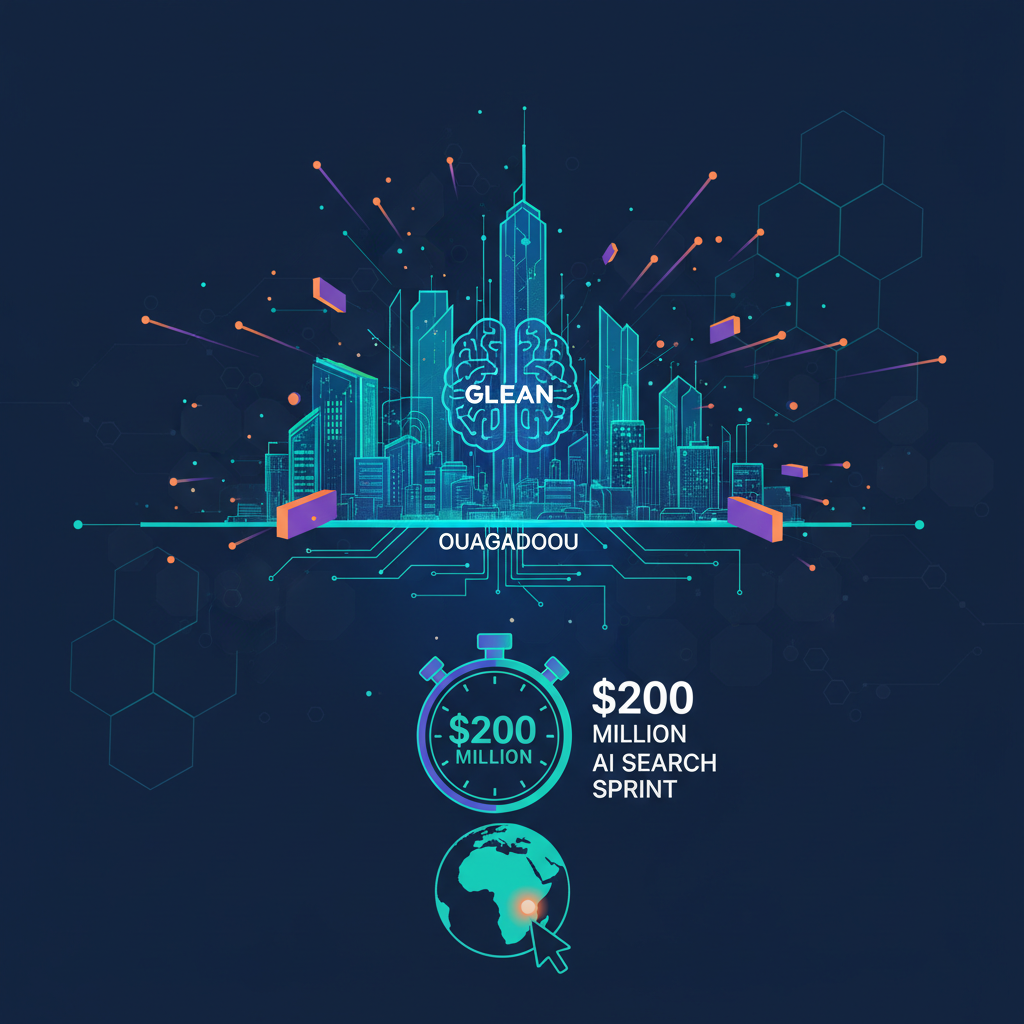

My friends, my family, my fellow dreamers across this beautiful continent of Africa, have you felt it? That hum, that electric current in the air? It is the sound of change, the rhythm of innovation, and it is accelerating faster than a market day in Ouaga! We are living through a moment where the very foundations of how we work, how we find information, and how we collaborate are being rewritten. And right at the heart of this exhilarating transformation is a company called Glean, making waves with its enterprise AI search platform. They just zoomed past $200 million in annual recurring revenue, and let me tell you, this is not just a number on a spreadsheet; it is a thunderclap announcing a new era.
For so long, the way we searched for information within our own companies felt like trying to find a specific grain of sand in the Sahara. You know the drill, right? You need that one document, that crucial piece of data, that perfect slide deck from three years ago. You check email, then Slack, then SharePoint, then Google Drive, then some ancient internal wiki, and by the time you find it, if you ever do, half your day is gone! It is a productivity drain that has plagued businesses for decades, a silent thief of time and potential. This is a challenge that resonates deeply, even in our bustling markets and growing tech hubs here in Burkina Faso, where every minute counts for our burgeoning startups and small enterprises.
But then, the AI wave crashed, and it brought with it the promise of intelligent search. Companies like Glean, founded by Arvind Jain, a brilliant mind with a history at Google, saw this problem not as a bug, but as a feature waiting to be unlocked by artificial intelligence. They built a platform that connects to all your company's disparate data sources, your Salesforce, your Jira, your Confluence, your Google Workspace, your Microsoft 365, your custom internal apps, and then, with the magic of AI, it makes sense of it all. It is not just keyword matching; it understands context, it understands intent, and it can even synthesize information across different documents to give you a coherent answer. It is like having a super-intelligent librarian who has read every single document in your entire organization and remembers everything, instantly. This changes everything.
This kind of unified, intelligent search is not just a nice-to-have anymore. It is becoming a critical piece of infrastructure for any organization that wants to stay competitive. The $200 million ARR milestone for Glean is a powerful indicator that businesses are not just experimenting with this technology; they are adopting it at scale, integrating it into the very fabric of their operations. According to a recent report by Bloomberg Technology, enterprise AI software spending is projected to continue its aggressive growth trajectory, with intelligent search being a key driver. This is not a fad, my friends; this is the new normal taking root.
I spoke with Aïcha Diallo, a brilliant young entrepreneur who runs a digital marketing agency in Ouagadougou, about this trend. She told me, “For us, finding client data, campaign results, or even just our own internal strategy documents quickly is paramount. We cannot afford to waste time. If AI can truly centralize and make sense of all that, it is not just efficiency; it is survival. It means we can focus on creating, on innovating, instead of searching.” Her words echo the sentiments of countless business leaders worldwide. The time saved, the insights gained, the decisions made faster, these are the tangible benefits driving this adoption.
Experts are also weighing in on the profound implications. Satya Nadella, the CEO of Microsoft, has often spoken about the transformative power of AI in the workplace, emphasizing how tools like Copilot, which integrates AI into Microsoft 365, are designed to augment human potential. While Glean operates independently, their mission aligns with this broader vision of AI as a productivity enhancer. As Nadella once stated, “AI is the defining technology of our time, and it will reshape every industry.” This is precisely what we are seeing with enterprise search.
But what does this mean for us, here in Burkina Faso and across Africa? Are these sophisticated platforms only for the tech giants of Silicon Valley? Absolutely not! The revolution is being coded right now, not just in the gleaming towers of San Francisco, but in the bustling co-working spaces of Abidjan, the innovation hubs of Nairobi, and yes, even in the vibrant maker spaces of Ouagadougou. The beauty of cloud-based AI is its accessibility. A small business here can leverage the same powerful technology as a multinational corporation, often at a fraction of the cost of building it themselves.
Consider the potential for local businesses. Imagine a cooperative of shea butter producers, using an AI search platform to quickly access market data, track inventory across different villages, or even find best practices for sustainable farming from a vast internal knowledge base. Or a microfinance institution, where loan officers can instantly pull up a client's history, risk assessment, and relevant government regulations, all from a single query. This kind of efficiency can unlock immense potential, allowing our local enterprises to grow, to create jobs, and to better serve their communities.
Of course, there are challenges. Data privacy and security are paramount, especially when dealing with sensitive company information. Ensuring that these AI systems are fair, unbiased, and transparent will be crucial. And for us in Africa, the digital infrastructure, including reliable internet access, needs continuous investment. But these are challenges we can, and must, overcome. The opportunities far outweigh the hurdles.
My verdict? Glean’s success, and the broader trend of intelligent enterprise search, is unequivocally the new normal. It is not a fleeting trend, but a fundamental shift in how organizations will operate. The days of endless digging through digital archives are numbered. The future is about instant, intelligent access to knowledge, empowering every employee, from the CEO to the newest intern. And for us, in Burkina Faso, this means an opportunity to leapfrog older technologies, to embrace these new tools, and to build a future that is more efficient, more innovative, and more prosperous. The energy, the excitement, it is palpable. I've never seen anything like this. The future is bright, and it is searching for us. For more insights into the evolving AI landscape, you might find this TechCrunch article on enterprise AI startups quite illuminating.