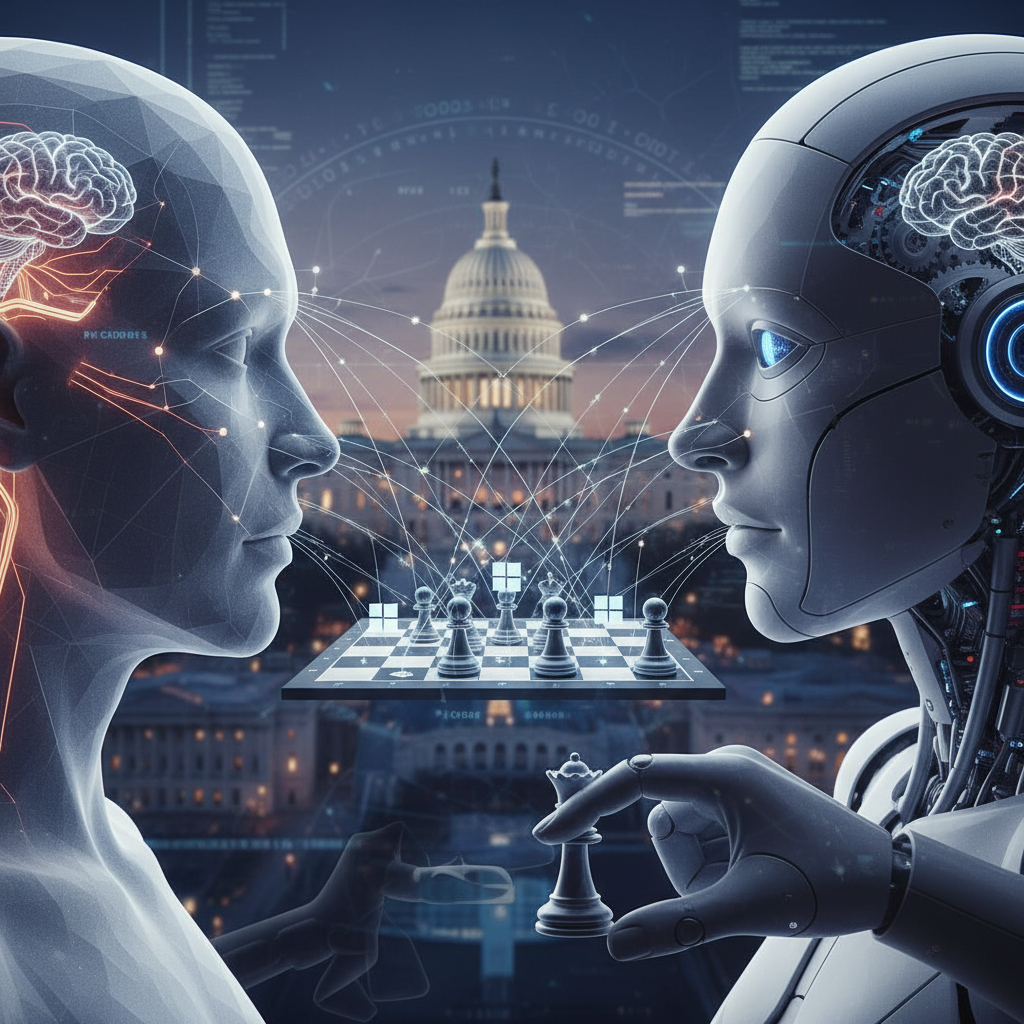

Let's be real. You're probably scrolling through this on a device that's already got AI humming under the hood, subtly nudging your choices, curating your feed, maybe even finishing your sentences. We're all living in this grand experiment, a digital petri dish where our brains are the primary subjects. Now, imagine that experiment being regulated, or not regulated, by a bunch of folks in Washington D.C. who are getting an earful, and a whole lot more, from the very companies running the show.
That's the uncomfortable truth time we're facing right now. The US Congress is deep in debates over comprehensive AI legislation. On the surface, it sounds like progress, right? Finally, some guardrails for this wild west of algorithms. But pull back the curtain, and you see the familiar dance: industry lobbyists, flush with cash from the likes of Microsoft, Google, and OpenAI, swarming Capitol Hill. They're not just whispering sweet nothings into senators' ears; they're actively shaping the narrative, framing the risks, and subtly, or not so subtly, guiding the legislative pen. And here's what the tech bros don't want to talk about: this isn't just about dollars and cents, it's about the very architecture of our attention, our decision-making, and ultimately, our democracy.
Consider Sarah, a single mom in Atlanta, trying to navigate the labyrinthine world of online applications for a new job. She uses an AI-powered resume builder, thinking it will give her an edge. What she doesn't know is that the algorithms it uses, the ones potentially influenced by lobbying efforts to keep them opaque and unregulated, might be subtly biased against her name, her neighborhood, or the gaps in her employment history from when she had to care for her sick mother. She submits the application, feels a pang of hope, but gets no call back. Was it her qualifications, or was it the AI, designed in a boardroom far away, with little oversight, that quietly screened her out? This isn't some dystopian sci-fi; this is April 2026, and it's happening every single day.
Research has already started to peel back the layers of how AI interaction impacts human cognition. Studies from institutions like Stanford and MIT have shown that over-reliance on AI for tasks like decision-making can lead to a phenomenon called 'automation bias,' where humans trust AI outputs even when they contradict their own judgment or obvious facts. We're outsourcing our critical thinking, folks. Dr. Kate Crawford, a leading scholar on AI, has frequently warned about the power dynamics at play. As she stated in a recent interview, "AI is not neutral; it reflects the values and priorities of those who build it and those who fund it. When legislation is shaped by industry, it's inevitable that those values will be enshrined, often at the expense of public good." This isn't just about making our lives easier; it's about making our minds different.
Psychologically, this constant interaction with AI, especially in an unregulated or poorly regulated environment, can foster a sense of learned helplessness. If an AI system consistently makes decisions for us, or subtly steers us, we might stop questioning, stop exploring, stop exercising our own cognitive muscles. Think about the personalized news feeds, curated by algorithms from companies like Meta or Google. They create echo chambers, reinforcing existing beliefs and making it harder for people to engage with diverse perspectives. This isn't just a social problem; it's a profound cognitive shift, narrowing our mental horizons and making us more susceptible to manipulation.
And let's not forget the emotional toll. The constant pressure to perform for algorithms, to optimize our online presence, to conform to what the AI 'wants,' can lead to anxiety and stress. We're seeing a rise in 'algorithmic anxiety,' where people worry about being surveilled, judged, or disadvantaged by unseen systems. This isn't some abstract fear; it's a very real, lived experience for millions of Americans. When Congress debates AI legislation, they're not just discussing lines of code; they're debating the future of our collective mental health and societal cohesion. Wired has covered extensively how AI is changing our daily interactions, often in ways we don't fully perceive.
Silicon Valley has a blind spot the size of Texas when it comes to understanding the lived experiences of people outside their bubble. They talk about innovation, efficiency, and progress, but rarely about the downstream psychological effects on communities already marginalized. When the legislative process is dominated by their voices, the concerns of average Americans, particularly those from underserved communities, often get drowned out. We need to ask: are these proposed laws truly protecting us, or are they simply legitimizing the existing power structures and allowing tech giants to continue their unchecked influence over our cognitive landscape?
Consider the sheer financial might. In 2023 alone, major tech companies collectively spent tens of millions of dollars on lobbying, with Microsoft and Google often leading the pack. This isn't pocket change. This is a strategic investment to ensure that any legislation passed favors their business models, their data collection practices, and their continued dominance. When Senator Maria Cantwell, Chair of the Senate Commerce Committee, speaks about the need for a balanced approach, we have to wonder what kind of 'balance' is achievable when one side has such an overwhelming financial advantage.
Dr. Meredith Broussard, a research professor at NYU and author, has consistently pointed out the dangers of techno-chauvinism, the belief that technological solutions are always superior. She argues that "we need to be incredibly skeptical of claims that AI will solve all our problems, especially when those claims come from the very companies that stand to profit most from its widespread adoption." This skepticism needs to extend to the legislative process itself. Are our elected officials truly scrutinizing these technologies, or are they being sold a bill of goods by well-funded lobbyists?
The broader societal implications are staggering. If AI legislation fails to adequately address issues like algorithmic transparency, accountability, and bias, we risk cementing a future where our cognitive biases are amplified, our social divisions deepened, and our individual autonomy eroded. This isn't just about privacy; it's about the very fabric of our shared reality. The way we perceive information, form opinions, and interact with each other could be fundamentally reshaped by systems designed without sufficient public input or regulatory oversight. This is why the debate in Congress isn't just a political squabble; it's a fight for our minds.
So, what's a regular person to do? First, demand transparency. Understand that the AI you interact with isn't magic; it's code, and that code has intentions, often shaped by profit motives. Second, cultivate your own critical thinking. Don't let AI make all your decisions. Question the information it presents. Seek out diverse sources beyond your algorithmic bubble. Third, engage with the political process. Your voice, collectively, can counter the immense lobbying power of big tech. Support organizations advocating for ethical AI and robust regulation. The future of our minds, and our society, depends on it. We can't afford to let the lobbyists dictate the terms of our cognitive surrender. For more on the technical aspects of AI and its societal impact, check out MIT Technology Review. The stakes are too high to be passive observers in this legislative drama. The fight for fair and ethical AI is a fight for our collective future, and it starts with understanding how these debates in Washington are already affecting us, deep in our gray matter.