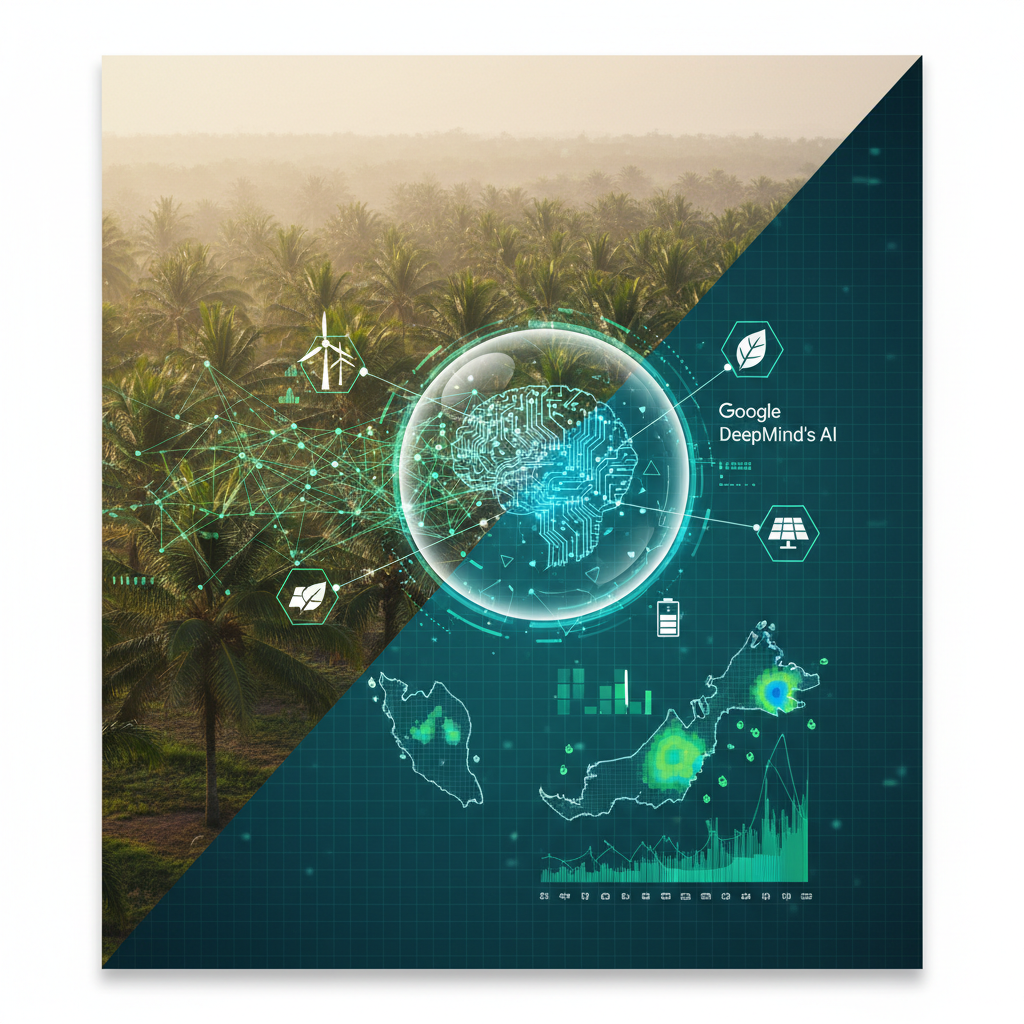

The air in Kuala Lumpur, even on a good day, often carries a certain weight, a subtle reminder of industrial progress and the ever-present haze that sometimes blankets our skies. It makes you wonder, doesn't it, about the future of our planet, and whether the very technologies driving some of these changes can also be the ones to heal them? This question, whether artificial intelligence can truly save our planet from the ravages of climate change, is not just academic; it is deeply personal for many of us living in Southeast Asia.
For decades, the narrative around environmental protection felt like a constant uphill battle, often framed by scientific warnings and policy debates. Now, AI has entered the chat, promising a new arsenal of tools. But is this a genuine game-changer, a powerful keris in our fight against environmental degradation, or merely a sophisticated distraction, a technological wayang kulit that entertains but ultimately changes little? Let us peel back the layers and see.
Historically, our approach to environmental challenges has been reactive. We clean up spills, legislate against pollution, and try to mitigate damage after it is done. The industrial revolution, while bringing immense prosperity, also unleashed unprecedented environmental impact. Fast forward to the digital age, and the sheer volume of data generated about our planet, from satellite imagery to sensor networks, has grown exponentially. This explosion of data, however, was largely untapped potential until the advent of powerful AI and machine learning algorithms.
Consider the early days of climate modeling. Supercomputers crunched numbers, but their predictive capabilities were limited by computational power and the complexity of Earth's systems. Today, AI offers a paradigm shift. Instead of merely processing data, AI can learn from it, identify intricate patterns invisible to the human eye, and even generate novel solutions. We are moving from simply observing the weather to potentially forecasting climate shifts with unprecedented accuracy, from monitoring deforestation to predicting its likelihood before it happens.
The current state of AI in climate action is a vibrant tapestry of innovation. Companies like Google DeepMind, for instance, have been at the forefront, applying their advanced machine learning capabilities to diverse environmental problems. Their work with optimizing energy consumption in data centers, for example, has reportedly reduced cooling energy usage by up to 40%, a significant saving given the massive energy footprint of these facilities. This is not just about saving money for Google; it is about demonstrating how AI can make core infrastructure more sustainable.
Beyond corporate campuses, AI is being deployed in more direct environmental applications. In agriculture, precision farming powered by AI can optimize irrigation, fertilizer use, and pest control, reducing waste and increasing yields. In Malaysia, where palm oil is a significant industry, AI could play a crucial role in ensuring sustainable practices. Imagine AI analyzing satellite imagery to detect illegal deforestation in real-time, or predicting crop diseases before they spread, minimizing the need for broad-spectrum pesticides. This is not science fiction; it is happening. The architecture is fascinating, involving neural networks trained on vast datasets of environmental indicators, weather patterns, and historical land use.
Data from the International Energy Agency (IEA) suggests that digital technologies, including AI, could help reduce global carbon emissions by 10% by 2030. That is a substantial figure, equivalent to taking hundreds of millions of cars off the road. But it is not without its caveats, as the energy consumption of training large AI models itself is a growing concern. A single training run for a large language model can emit as much carbon as several cars over their lifetime. This paradox, where the solution itself contributes to the problem, is something we must address head-on.
Expert opinions on this trend are varied, yet largely optimistic with a healthy dose of caution. Dr. Andrew Ng, a prominent figure in AI and founder of Landing AI, has often emphasized the practical applications of AI. He once stated, “Just as electricity transformed almost everything 100 years ago, I think AI will also transform almost everything.” This transformation, he suggests, extends powerfully into sustainability, offering tools to optimize complex systems like energy grids and supply chains. His perspective leans towards AI as an indispensable tool, a force multiplier for human efforts.
However, others offer a more measured view. Dr. Kate Crawford, a leading scholar on AI and its societal implications, has highlighted the hidden environmental costs of AI, particularly its dependence on energy-intensive hardware and rare earth minerals. In her work, she meticulously details the material footprint of AI, reminding us that algorithms do not exist in a vacuum; they are embodied in physical infrastructure. Her research serves as a vital counterpoint, urging us to consider the full lifecycle impact of our AI solutions. We cannot simply shift the environmental burden from one area to another and call it progress.
Here in Malaysia, the conversation is gaining traction. The Malaysian Digital Economy Corporation (mdec) has been actively promoting the adoption of AI in various sectors, including those with environmental implications. MDEC's initiatives often highlight the potential for AI to drive efficiency and sustainability. For example, our local universities are exploring AI applications in smart cities, optimizing traffic flow to reduce emissions, and developing early warning systems for floods, a recurring issue for many Malaysian communities. This local application is crucial, because while global models are powerful, localized solutions tailored to our unique climate and biodiversity are equally vital.
One of our own, Professor Dr. Mazlin Mokhtar from Universiti Kebangsaan Malaysia, a respected environmental scientist, recently commented, “AI offers unprecedented analytical power for environmental monitoring and prediction. However, its implementation must be guided by strong ethical frameworks and a deep understanding of local ecological systems. We cannot simply import solutions; we must adapt and innovate for our specific challenges, like mitigating haze or protecting our rainforests.” This resonates deeply, reminding us that technology without context is often ineffective.
My verdict? The trend of leveraging AI for climate action is far from a fad; it is rapidly becoming the new normal. The sheer analytical power, predictive capabilities, and optimization potential of AI are too significant to ignore. From managing renewable energy grids to monitoring biodiversity and optimizing resource use, AI offers tools that were unimaginable just a few decades ago. However, it is not a silver bullet, nor is it without its own environmental footprint. We must be discerning users, not just enthusiastic adopters.
For Southeast Asia, this matters immensely. Our region is particularly vulnerable to climate change, facing rising sea levels, extreme weather events, and threats to our rich biodiversity. The World Bank has repeatedly stressed the economic and social risks climate change poses to countries like Malaysia. AI offers us a chance to leapfrog some of the traditional, slower methods of environmental management. Malaysia is positioning itself perfectly to harness this, with a growing digital infrastructure and a commitment to sustainable development goals. Our challenge is to ensure that the deployment of AI is done responsibly, transparently, and with a keen awareness of its energy demands. We must foster local talent to build AI solutions that understand our unique ecosystems, our adat, and our aspirations for a greener future. It is a complex dance, balancing innovation with responsibility, but one we must master for the sake of our children and generations to come. The promise is real, but so is the responsibility. It is up to us to wield this powerful tool wisely, like a master craftsman with a finely honed blade, to carve out a sustainable tomorrow. This is not just about technology; it is about stewardship of our shared home.json.