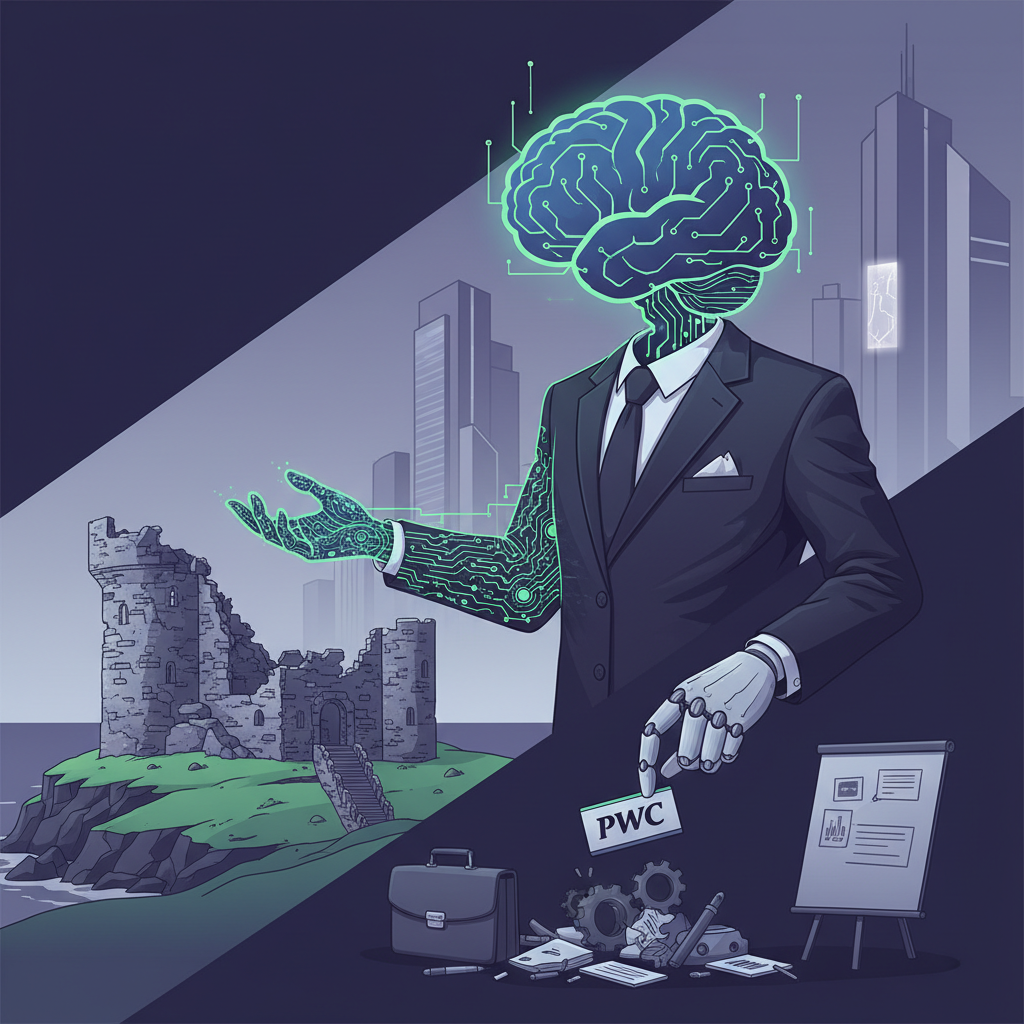

Let's be honest, the tech world has been promising us the moon and the stars, and occasionally delivering a slightly less impressive rock. But this time, it feels different, doesn't it? The chatter about AI replacing white-collar jobs, once a distant hum, has become a cacophony of layoffs and restructuring announcements. We're talking about the very professions that once seemed immune, the ones that required 'critical thinking' and 'human judgment.' Well, it seems the algorithms have been doing their homework, and they're ready for their final exams.
From the gleaming offices of global consulting giants like McKinsey and Accenture, to the hushed corridors of venerable law firms, and even the bustling newsrooms where I've spent a good chunk of my life, the robots are not just at the door, they've got their feet under the desk. It’s a sobering thought, particularly for us here in Ireland, a nation that has, for decades, proudly positioned itself as Europe's tech hub, a welcoming home for the Googles, Metas, and Microsofts of the world. Dublin's Silicon Docks have a story to tell, and it's increasingly one of automation and algorithmic efficiency.
My argument is simple, yet perhaps uncomfortable: the current wave of AI-driven job displacement in white-collar sectors is not a temporary blip, nor is it merely about augmenting human capabilities. This is a fundamental redefinition of value, a brutal culling of tasks that were once considered the exclusive domain of highly paid professionals. We are witnessing the industrial revolution for the intellect, and many are about to find themselves on the wrong side of the assembly line. The craic is mighty in Irish AI, but for how long will that be true for the people whose jobs are being automated?
Consider the consulting sector. For years, firms like Deloitte and PwC have thrived on providing strategic advice, market analysis, and operational efficiency. Now, large language models, like OpenAI's GPT-4 or Anthropic's Claude 3, can sift through vast datasets, identify patterns, and even draft comprehensive reports in a fraction of the time it would take a junior consultant. We've seen reports of major consulting firms reducing their workforce, particularly in back-office and research roles, precisely because AI tools are taking over. PwC, for instance, has openly discussed integrating generative AI into its services, a move that inevitably means fewer human hands are needed for certain tasks. It's not just about speed, it's about cost efficiency on a scale that human labor simply cannot match. According to a recent analysis by Reuters, the global consulting market is projected to integrate AI tools at an accelerating pace, leading to significant shifts in workforce demand.
Then there's the legal profession. Traditionally, law has been seen as a bastion of human intellect, requiring nuanced interpretation and complex argumentation. Yet, AI is now performing tasks like document review, contract analysis, and even predictive litigation outcomes with astonishing accuracy. Companies like LegalZoom are leveraging AI to automate basic legal services, making them more accessible and affordable, but also reducing the need for entry-level lawyers. Even in Ireland, where our legal system prides itself on its robust traditions, the pressure to adopt AI for efficiency is mounting. A report from MIT Technology Review highlighted how AI is already transforming legal discovery, a process that once consumed thousands of billable hours.
And my own profession, journalism, is hardly immune. Newsrooms, already stretched thin by years of budget cuts, are increasingly experimenting with AI for everything from drafting earnings reports to summarizing political speeches. While I'd like to think my particular brand of wit and cynicism is irreplaceable, I've seen AI generate surprisingly coherent, if bland, articles. The BBC, for example, has been exploring AI's role in content creation and translation. It's not about replacing the star columnist, perhaps, but it's certainly about reducing the need for researchers, copy editors, and even some beat reporters. The human touch, the ability to sniff out a story and tell it with flair, that's still our edge, but the mundane tasks, the grunt work, are ripe for automation.
Now, I can hear the counterarguments already. 'Aoifè, you're being alarmist,' some might say. 'AI will create new jobs, it always does. It's about augmentation, not replacement.' And yes, it's true that AI will undoubtedly create new roles, particularly in areas like AI ethics, prompt engineering, and model training. There will be new opportunities for those who can build, manage, and understand these sophisticated systems. We've seen this narrative play out with every major technological shift, from the loom to the internet. The optimists will point to the burgeoning data science sector, the demand for AI researchers, and the growth of companies like NVIDIA, whose chips power this revolution. They'll argue that humans will simply move up the value chain, focusing on more creative and strategic tasks while AI handles the drudgery.
But here's my rebuttal, delivered with a healthy dose of Irish skepticism: this time, the 'new jobs' might not be enough, or they might not be accessible to the millions displaced. The barrier to entry for many of these new AI-centric roles is significantly higher than the jobs being lost. It requires specialized skills, often advanced degrees, and a comfort with complex technology that isn't easily acquired through a weekend course. We're not talking about retraining factory workers to operate a new machine; we're talking about retraining lawyers to code, or consultants to become AI ethicists. That's a much steeper climb, and the sheer scale of potential displacement suggests a significant societal challenge.
Furthermore, the 'augmentation' argument often glosses over the fact that augmentation for some means redundancy for others. If one AI-powered paralegal can do the work of five human paralegals, those four humans are out of a job, regardless of how 'augmented' the remaining one feels. And let's not forget the economic implications. If a significant portion of the white-collar workforce, particularly in middle-income roles, finds their skills devalued or obsolete, what does that do to consumer spending, to social stability, to the very fabric of our societies? Only in Ireland would you find this level of discussion about the societal impact of tech alongside the relentless pursuit of foreign direct investment.
The implications for Ireland are particularly acute. Our economic model has, in many ways, been built on attracting multinational tech companies, offering a skilled, English-speaking workforce and a favorable tax regime. If the 'workforce' part of that equation becomes increasingly automated, what then? Will our appeal diminish? Will the global headquarters of these tech giants remain here if the majority of their European operations can be run by a handful of engineers and a server farm? These are not hypothetical questions; they are already being asked in boardrooms across Silicon Docks and beyond.
So, what's to be done? We can't put the genie back in the bottle, nor should we try. AI is here to stay, and its capabilities will only grow. But we must confront the reality of its impact with open eyes, not with rose-tinted glasses. Governments, educators, and industry leaders need to collaborate on massive, accessible retraining programs that genuinely equip people for the jobs of tomorrow, not just for the jobs that AI can't do yet. We need to rethink our social safety nets, perhaps even explore concepts like universal basic income, to cushion the blow for those who will inevitably be left behind.
This isn't just about economic policy; it's about human dignity. We've built societies where work is central to identity and purpose. To strip that away for millions without a viable alternative is to invite social unrest and profound disillusionment. The era of the white-collar worker as we know it is drawing to a close, and it's time we started planning for the morning after. Because when ChatGPT applies for your job, it won't be asking for a pension plan, and it certainly won't be complaining about the cost of housing in Dublin. The future, as they say, is already here, it's just unevenly distributed, and for many, it's looking a bit bleak. We need to ensure that as the algorithms advance, humanity doesn't get left behind in the digital dust.