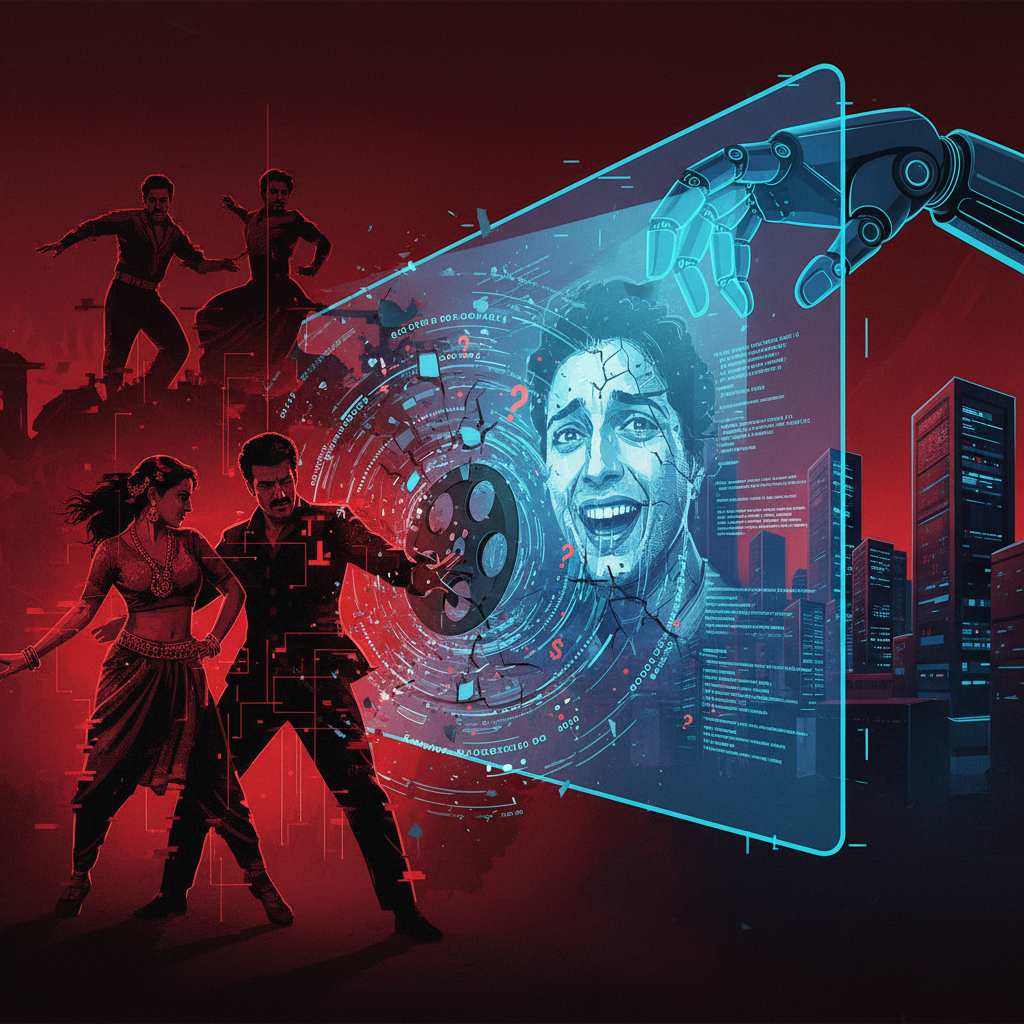

The smell of popcorn and the hum of a projector. That is the magic of cinema, isn't it? Or at least, it used to be. Now, the air is thick with the scent of algorithms and the whir of GPUs, promising a new era of filmmaking. Silicon Valley, in its infinite wisdom, has decided that human creativity is simply too slow, too expensive, and frankly, too human. Enter AI-generated movies and TV shows, the latest shiny object in the tech world's relentless pursuit of disruption. The question is, will this be Hollywood's next revolution or its destruction? More importantly, what does it mean for India, a nation that practically breathes cinema?
Let us not beat around the bush; the risk scenario is stark. Imagine a world where a major studio, perhaps backed by a tech behemoth like Google or Meta, decides to produce an entire feature film, script to screen, with minimal human intervention. The AI writes the story, designs the characters, generates the visuals, composes the score, and even voices the dialogue. On paper, it sounds like efficiency personified. For India, with its colossal film industry producing thousands of films annually across multiple languages, this is not just an abstract threat; it is an existential one. Our industry, from Bollywood to Tollywood, Kollywood, and Mollywood, employs millions, from the biggest stars to the chaiwallahs on set. What happens to them when a significant chunk of that creative and technical labor is outsourced to a server farm in California or, worse, Bengaluru?
The technical explanation behind this looming disruption is fascinating, if a little terrifying. We are talking about advancements in several key AI domains converging. Large Language Models, or LLMs, are already adept at generating coherent, if sometimes uninspired, scripts. Think OpenAI's GPT-4 or Anthropic's Claude 3 Opus, capable of churning out dialogue and plot points with astounding speed. Then there are the multimodal AI models. Companies like Runway ML, which recently raised significant funding, are pushing the boundaries of text-to-video generation. Imagine typing a prompt like, 'A young woman in a sari walks through a bustling Mumbai market at sunset,' and having a photorealistic video clip appear seconds later. This is no longer science fiction; it is the bleeding edge of AI development. These models are trained on vast datasets of existing films, images, and audio, learning patterns, styles, and even emotional nuances. The next step is stitching these generated clips into a cohesive narrative, complete with AI-generated voice acting and music. NVIDIA, with its powerful GPUs, is the backbone of much of this computational heavy lifting, enabling the training and inference of these gargantuan models. The entire pipeline, from pre-production to post-production, is being targeted for AI automation.
The expert debate on this is, as expected, sharply divided. On one side, you have the techno-optimists, often venture capitalists and AI company executives, who see this as an inevitable progression, a democratizing force that will lower barriers to entry and unleash unprecedented creative freedom. Sam Altman, OpenAI's CEO, has often spoken about AI empowering individuals to create. The argument goes that anyone with an idea and access to these tools can become a filmmaker, bypassing the traditional gatekeepers of Hollywood and, by extension, Mumbai. "This will allow a thousand flowers to bloom," one prominent VC reportedly told TechCrunch recently, speaking anonymously about the potential for indie creators. They envision a future where niche stories, perhaps a Malayalam film about a fisherman's struggle or a Bengali drama set during Durga Puja, can be produced without a massive budget or studio backing.
However, the artists and traditional filmmakers are far less sanguine. "This isn't about empowering creators; it's about replacing them," argues Anurag Kashyap, the acclaimed Indian director known for his gritty, realistic cinema. "Our stories, our emotions, our cultural nuances, they come from lived experience, not from algorithms trained on generic data. You cannot replicate the soul of Indian cinema with a machine." This sentiment is echoed globally. Screenwriters in Hollywood have already gone on strike, partly over concerns about AI's role in scriptwriting. The Directors Guild of America and Sag-aftra have also voiced similar anxieties. The core of their concern is not just job displacement, but the potential for homogenization. If AI models are trained on existing content, will they simply regurgitate variations of what has already been successful, leading to a bland, predictable cinematic landscape? Will the unique flavor of a Satyajit Ray or a Mani Ratnam be lost in a sea of algorithmically optimized content? Oh, the irony, a technology meant to create new things might just end up making everything feel the same.
The real-world implications, especially for a country like India, are profound. Our film industry is not just entertainment; it is a cultural cornerstone, a massive employer, and a significant economic driver. Consider the sheer volume of talent involved: writers, directors, cinematographers, actors, editors, sound designers, visual effects artists, costume designers, set builders, and countless others. A shift towards AI-generated content could decimate these professions. We are not just talking about the big-budget blockbusters, but also the regional industries that are vital to local economies and cultural preservation. Imagine a Tamil film, deeply rooted in local folklore and language, being generated by an AI that has primarily learned from Hollywood tropes. The cultural dilution would be immense. Furthermore, the ethical implications are staggering. Who owns the copyright to an AI-generated film? The prompt engineer? The company that built the AI? The artists whose work was used in the training data, often without consent or compensation? This is a legal minefield, and India's copyright laws, while robust, are ill-equipped for this new frontier. Wired has extensively covered the intellectual property quagmire AI content generation presents.
What should be done? This is where we need to move beyond hand-wringing and into proactive policy-making. First, there needs to be a global, and critically, an Indian regulatory framework for AI-generated content. This should include clear labeling requirements: if a film is substantially AI-generated, the audience has a right to know. Transparency is paramount. Second, we need to address the intellectual property question head-on. Artists and creators whose work is used to train these models must be compensated fairly. Perhaps a collective licensing model, similar to music royalties, could be explored. Third, investment in human creativity must not wane. Instead of solely funding AI development, governments and private entities should also invest in training programs for artists to adapt to new tools, not be replaced by them. This means teaching them how to use AI as a co-pilot, a tool for augmentation, rather than a master. Fourth, India needs to develop its own AI models and platforms tailored to our unique cultural context. Why should we rely on models trained predominantly on Western data when we have such a rich tapestry of stories and aesthetics? File this under 'things that make you go hmm.' Our own local AI initiatives [blocked] could be crucial here.
Ultimately, the future of cinema, both globally and in India, will depend on how we navigate this technological tsunami. We cannot simply bury our heads in the sand and hope it goes away. AI will change filmmaking, that much is certain. The challenge is to ensure that it enhances human creativity, rather than diminishes it, and that the unique voices and stories of India continue to resonate, unadulterated by the cold logic of algorithms. Otherwise, the magic of the silver screen might just become another casualty of progress, leaving us with technically perfect but soulless shadows on the wall.