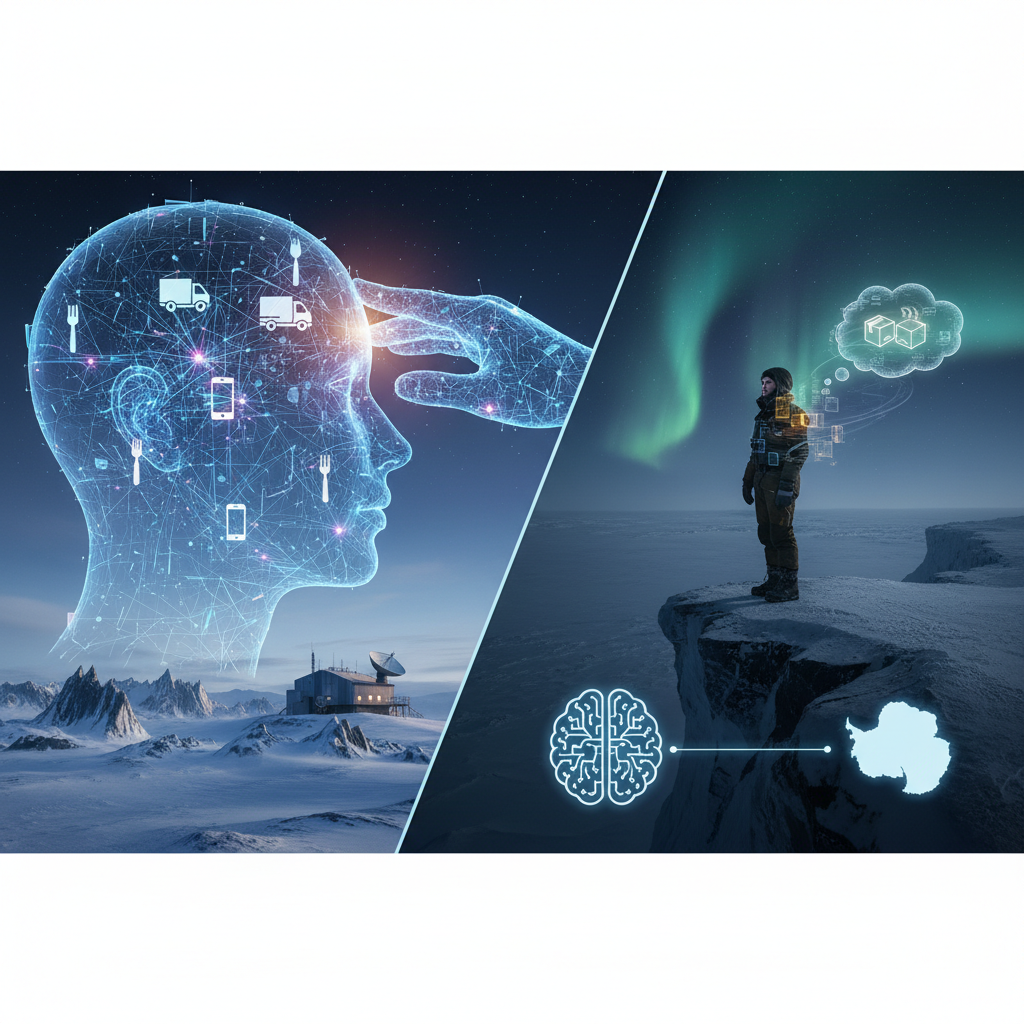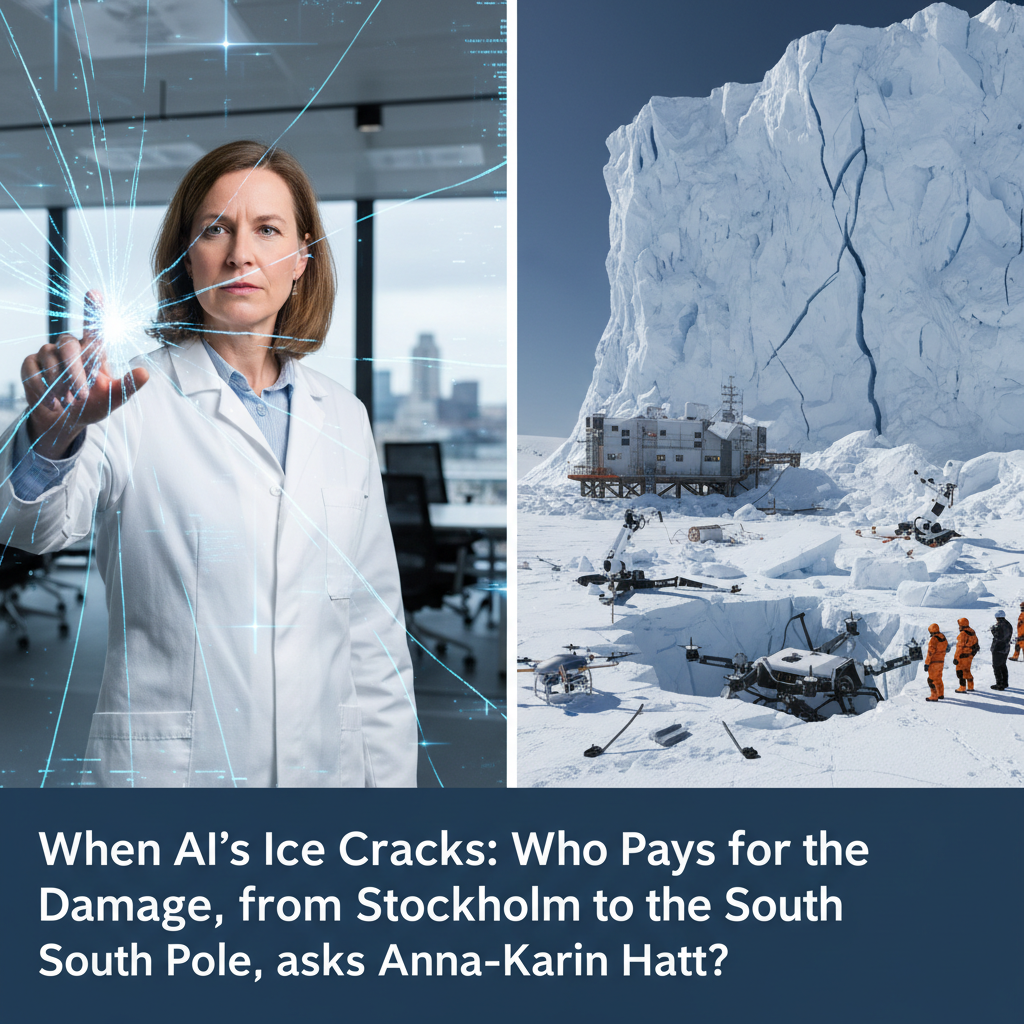
Last night, the aurora lit up our research station with a silent, emerald dance across the vast, inky sky. It was a reminder of the immense, beautiful power of nature, and how small we are against its forces. Here, at the very bottom of the world, where the ice whispers ancient secrets, the consequences of every action are magnified. This harsh reality makes the global debate around AI liability feel particularly sharp. When an autonomous system makes a mistake, when a predictive model misleads, who is truly responsible? Is it the developer, the deployer, the user, or perhaps, the AI itself?
The conversation is no longer theoretical, not even here. We rely on sophisticated AI for everything from monitoring ice sheet dynamics to optimizing our limited energy resources. Imagine a scenario where an AI-driven drone, tasked with mapping penguin colonies, malfunctions and disrupts a sensitive breeding ground. Or a climate model, fed with imperfect data, leads to faulty predictions about sea level rise, impacting global policy. These are not distant hypotheticals; they are pressing concerns that echo in the quiet hum of our servers.
The European Union has been at the forefront of this discussion, with its AI Act setting a global precedent. While the Act primarily focuses on high-risk AI systems and their regulatory compliance, the question of civil liability remains a complex knot. In Sweden, where innovation often walks hand-in-hand with a strong sense of social responsibility, this is a topic of intense scrutiny. Anna-Karin Hatt, CEO of Almega, Sweden's employers' organization for the service sector, has often emphasized the need for clarity. "We need legal frameworks that foster innovation while protecting individuals and businesses," Hatt stated in a recent industry discussion. "The current liability laws, designed for a pre-AI world, are simply not adequate for the complexities we face today. We cannot stifle progress, but neither can we ignore the potential for harm." Her perspective resonates deeply, highlighting the delicate balance required.
Consider the intricate web of modern AI development. A large language model like OpenAI's GPT-4 or Google's Gemini might be trained on vast datasets, then fine-tuned by a startup, and finally deployed by a third-party company in a specific application. If that application, say a medical diagnostic tool, provides incorrect advice leading to patient harm, where does the blame lie? Is it with the original model developer, the fine-tuner, the deploying company, or the medical professional who relied on the tool? The legal precedents are still being forged, often in the crucible of real-world incidents.
In the silence of Antarctica, you hear things differently. The quiet allows for deeper reflection on these intricate problems. The legal systems in many countries, including Sweden, operate on principles of fault-based liability, where negligence must be proven. But proving negligence in an autonomous system, where decisions are made by algorithms rather than human intent, is like trying to trace a single snowflake in a blizzard. Some legal scholars advocate for a shift towards strict liability for high-risk AI, meaning the operator would be liable regardless of fault. This approach, similar to how dangerous products are treated, could simplify compensation claims but might also disincentivize innovation.
Startups, often at the cutting edge of AI development, face particular challenges. They might lack the deep pockets of tech giants like Microsoft or Meta, yet they are the ones pushing boundaries. If a small Swedish startup develops a groundbreaking AI for environmental monitoring, and it causes unforeseen damage, the liability could be catastrophic for their nascent business. This risk creates a chilling effect, potentially stifling the very innovation we need to address global challenges, including climate change.
Regulators are grappling with these issues globally. The UK's Law Commission, for example, has explored options for reforming product liability laws to better accommodate AI. Meanwhile, the US is seeing a patchwork of state-level initiatives and federal discussions, but no comprehensive national framework yet. The European Union's proposed AI Liability Directive aims to make it easier for victims to claim damages from AI systems, introducing a presumption of causality in certain cases. This means that if a high-risk AI system causes damage, it will be presumed to have caused it, shifting the burden of proof to the AI provider to demonstrate otherwise. This is a significant move, and one that is being watched closely by legal experts around the world, including those advising Swedish companies.
The financial implications are staggering. Insurers are already developing new policies to cover AI-related risks, but the actuarial science is still in its infancy. How do you quantify the risk of an algorithm making a 'bad' decision? The data is scarce, and the variables are constantly changing. Companies like NVIDIA, whose powerful GPUs are the backbone of much of today's AI, are also deeply invested in the safety and ethical deployment of these systems, understanding that widespread harm could undermine public trust and future adoption. Their hardware is essential, but the software running on it carries the risk.
Here in Antarctica, our research often involves collaboration with international partners, pooling resources and expertise. This collaborative spirit extends to the data we collect and the AI models we use. When an AI system is developed by a consortium across different jurisdictions, the liability question becomes even more convoluted. Which country's laws apply? Who is the 'producer' in a globally distributed development process? These are not just academic questions; they are practical hurdles that could impede critical scientific progress.
Dr. Mikael Lindvall, a leading expert in AI ethics and law at Lund University in Sweden, recently highlighted this complexity. "The traditional legal concepts of 'control' and 'causation' are being stretched to their limits by autonomous AI systems," he explained. "We need to think about shared responsibility, about creating mechanisms for redress that are fair to both victims and innovators. It's not about finding a single scapegoat, but about understanding the systemic risks." His words resonate with the collaborative, problem-solving ethos that defines life at the South Pole.
This is what AI looks like at the end of the world. It is not just about algorithms and data, but about the very human questions of trust, responsibility, and justice. As AI becomes more integrated into our lives, from self-driving cars to climate modeling, the need for clear, equitable liability frameworks becomes paramount. Without them, the potential for innovation could be overshadowed by the fear of unforeseen consequences, leaving us adrift in an algorithmic sea without a compass. The ice may be vast and silent, but the questions it poses about our technological future are loud and clear. The global conversation, from the bustling tech hubs to our remote station, must continue to seek answers, ensuring that the benefits of AI do not come at an unacceptable human cost. For more insights into AI's societal impact, Wired often provides excellent analysis, and for the latest in regulatory developments, Reuters Technology is a reliable source. For a deeper dive into the technical and ethical considerations, MIT Technology Review is invaluable.