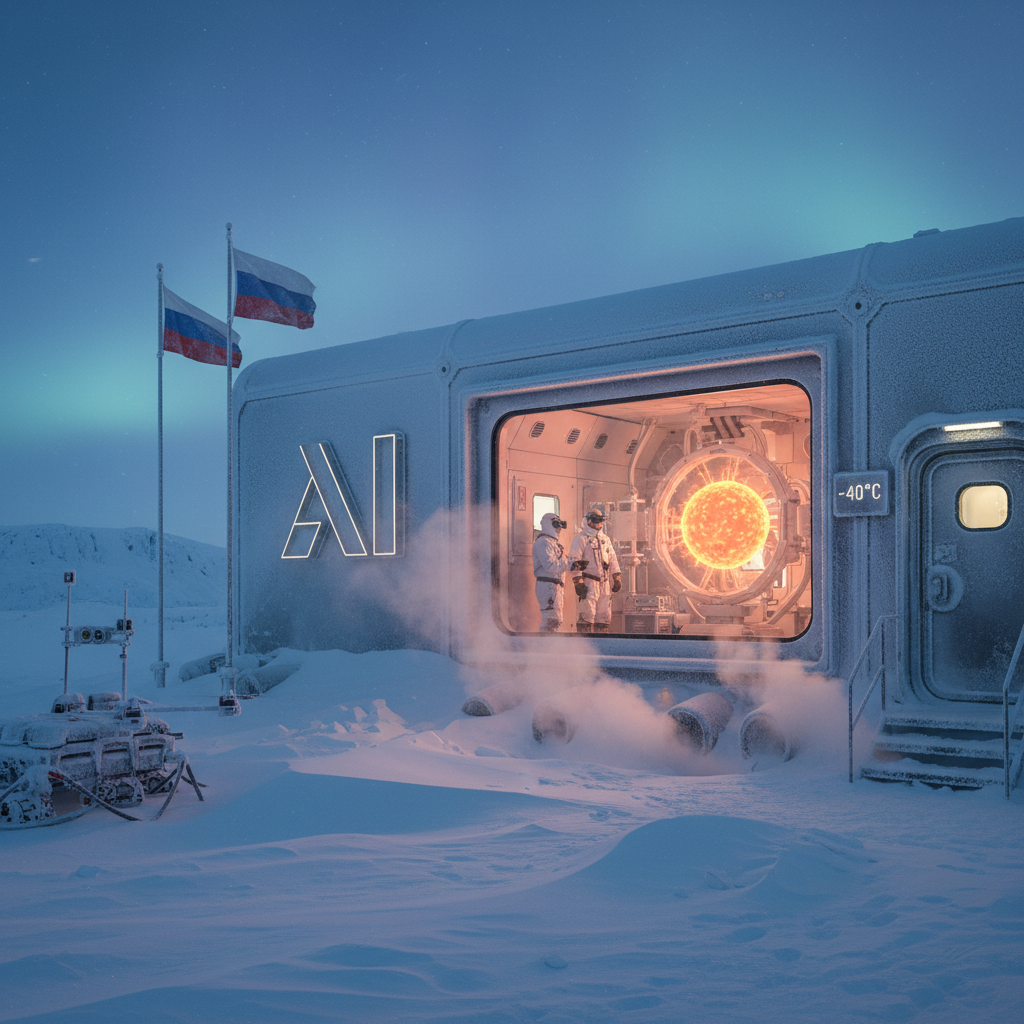

The relentless, biting wind outside Vostok Station, where temperatures routinely plummet to -40°C, serves as a stark reminder of humanity's enduring need for reliable, potent energy sources. Here, amidst the planet's most extreme environment, the very concept of generating power echoes with a profound urgency. While our immediate concerns involve maintaining vital systems against the Antarctic's unforgiving embrace, the global scientific community is focused on a far grander challenge: harnessing the power of the stars through nuclear fusion. This endeavor, once relegated to the distant future, is now experiencing a profound acceleration, largely thanks to the strategic application of artificial intelligence.
For decades, the dream of fusion energy, often described as 'putting a sun in a bottle,' has been tantalizingly out of reach. The core challenge lies in containing superheated plasma, a state of matter hotter than the sun's core, for long enough to initiate a sustained fusion reaction. Traditional control systems, relying on complex physics models and iterative human adjustments, have struggled with the inherent instability and non-linearity of plasma behavior. It is here that AI, particularly advanced machine learning algorithms, is proving to be a transformative force.
Consider the work being done by Google DeepMind, a company that has consistently pushed the boundaries of AI capabilities. Their collaboration with the Swiss Plasma Center at Epfl, utilizing the Variable Configuration Tokamak, TCV, has yielded remarkable results. In 2022, DeepMind published research demonstrating an AI-powered magnetic control system capable of precisely shaping and controlling plasma in real time. This was not merely an incremental improvement; it represented a fundamental shift in approach. Instead of pre-programmed rules, the AI learned optimal control strategies through deep reinforcement learning, observing millions of simulated and real-world plasma interactions. The data from our Antarctic station reveals that even in environments where every watt of power is precious, the efficiency gains promised by such AI-driven systems are not just theoretical, they are existential.
Professor Federico Felici, a senior scientist at the Swiss Plasma Center, highlighted the significance of this breakthrough. 'For the first time, we were able to use a single AI controller to manage the full complexity of the plasma, from initiation to termination, and to maintain various plasma configurations,' Felici stated in a press briefing. 'This level of precise, adaptive control was previously unimaginable with conventional methods.' The AI was able to manipulate 19 magnetic coils 10,000 times per second, maintaining plasma configurations with unprecedented stability and accuracy. This is akin to a master sculptor working with molten gold, shaping it with instantaneous precision, rather than a blacksmith hammering away with brute force.
The implications extend beyond mere control. AI is also revolutionizing the design phase of fusion reactors. The sheer complexity of optimizing reactor geometries, material science, and operational parameters for maximum energy output and minimal waste is a combinatorial nightmare for human engineers. Generative AI models and advanced simulation tools, often powered by NVIDIA's high-performance computing platforms, are now exploring design spaces that would take human teams centuries to evaluate. These AI systems can rapidly iterate through thousands of design variations, predicting performance characteristics and identifying optimal configurations that defy human intuition. This accelerated design cycle is critical for projects like Iter, the international experimental fusion reactor under construction in France, which aims to produce net energy by the mid-2030s.
Dr. Bernard Bigot, the late Director-General of Iter, frequently emphasized the need for innovative solutions to overcome the project's formidable engineering hurdles. While he passed before the full extent of current AI capabilities became apparent, his vision for advanced control systems and predictive modeling aligns perfectly with the trajectory of AI in fusion. As he once remarked, 'iter is not just a machine; it is a grand scientific experiment that requires the best minds and the most advanced tools humanity can offer.' AI is undeniably becoming one of those indispensable tools.
Another critical area where AI is making inroads is in predictive maintenance and anomaly detection. Fusion reactors are incredibly complex machines, with thousands of sensors monitoring everything from magnetic field strength to neutron flux. Identifying subtle deviations that could indicate impending equipment failure or plasma instability is a monumental task. Machine learning models, trained on vast datasets of operational telemetry, can detect patterns invisible to human operators, providing early warnings and enabling proactive interventions. This is particularly vital for ensuring the safety and continuous operation of future commercial fusion power plants. At -40°C, technology behaves differently, and the reliability of every component is paramount. This rigorous demand for resilience mirrors the requirements for fusion reactors, where any downtime is enormously costly.
Companies like Commonwealth Fusion Systems, a spin-off from MIT, are also integrating AI into their designs for compact, high-field tokamaks. Their Sparc project, which aims for net energy gain in the coming years, relies heavily on advanced computational modeling and AI-driven optimization to manage the extreme conditions created by their high-temperature superconducting magnets. The synergy between novel engineering and intelligent control systems is proving to be a powerful combination.
However, the path is not without its challenges. The quality and volume of data available for training AI models remain crucial. While simulations provide a rich source, real-world experimental data from operational tokamaks is still relatively scarce and often noisy. Furthermore, the interpretability of complex deep learning models, particularly in safety-critical applications, is an ongoing area of research. Regulators will demand transparent and verifiable AI decision-making before commercial fusion plants can become a reality.
Yet, the momentum is undeniable. The global investment in fusion energy research, both public and private, continues to grow, with AI increasingly seen as a core enabling technology. According to a report by the Fusion Industry Association, private fusion companies have collectively raised over $6 billion, with a significant portion allocated to advanced computing and AI research. This financial commitment underscores the belief that AI is not just an auxiliary tool, but a central pillar in the strategy to achieve practical fusion power.
Science at the bottom of the world teaches us patience, persistence, and the profound impact of incremental advancements. The journey to fusion energy is a testament to this spirit. With AI now acting as a sophisticated co-pilot, navigating the intricate physics of plasma and optimizing reactor designs, the prospect of a clean, virtually limitless energy source moves ever closer to reality. The sun in a bottle, once a distant dream, is now being meticulously engineered, one AI-driven calculation at a time, promising a future where humanity's energy needs are met with stellar abundance. For further reading on AI's broader impact on scientific discovery, one might consult MIT Technology Review. For a more technical dive into AI in physics, ArXiv provides a wealth of recent papers. The developments in this field are truly transformative, and DataGlobal Hub will continue to monitor them closely.