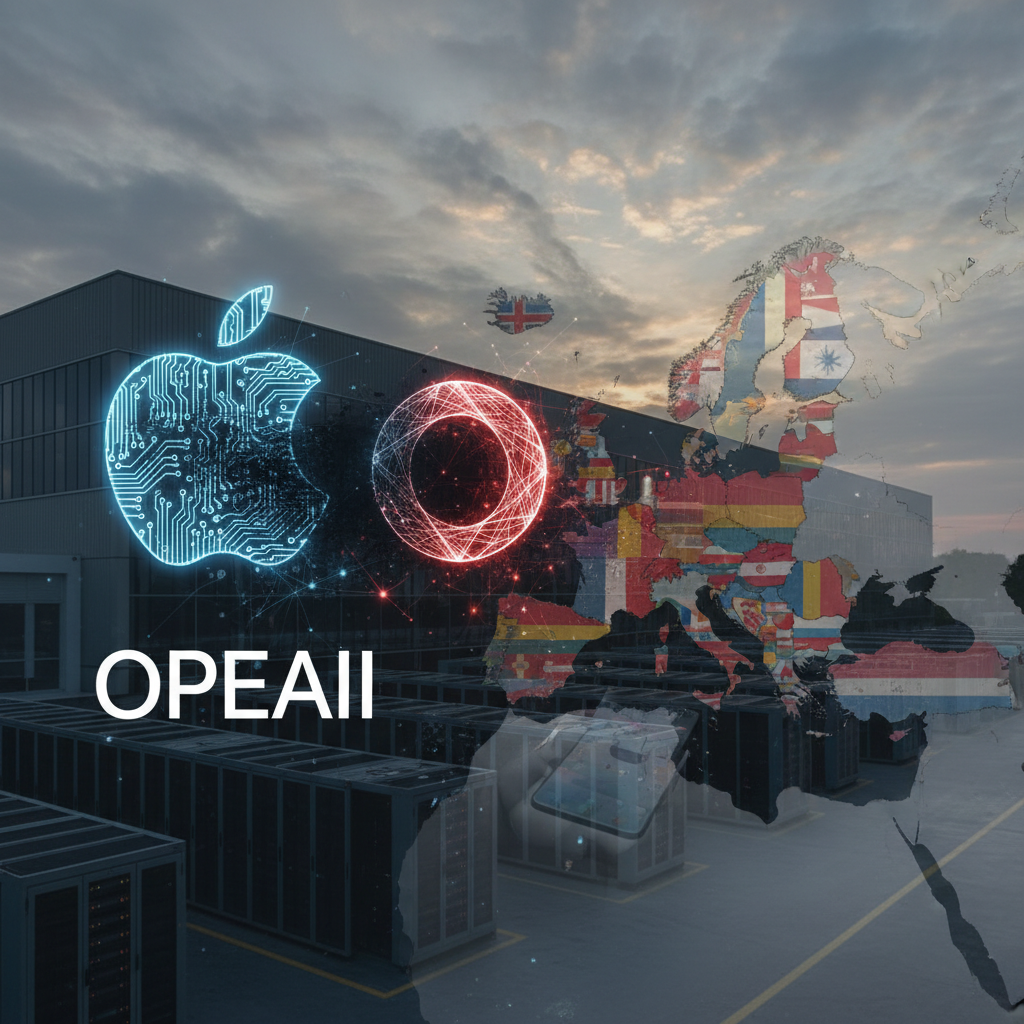

Let us be frank, shall we? The tech world, in its endless pursuit of the next big thing, has a habit of presenting us with shiny new toys wrapped in promises of progress. This time, the gift horse is wearing an Apple logo, and inside, it's whispering sweet nothings powered by OpenAI. The news, confirmed just weeks ago, that Apple is integrating OpenAI's advanced AI models directly into iOS and macOS, promising a 'proactive and personalized' user experience, has sent ripples through the industry. Some call it a masterstroke, a necessary evolution. I call it a Trojan horse, and Budapest has a message for Brussels. Wake up.
For years, Apple has prided itself on privacy, on keeping your data local, on being the walled garden where your digital life was supposedly safe from the prying eyes of advertisers and data brokers. Now, suddenly, that wall seems to have a very large, OpenAI-shaped gate. While the specifics are still emerging, the broad strokes are clear: your iPhone, your Mac, your Apple Watch, they are all about to become conduits for OpenAI's algorithms. Imagine Siri, not just answering your questions, but anticipating them, drafting emails, summarizing documents, even generating images based on your personal data, all powered by models that reside, at least in part, on remote servers controlled by a US company.
This isn't about whether the technology is impressive. Of course, it is. OpenAI's GPT models have demonstrated capabilities that were science fiction just a few years ago. The ability to generate coherent text, understand complex queries, and even write code is undeniably powerful. Apple's integration, leveraging its massive user base and hardware prowess, will undoubtedly accelerate the adoption of these advanced AI features into the daily lives of hundreds of millions. Analysts at Bloomberg Technology are already predicting a significant boost in iPhone sales, citing the 'AI upgrade cycle' as the next major driver for the company, potentially adding billions to its market capitalization.
But let's peel back the layers of this polished fruit. What does this mean for Europe, for our much-vaunted digital sovereignty? We have spent years, and countless legislative hours, trying to craft regulations like the GDPR and the upcoming AI Act, designed to protect our citizens, to ensure data privacy, and to foster a competitive, ethical AI ecosystem within the EU. Yet, with one stroke, two American tech behemoths seem to be sidestepping much of that effort by baking their services directly into the very devices we use every day. The Hungarian perspective nobody wants to hear is this: we are becoming digital serfs to Silicon Valley.
Consider the data. Apple claims that much of the processing will happen on-device, or through 'private cloud compute' that maintains user privacy. But how much is 'much'? And what happens when the models need to be updated, refined, or when more complex queries necessitate sending data to OpenAI's larger, more powerful cloud infrastructure? The sheer volume of personal information, from your calendar and contacts to your photos and messages, that could potentially be processed by these external AI models is staggering. Even if anonymized, even if encrypted, the aggregation of such vast datasets presents an irresistible target, and a profound challenge to our regulatory frameworks.
"The integration of powerful generative AI directly into consumer devices raises significant questions about data provenance, model transparency, and user control," stated Dr. Katalin Novák, a leading AI ethics researcher at the Hungarian Academy of Sciences, in a recent interview. "We are moving into an era where the lines between personal data and the algorithms that process it are blurring, and the regulatory bodies are constantly playing catch-up." Her concerns are not isolated; across Europe, policymakers are grappling with how to enforce their digital laws when the technology is designed to operate globally, often with little regard for national borders or local regulations.
This partnership also highlights Europe's persistent struggle to create its own competitive AI champions. While we have brilliant researchers and innovative startups, the sheer scale and resources of companies like Apple and OpenAI dwarf anything we have managed to cultivate. When the default AI on every iPhone is American, where does that leave European alternatives? How do our home-grown AI companies compete when the operating system itself is a gatekeeper, funneling users towards pre-selected, non-European services? It's a question of market access, of fair competition, and ultimately, of economic independence. We cannot build a digitally sovereign Europe if our foundational digital infrastructure is controlled from outside.
And let's not forget the cultural implications. AI models are trained on vast datasets, reflecting the biases and perspectives of their creators and the data they consume. If our primary interface with AI, embedded deeply into our personal devices, is shaped predominantly by American cultural norms and data, what does that mean for the preservation of European languages, traditions, and values? Will our AI assistants subtly nudge us towards content, products, or even ways of thinking that align with a Silicon Valley worldview? Contrarian? Maybe. Wrong? Prove it. The subtle erosion of cultural distinctiveness through algorithmic influence is a risk we cannot afford to ignore, especially in a region as culturally rich and diverse as Central Europe.
We need to demand more than vague assurances of privacy. We need transparency about what data is collected, how it is used, and where it is stored. We need robust opt-out mechanisms that are genuinely easy to understand and implement, not buried in layers of settings. And crucially, we need to accelerate our efforts to foster European AI solutions that can offer genuine alternatives, built on our values and designed with our citizens' rights at the forefront. The EU's AI Act is a start, but it needs teeth, and it needs to be applied rigorously to these new, deeply integrated AI systems. The future of our digital autonomy depends on it. We cannot allow our iPhones to become instruments of digital colonization. This is a battle for the soul of our digital future, and it is being fought, quietly, on the screens of our most personal devices. This is not just about a smarter Siri, it is about who controls the narrative, who owns the data, and ultimately, who holds the power in the digital age. The time for polite requests is over; it is time for Europe to assert its digital will, before it is too late. For more on the broader implications of AI in everyday tech, consider the ongoing discussions around AI and ethics in technology.