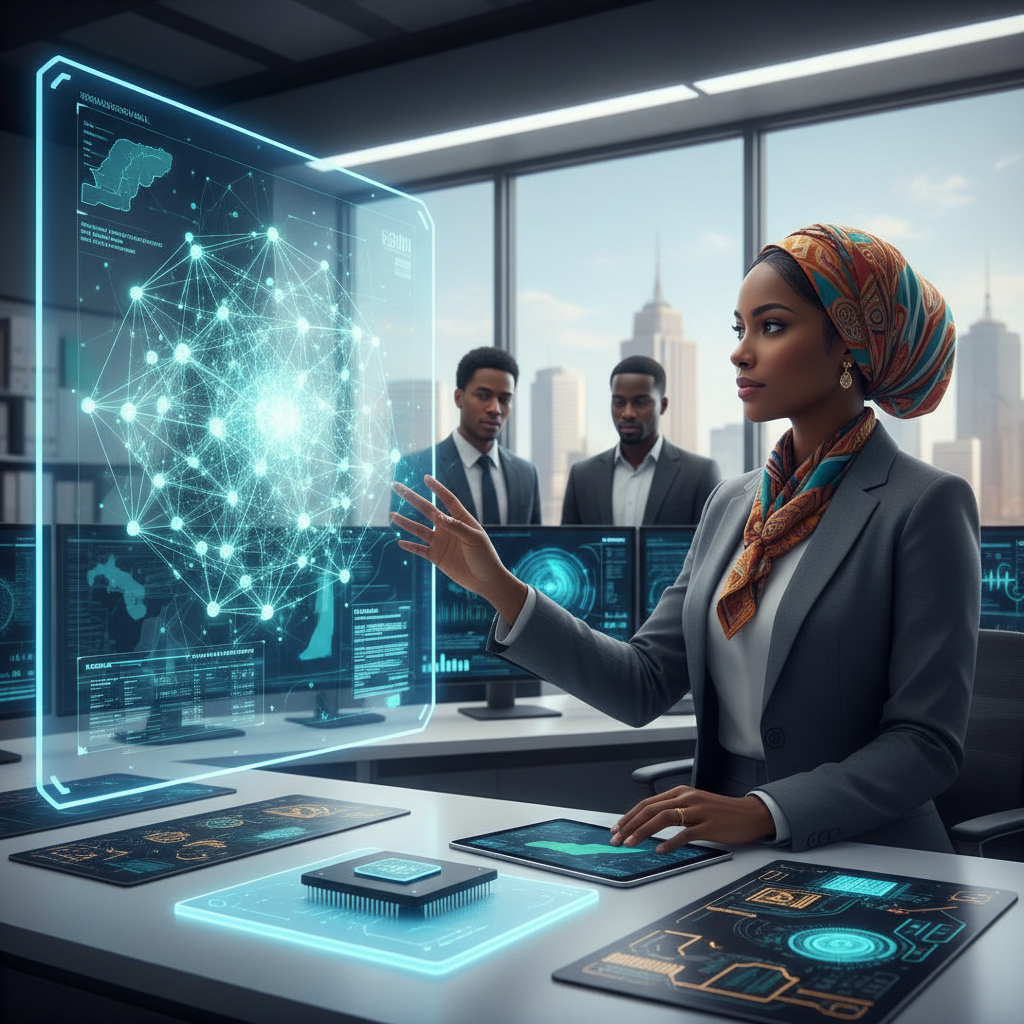

You're going to want to sit down for this. For those of us who grew up with stories of the universe told around a fire, the idea of peering into its very building blocks can feel like something out of a science fiction novel. And yet, here we are, in April 2026, talking about how artificial intelligence, that buzzword that follows us from our smartphones to our banking apps, is now helping scientists at places like Cern unravel the deepest secrets of existence. It sounds like a lot, doesn't it? Like trying to explain the intricacies of the Lusaka Stock Exchange to someone who only trades chickens at Soweto Market. But trust me, the principles, when you strip away the jargon, are surprisingly relatable.
What is AI in Particle Physics?
At its core, AI in particle physics is about using intelligent algorithms to make sense of the colossal amounts of data generated by experiments designed to study the fundamental constituents of matter and energy. Think of it this way: when scientists smash particles together at nearly the speed of light in giant accelerators like the Large Hadron Collider (LHC) at Cern, they are not just making a big bang. They are creating fleeting moments of extreme energy, producing thousands of new particles that decay almost instantly. Each collision is like a miniature, incredibly complex puzzle, and the detectors surrounding these collision points capture billions of pieces of information. We are talking petabytes of data every year, a volume so immense it would make the entire internet feel like a small village library.
AI, particularly machine learning and deep learning, steps in as the ultimate data detective. It sifts through this digital mountain, identifying patterns, classifying events, and filtering out the noise to find the rare, significant signals that hint at new physics. Without AI, much of this data would remain an indecipherable mess, like trying to find a specific grain of sand on a beach the size of the Copperbelt Province.
Why Should You Care?
Now, you might be thinking, "Lindiwe, what does some subatomic particle in Switzerland have to do with my life here in Matero?" And that, my friend, is an excellent question. The answer is, quite a lot, actually. The pursuit of fundamental knowledge, understanding how the universe works, has a funny way of spinning off technologies that change our everyday lives. The World Wide Web, for instance, was invented at Cern as a way for physicists to share information more easily. Imagine that, the very fabric of our digital existence born from the need to discuss quarks and leptons.
Beyond historical precedent, the AI techniques being refined for particle physics are incredibly advanced. They push the boundaries of computational efficiency, pattern recognition, and anomaly detection. These are the same capabilities that will eventually power more accurate medical diagnostics, smarter climate models, and even more robust cybersecurity systems. When NVIDIA's powerful GPUs are being pushed to their limits to simulate particle interactions, you can bet that the breakthroughs in processing power and algorithmic efficiency will trickle down to the AI that runs your next-generation smartphone or helps manage Zambia's national power grid. As Dr. Fabiola Gianotti, the Director-General of Cern, once noted, "The technologies developed at Cern, often driven by the extreme requirements of particle physics, have a profound impact on society." It is about pushing the limits of what is possible, and the benefits often spill over in unexpected ways.
How Did It Develop?
The use of computational methods in particle physics is not new. Scientists have been using statistical analysis and algorithms for decades. However, the sheer scale of data from experiments like the LHC, which began operations in 2008 and underwent significant upgrades, overwhelmed traditional methods. The detectors became more sensitive, the collision rates higher, and the amount of information generated exploded. It became clear that human analysis, even with sophisticated software, could not keep up.
This is where the revolution in machine learning, particularly deep learning, over the last decade became a game-changer. Inspired by the human brain's neural networks, these algorithms could learn from vast datasets to identify complex patterns. Researchers at Cern and other particle physics labs started experimenting with these new tools, initially for tasks like particle identification and track reconstruction. The early successes were so promising that AI quickly became an indispensable part of the data analysis pipeline. It was a natural progression, really, from using simple statistical models to employing sophisticated neural networks to sift through the universe's digital dust.
How Does It Work in Simple Terms?
Imagine you are a detective, and you have just witnessed a massive explosion in a crowded market. There are thousands of pieces of debris scattered everywhere: broken stalls, scattered vegetables, bits of clothing. Your job is to find the tiny, specific fragments that tell you what caused the explosion, perhaps a unique piece of a detonator or a rare type of shrapnel. Doing this by hand would be impossible. You would need an army of helpers, and even then, you would miss things.
Now, imagine you have a super-smart assistant, an AI, that can instantly scan every single piece of debris. It has been trained on millions of previous explosion scenarios, so it knows exactly what to look for. It can tell the difference between a harmless piece of wood and a crucial metallic fragment, even if they look similar to the untrained eye. It can reconstruct the trajectory of every piece, telling you where it came from and where it landed. That is essentially what AI does in particle physics.
It takes the raw data from the detectors, which are just electrical signals, and uses algorithms to reconstruct the paths of particles, identify their types (electrons, muons, protons, etc.), and determine their energies. It then looks for anomalies or specific signatures that might indicate the presence of a new, unknown particle or a never-before-seen interaction. It is like teaching a computer to see the invisible, to hear the silent whispers of the quantum world. The irony is almost too perfect, that we use human-made intelligence to understand the intelligence of the universe itself.
Real-World Examples
-
The Higgs Boson Discovery: While the Higgs boson was famously discovered in 2012, AI played an increasingly vital role in the subsequent analyses, helping to refine measurements and confirm its properties. The sheer volume of data involved in the search for this elusive particle, often dubbed the "God particle," necessitated advanced statistical and machine learning techniques to separate the signal from the overwhelming background noise. Without these computational tools, confirming the Higgs' existence and studying its behavior would have been significantly more challenging and time-consuming.
-
Searching for Dark Matter: Scientists believe that dark matter makes up about 27% of the universe, yet we cannot see it or directly interact with it. AI algorithms are now being deployed in experiments like the LHC to look for subtle deviations from known physics that could be signatures of dark matter particles. These algorithms are trained to identify extremely rare events that might indicate a dark matter particle was produced and then decayed, leaving behind a specific pattern of other particles. It is like finding a ghost in a crowd, a task perfectly suited for AI's pattern-matching prowess.
-
Detector Calibration and Optimization: Before any meaningful physics can be extracted, the detectors themselves need to be precisely calibrated. AI is used to monitor detector performance, identify faulty components, and optimize their settings in real-time. This ensures the data collected is as accurate and reliable as possible. It is like having a team of expert mechanics constantly fine-tuning a high-performance racing car, but with algorithms doing the heavy lifting.
-
Accelerating Simulations: Particle physics relies heavily on simulations to predict what should happen in a collision according to current theories. These simulations are computationally intensive. AI, particularly generative adversarial networks (GANs), is now being used to speed up these simulations significantly, sometimes by orders of magnitude. This allows physicists to explore more theoretical scenarios and compare them more quickly with experimental data, accelerating the pace of discovery. You can read more about the cutting-edge applications of AI in scientific research on MIT Technology Review.
Common Misconceptions
One common misconception is that AI is somehow replacing human physicists. This could not be further from the truth. AI is a tool, an incredibly powerful one, but a tool nonetheless. It automates the tedious, data-intensive tasks, allowing human scientists to focus on the higher-level intellectual challenges: formulating new theories, designing experiments, and interpreting the profound implications of the discoveries. It is like giving a master chef a faster, more efficient oven; they still need to create the recipe and understand the flavors. The human element, the curiosity, the intuition, remains absolutely essential.
Another misconception is that AI is infallible. Like any tool, it is only as good as the data it is trained on and the algorithms it employs. Biases in training data or flaws in the model design can lead to incorrect conclusions, which is why human oversight and rigorous validation are critical. It is not magic, it is mathematics and computation, and it requires constant scrutiny.
What to Watch for Next
The future of AI in particle physics is incredibly exciting. We are seeing a move towards real-time AI analysis, where algorithms make decisions about which data to keep and which to discard almost as the collisions happen. This is crucial for future experiments with even higher collision rates. There is also a growing push towards developing AI that can not only identify patterns but also explain its reasoning, moving beyond a black box approach. This explainable AI will be vital for building trust and understanding in complex scientific discoveries.
Furthermore, the integration of quantum computing with AI for particle physics is an emerging field. While still in its infancy, quantum machine learning could offer unprecedented computational power to tackle problems currently intractable even for the most powerful classical supercomputers. Imagine the possibilities for understanding the very fabric of spacetime, the origins of the universe, or the nature of gravity, all accelerated by these combined technologies. It is a frontier where the digital meets the quantum, and the implications could be truly mind-bending.
From the bustling markets of Lusaka to the quiet, sterile labs of Cern, the world is becoming increasingly interconnected by technology. The quest to understand the universe, once the domain of philosophers and stargazers, is now being supercharged by algorithms. And if you ask me, that is a story worth telling, one that shows how even the most abstract science can ripple through our world in profound and unexpected ways. For more on how AI is shaping global tech, keep an eye on DataGlobal Hub. The universe is still full of surprises, and AI is helping us find them, one particle at a time.