
Picture this: you're at a bustling farmer's market in Brooklyn, trying to remember the name of that amazing artisanal cheese you bought last week. Your hands are full, the sun is in your eyes, and your brain feels like a tangled ball of yarn. In the past, you might have fumbled for your phone, typed a frantic search query, and waited for the internet gods to deliver. But now, with Apple Intelligence running right on your iPhone, you just whisper to Siri, "Hey, what was that sharp, creamy cheese I got from the stand with the blue awning last Saturday?" And boom, without a single byte leaving your device, Siri reminds you. "That would be the 'Midnight Moon' goat cheese from Meadow Creek Dairy." You just saw the future and it's incredible.
This isn't just a convenient trick, folks. This is a fundamental shift in how we interact with artificial intelligence, particularly here in the USA. While companies like Google and OpenAI have been building colossal, cloud-based AI models, Apple has been quietly, meticulously, investing in on-device AI. They're putting the smarts directly into your pocket, not on some distant server farm in Silicon Valley or Virginia. This isn't just about privacy, though that's a huge part of it. It's about immediacy, personalization, and, crucially, a different kind of cognitive load.
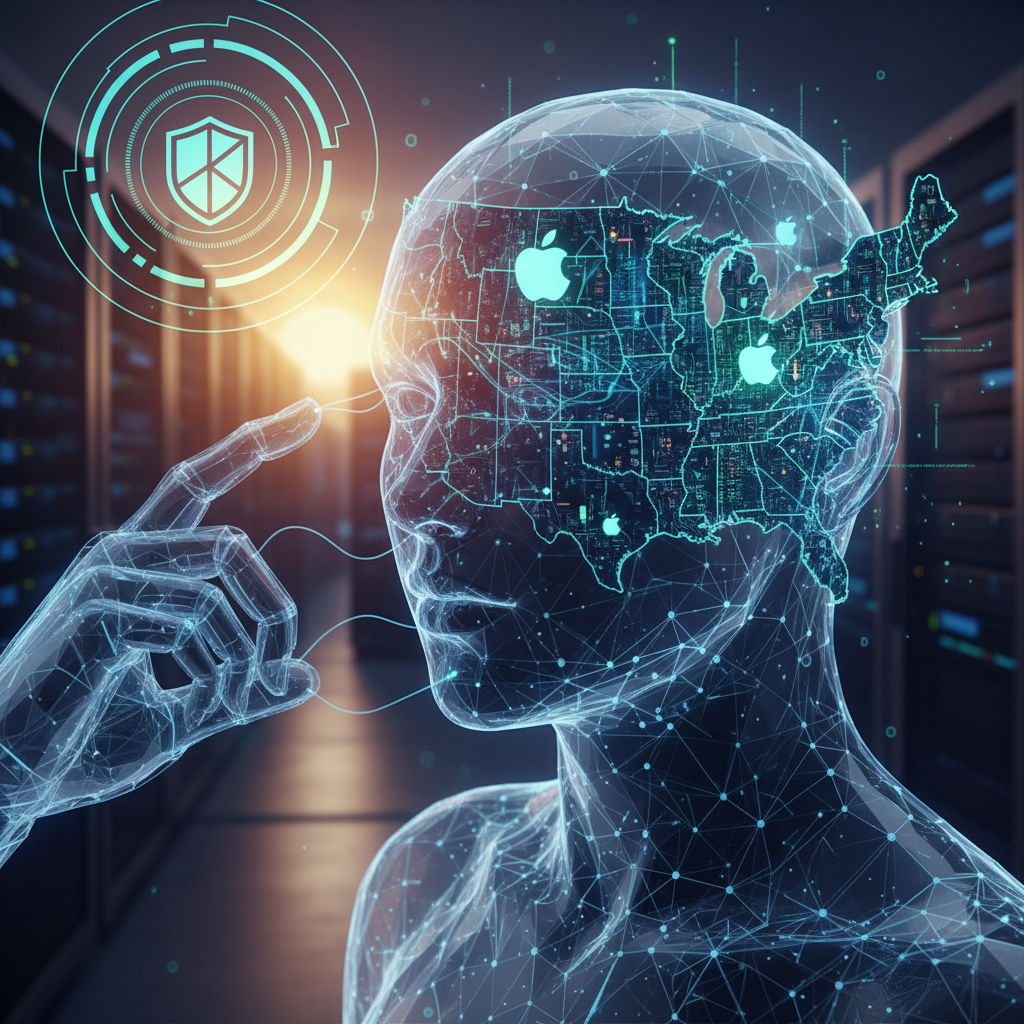
For years, our digital lives have been a constant back-and-forth with the cloud. Every search, every voice command, every smart home request, it all zipped off to a data center somewhere, got processed, and then zipped back. This created a subtle but pervasive cognitive friction. We learned to wait. We learned to phrase our queries in specific ways for optimal cloud processing. We implicitly understood that our data was traveling, being analyzed, and potentially stored. But with Apple Intelligence, much of that changes. The processing happens right there, on your iPhone's powerful A-series chip, or your Mac's M-series silicon. It’s a local, personal AI, tailored to your data, your habits, and your context, all without leaving your device. This is going to change everything.
Dr. Sarah Miller, a cognitive psychologist at Stanford University, recently highlighted this distinction. "When AI processing happens locally, the perceived latency drops to near zero, and the mental model of privacy fundamentally shifts," she explained in a recent seminar. "Users feel a greater sense of control and intimacy with their devices. This can lead to a more fluid, less self-conscious interaction, almost like an extension of their own thought process." Think about it: no more second-guessing if your casual query about a sensitive topic is going to be logged somewhere. The barrier to asking is lowered, and that can profoundly impact our daily decision-making and information retrieval habits.
This on-device approach fosters a unique kind of trust. Apple has long championed privacy as a core tenet, and their AI strategy doubles down on it. Tim Cook, Apple’s CEO, has repeatedly stated, "Privacy is a fundamental human right." This ethos is baked into Apple Intelligence. Your personal context, your photos, your messages, your calendar events, they all stay on your device. The AI learns from you, for you, without sending your most personal data spiraling into the cloud. This is a stark contrast to the cloud-first models that often require vast amounts of user data to be sent to central servers for training and inference. For many Americans, especially those concerned about data breaches and surveillance, this is a breath of fresh air.
But what are the psychological implications of having such a powerful, personal AI literally in your pocket, always learning, always available, always local? One fascinating area of research is the concept of 'cognitive offloading.' We already offload tasks to our phones constantly: remembering phone numbers, navigating, setting reminders. With on-device AI, this offloading becomes even more seamless and pervasive. Instead of just storing information, the AI actively helps process it. It can summarize long emails, draft replies in your style, organize your notes, and even help you brainstorm ideas, all based on your personal data, without that data ever leaving your device. This could free up mental bandwidth, allowing us to focus on higher-order thinking and creativity. Or, conversely, it could lead to a dependency where our own cognitive muscles atrophy.
Dr. Alex Chen, a researcher at the MIT Media Lab, has been studying this phenomenon. "The danger isn't that we become dumber, but that we become less adept at certain types of information processing if we always defer to the AI," Dr. Chen noted in a recent Wired article. "However, the potential for augmented cognition, where the AI acts as a true intellectual partner, is immense. The key is mindful interaction, understanding when to lean on the AI and when to engage our own critical faculties." It's a delicate balance, like having a super-smart assistant who knows you better than anyone, but still needs you to set the agenda.
The societal implications are also significant. In a world increasingly fragmented by digital divides and privacy concerns, Apple's strategy offers a potential pathway to more equitable and secure AI access. Not everyone has robust, high-speed internet access, especially in rural parts of the USA. On-device AI reduces the reliance on constant connectivity, making powerful AI tools accessible even in areas with spotty service. This could democratize access to advanced AI capabilities, reducing the digital gap and empowering more communities.
Moreover, the security implications for sensitive data are profound. By keeping personal information on the device, the attack surface for hackers is significantly reduced. This is particularly relevant for sectors like healthcare and finance, where data privacy is paramount. Imagine a future where your medical AI assistant, trained on your personal health records, can provide insights and recommendations without your sensitive data ever leaving your encrypted device. This is the promise of on-device AI, a promise of privacy and security woven directly into the fabric of our digital lives.
Of course, there are challenges. Developing powerful AI models that run efficiently on resource-constrained devices is incredibly difficult. It requires groundbreaking advancements in chip design, software optimization, and model compression. Apple's M-series and A-series chips, with their dedicated neural engines, are at the forefront of this effort. They are literally building the hardware that makes this on-device AI dream a reality. This isn't just about software; it's a full-stack engineering marvel.
For us, the users, the advice is simple: embrace this new era of personal AI, but do so thoughtfully. Experiment with Apple Intelligence, let it learn your habits, and see how it can genuinely augment your daily life. But also, remember to flex your own cognitive muscles. Don't let the AI do all the heavy lifting. Use it as a tool to enhance your capabilities, not replace them. Engage with it, question it, and understand its limitations. This is a partnership, after all.
The future of AI isn't just about bigger models in the cloud; it's also about smarter, more personal intelligence right in your hand. Apple's on-device strategy is a bold bet, one that prioritizes privacy, immediacy, and a different kind of human-AI relationship. As we navigate this exciting new landscape, it's clear that the way we think, learn, and interact with the world is about to get a major upgrade. And trust me, you need to pay attention to this. It’s not just about what your iPhone can do; it’s about what it means for you.