
Most people look at agentic AI and focus on the model. That is usually the wrong place to start.
The model matters, but the real difference between a normal AI feature and an agentic system is the runtime around the model.
A model can generate an answer. An agentic system has to manage state, tools, memory, permissions, feedback, failure, cost, and auditability.
That distinction is important.
Generation vs. Controlled Action
If a system summarizes a support ticket, that is useful generative AI.
If it reads the ticket, identifies intent, checks the customer record, queries order history, applies the refund policy, decides whether approval is needed, updates the CRM, writes the final response, and logs every step, then you are looking at something closer to agentic AI.
The technical shift is not just generation. The technical shift is controlled action.
This is a distinction that gets lost in most conversations about AI agents. People see a demo where a model calls a tool and assume the hard part is done. It is not. The hard part is everything that happens between the tool call and the final output. The validation. The error handling. The decision about whether to proceed or stop. The record of what happened and why.
A tool call without governance is just an API request with extra steps. A tool call inside a governed system, with state tracking, permission checks, and rollback logic, is the beginning of an agent.
What Agentic AI Actually Needs
This is why agentic AI needs more than a prompt and a tool call. It needs clear tool contracts. Structured inputs and outputs. Memory that can be trusted. State persistence across steps. Permission boundaries. Human approval for risky actions. Evaluation before and after execution. Rollback logic when something fails. Observability for every decision. Cost and latency controls.
Without these, the system may look impressive in a demo, but it will be fragile in production.
Each of these requirements deserves attention.
Clear tool contracts mean that every tool the agent can use has a defined interface. The agent knows what it can send, what it will receive, and what side effects the tool might have. Without this, the agent is guessing at how to use its own capabilities.
Structured inputs and outputs mean the agent does not pass freeform text between steps. It passes typed, validated data. This reduces the chance of misinterpretation and makes debugging possible.
Memory that can be trusted means the agent's context is not just a growing prompt window. It is a managed store where facts are tagged with sources, timestamps, and confidence levels. If the agent retrieves something from memory, there should be a way to verify when that information was stored and whether it is still current.
State persistence across steps means the agent can pause, resume, and recover. If a five-step workflow fails at step three, the agent should not start over from scratch. It should know where it stopped, what it completed, and what remains.
Permission boundaries mean the agent knows what it is allowed to do and what requires escalation. Reading a database is different from writing to it. Querying a price is different from executing a transaction. The agent must distinguish between these and behave accordingly.
Human approval for risky actions means the system has a built-in checkpoint for decisions that carry real consequences. Not every action needs human review. But some do. The agent must know which ones.
Evaluation before and after execution means the agent checks its own work. Before acting, it verifies that the planned action matches the goal. After acting, it confirms that the result is what was expected. This is not optional. It is the difference between a system that corrects itself and one that compounds errors.
Rollback logic means the system can undo what it did. If an action produces an unexpected result, the agent should be able to reverse it or flag it for manual intervention. Systems without rollback logic are systems that can only move forward, even when forward is the wrong direction.
Observability means every decision the agent makes is logged, traceable, and reviewable. If something goes wrong, you should be able to reconstruct the exact sequence of events that led to the failure. Without observability, debugging an agent is guesswork.
Cost and latency controls mean the agent operates within resource boundaries. An agent that calls an expensive API in a loop without limits is not autonomous. It is unmanaged. Cost awareness is part of responsible system design.
Reading the Framework
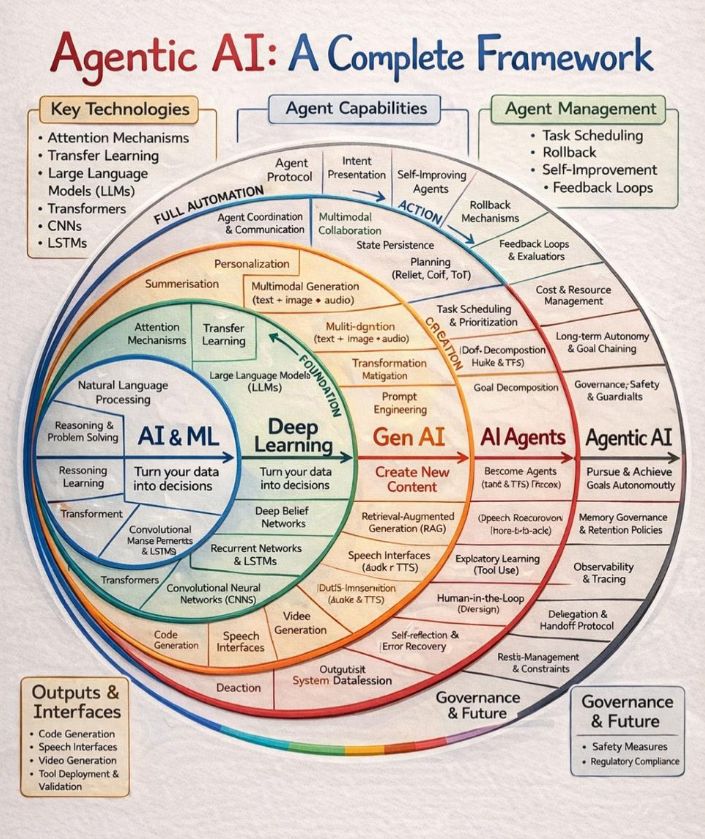
One useful way to think about the framework in the image is this:
AI and machine learning help systems understand data. Deep learning helps extract richer patterns from text, images, audio, and behavior. Generative AI creates new content from context. AI agents use tools to complete tasks. Agentic AI connects all of this into a governed system that can pursue goals with controlled autonomy.
That last phrase matters: controlled autonomy.
Autonomy without control creates risk. Control without autonomy becomes basic automation. The value is in designing the boundary between both.
The framework diagram maps this progression from the inside out. At the core, you have the foundational capabilities: natural language processing, reasoning, attention mechanisms. These are the building blocks. Moving outward, you reach deep learning, where the system begins to handle more complex representations. Then generative AI, where the system can create. Then AI agents, where the system can act. And finally, agentic AI, where the system can pursue goals across multiple steps with governance, memory, and accountability.
Each ring adds capability. But each ring also adds complexity. And complexity without structure is where systems break.
The Four Questions
A serious agentic system should always answer four questions:
What is the agent allowed to know? This defines the information boundary. Not every agent needs access to every data source. Limiting what the agent can see reduces the surface area for errors and misuse.
What is the agent allowed to change? This defines the action boundary. An agent that can read a database but not write to it has a very different risk profile from one that can modify records, send emails, or trigger payments.
How do we verify that the action was correct? This defines the evaluation boundary. If the agent takes an action, there must be a way to confirm that the action achieved the intended result. This can be automated, manual, or a combination. But it must exist.
What happens when the action fails halfway? This defines the recovery boundary. Partial failures are the most dangerous kind, because the system is in an inconsistent state. The agent needs a plan for this scenario before it starts executing.
These four questions are not theoretical. They are the minimum requirements for any system that will operate in a real environment with real consequences.
Where the Real Engineering Begins
The future of agents will not be won by the best prompt alone. It will be won by teams that understand orchestration, memory, evaluation, governance, and system design.
Orchestration means coordinating multiple steps, tools, and models into a coherent workflow. Memory means maintaining context that is reliable, scoped, and auditable. Evaluation means checking results against expectations at every stage. Governance means enforcing rules about what the agent can and cannot do. System design means building all of this in a way that is maintainable, observable, and scalable.
The chart is busy, but the message is simple.
An AI agent is not just a model that talks. It is a system that can observe, decide, act, verify, learn, and stay within its boundaries.
That is the standard. Everything below it is a feature. Everything at or above it is a system.