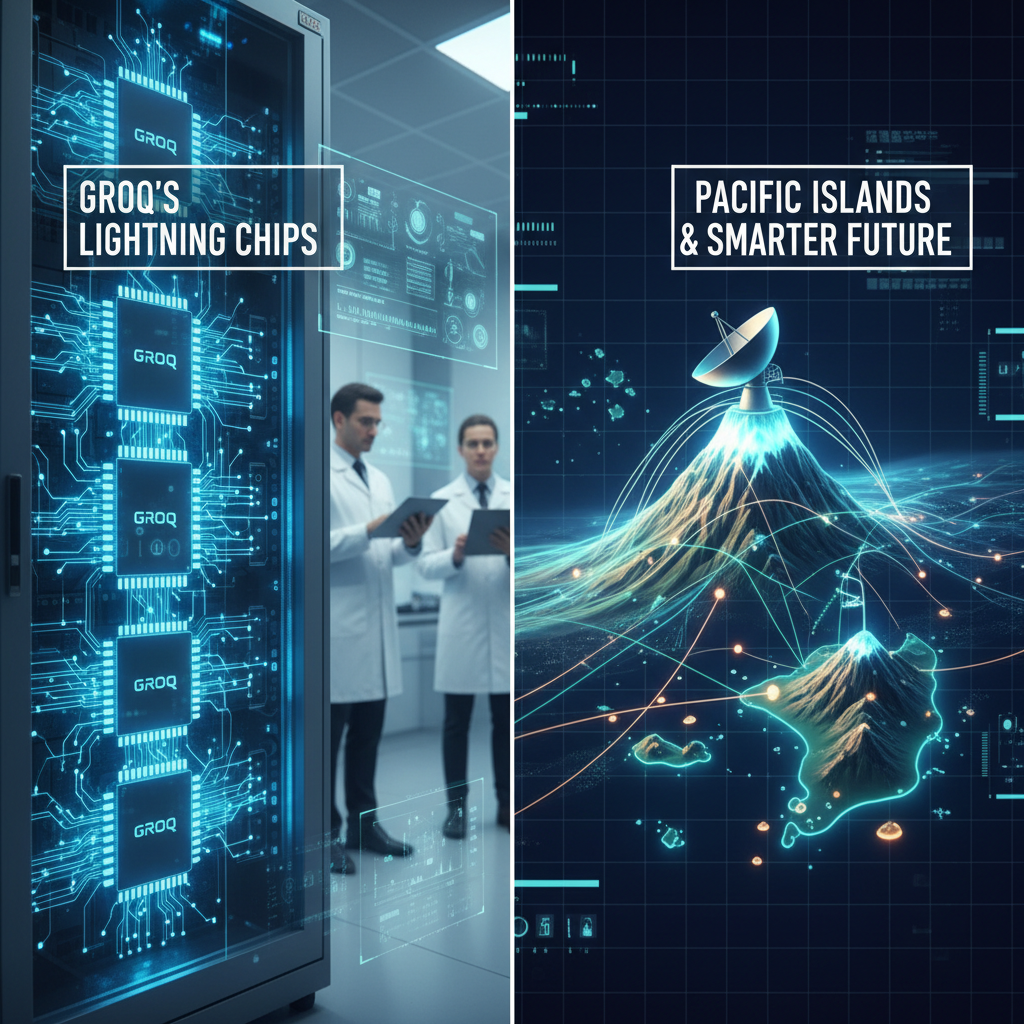

Here in French Polynesia, where the rhythm of the ocean dictates so much of life, we often look to the horizon for what is coming next. We are a people connected by water, by shared traditions, and increasingly, by the invisible threads of technology. When I hear about breakthroughs in artificial intelligence, my first thought is always, 'How will this touch our shores? How will it help our communities, our environment, our children?'
That is why the recent buzz around Groq, a company few outside the tech world had heard of until recently, has truly caught my attention. They are not just making faster computer chips, they are talking about a fundamental shift in how we interact with AI, making it more immediate, more accessible, and crucially, more affordable. For islands like ours, where every resource counts and connectivity can be a challenge, this is not just technical jargon, it is a potential lifeline.
The Whisper of a New Tide: Groq's Breakthrough Explained
Imagine asking an AI a complex question, not waiting for seconds, but getting an answer almost instantly, as if you were speaking to a person right next to you. This is the promise of Groq's custom AI inference chips. For years, the bottleneck in AI, especially with large language models like GPT or Claude, has been 'inference', the process where the AI takes your input and generates a response. These models are massive, requiring immense computational power, usually from expensive, power-hungry GPUs made by companies like NVIDIA.
Groq, founded by Jonathan Ross, a former Google engineer who helped create the Tensor Processing Unit, decided to rethink the entire architecture. Instead of optimizing existing designs, they built a new chip from the ground up, specifically for inference. Their chips, known as Language Processor Units or LPUs, are designed for sequential processing, which is exactly how large language models work. This specialized design allows them to process information at speeds reportedly 10 times faster than traditional GPUs, and at a fraction of the cost and power consumption. It is like replacing a multi-purpose cargo ship with a sleek, high-speed outrigger canoe designed just for island hopping; it is incredibly efficient for its specific task.
Why This Matters for Our Blue Continent
In the Pacific, technology takes a different form. It is not always about the latest gadget, but about practical solutions that empower our people and protect our precious environment. The implications of Groq's speed and affordability for our islands are profound. Think about climate change, a reality we live with every day. Accurate, real-time climate modeling, disaster prediction, and resource management are critical. If AI models can run faster and cheaper, local governments and research institutions, perhaps even the University of French Polynesia, could deploy more sophisticated tools without needing massive, expensive data centers.
Consider ocean conservation. Our marine ecosystems are under constant threat. AI can help monitor coral health, track illegal fishing, and analyze vast amounts of data from underwater sensors. But processing all that data quickly, especially in remote areas with limited infrastructure, has been a hurdle. With Groq's LPUs, a small, solar-powered research station on a remote atoll could potentially run complex AI analyses on site, providing immediate insights to protect our lagoons and marine life. This is a story about paradise and pixels, where advanced technology meets the urgent needs of our natural world.
Dr. Merehau Fati, a marine biologist at the Criobe research center in Moorea, shared her thoughts with me recently.