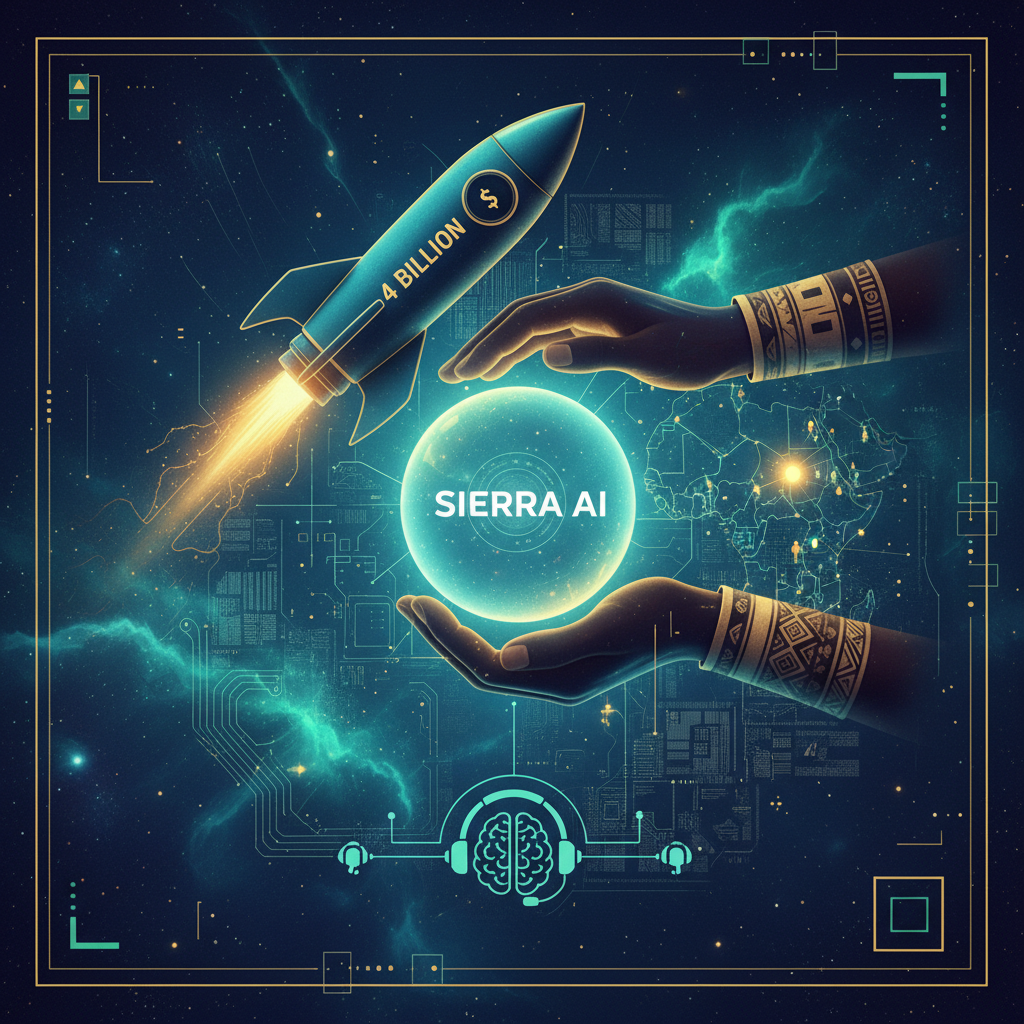

Is the future of customer service a smiling face or a perfectly programmed algorithm? This is a question that weighs heavily on my mind as I follow the meteoric rise of companies like Sierra AI, the brainchild of tech titans Bret Taylor and Clay Bavor. Their startup, reportedly valued at an astonishing $4 billion, is making waves with its promise to transform how businesses interact with their customers using sophisticated artificial intelligence. But as someone who has seen firsthand how deeply human connection underpins every transaction, every plea for help, every shared moment in places like the bustling markets of Treichville or the quiet villages of Korhogo, I have to ask: is this a genuine leap forward or just another shiny, expensive distraction?
Picture this: a small tailor in Adjamé, Madame Koné, who has built her business on trust and personal relationships. Her customers don't just come for a dress; they come for her advice, her stories, her understanding of their lives. Could an AI ever replicate that? The tech world, it seems, is betting billions that it can, or at least that it can handle the mundane, freeing up humans for the more complex, empathetic tasks. But what if the mundane is where the empathy truly begins?
For a long time, customer service has been a battleground of frustration for both sides. Customers often face long wait times, repetitive questions, and a general feeling of being unheard. Businesses, in turn, grapple with high operational costs and the challenge of maintaining consistent quality. This is the historical context that Sierra AI, and many others in the generative AI space, are looking to disrupt. From the early, clunky chatbots of the 2000s to the more sophisticated, rule-based systems of recent years, the goal has always been efficiency. However, the advent of large language models (LLMs) has opened up new possibilities, promising not just efficiency, but also a semblance of understanding and natural conversation.
Sierra AI, co-founded by former Salesforce co-CEO Bret Taylor and former Google executive Clay Bavor, is at the forefront of this new wave. Their approach is to deploy AI agents that can handle complex customer interactions, not just simple FAQs. They aim to integrate these agents seamlessly into existing customer relationship management (CRM) systems, allowing them to learn from past interactions and provide personalized support. The idea is that these AI agents can understand context, respond dynamically, and even anticipate customer needs, leading to a smoother, more satisfying experience. This is a significant step beyond the scripted responses we've grown accustomed to.
Indeed, the numbers coming out of the sector are compelling. A report by Reuters Technology recently highlighted that the global customer service AI market is projected to reach tens of billions of dollars within the next few years, with a compound annual growth rate exceeding 20%. Companies are pouring investment into this area, driven by the dual promise of cost reduction and improved customer satisfaction scores. Major players like Google and Microsoft are integrating similar capabilities into their cloud offerings, while startups like Sierra AI are carving out specialized niches. It's a gold rush, and everyone wants a piece.
But what does this mean for us, here in Côte d'Ivoire? I spoke with Dr. Aminata Diallo, a leading researcher in human-computer interaction at the Félix Houphouët-Boigny University in Abidjan. She told me something I'll never forget: "Technology must serve humanity, not replace it entirely. While AI can undoubtedly streamline processes, we must be vigilant about preserving the human element, especially in service roles where trust and cultural understanding are paramount." Her words echo a sentiment I often hear from local entrepreneurs. In our culture, a transaction is rarely just about exchanging goods or services; it's about building a relationship, often steeped in proverbs and shared laughter.
Consider the banking sector in Abidjan. While major banks like Société Générale Côte d'Ivoire and Ecobank are increasingly adopting digital solutions, the personal touch of a bank teller who knows your family, understands your business, and can navigate the unique challenges of local commerce is still invaluable. Could an AI truly grasp the intricacies of a farmer's loan application, understanding the seasonal cycles of cocoa or coffee, or the social pressures that might influence repayment? Sierra AI's technology is impressive, but its training data is largely Western-centric. The nuances of Ivorian French, the specific cultural references, the unspoken expectations in an interaction, these are not easily quantifiable for an algorithm.
Jean-Luc Konan, CEO of Cofina, a leading pan-African financial institution focused on SME financing, has often spoken about the importance of proximity to customers. While he acknowledges the efficiency gains from digital platforms, he emphasizes that "for many of our clients, particularly small business owners, face-to-face interaction builds confidence and allows for a deeper understanding of their needs that an algorithm simply cannot replicate." This perspective highlights a critical challenge for AI solutions aiming for global adoption: the need for deep localization and cultural intelligence.
Some experts, however, are more optimistic about AI's potential to augment, rather than replace, human agents. "The goal isn't to put people out of jobs, but to empower them," stated Satya Nadella, CEO of Microsoft, in a recent interview with a tech publication, discussing the broader impact of AI. "By handling routine queries, AI allows human agents to focus on complex problem-solving, creative solutions, and building stronger customer relationships." This vision aligns with the idea that AI can be a powerful tool in the hands of a skilled human, a digital assistant that elevates the quality of service.
Yet, the fear of job displacement remains a real concern, particularly in economies where service sectors employ a significant portion of the workforce. If Sierra AI's promise of highly efficient, autonomous customer service agents comes to full fruition, what happens to the thousands of young people in cities like Bouaké and Yamoussoukro who aspire to careers in call centers or customer support roles? We need to ensure that as we embrace these technological advancements, we also invest in retraining and upskilling our workforce, preparing them for the new roles that will inevitably emerge.
My verdict is this: Sierra AI's valuation and technological prowess are undeniable. The shift towards AI-powered customer service is not a fad; it is the new normal. The efficiency gains and potential for improved customer experiences are too significant to ignore. However, the true success of this trend, especially in diverse and culturally rich environments like Côte d'Ivoire, will depend on its ability to truly understand and integrate human empathy. It's not enough for an AI to sound human; it must be designed with a deep appreciation for the human experience, its complexities, and its cultural specificities. Otherwise, we risk creating a world where interactions are efficient but ultimately hollow, lacking the warmth and genuine connection that makes life, and business, truly meaningful. The challenge for Sierra AI, and indeed for all AI companies, is to build machines that can not only process information but also resonate with the human heart. We must demand that this technology elevates, rather than diminishes, our shared humanity. For more insights into how AI is impacting mental health in our region, you might find this article interesting: When Google's DeepMind Meets Abidjan's Minds: A New Era for Mental Wellness, or a Digital Divide? [blocked].