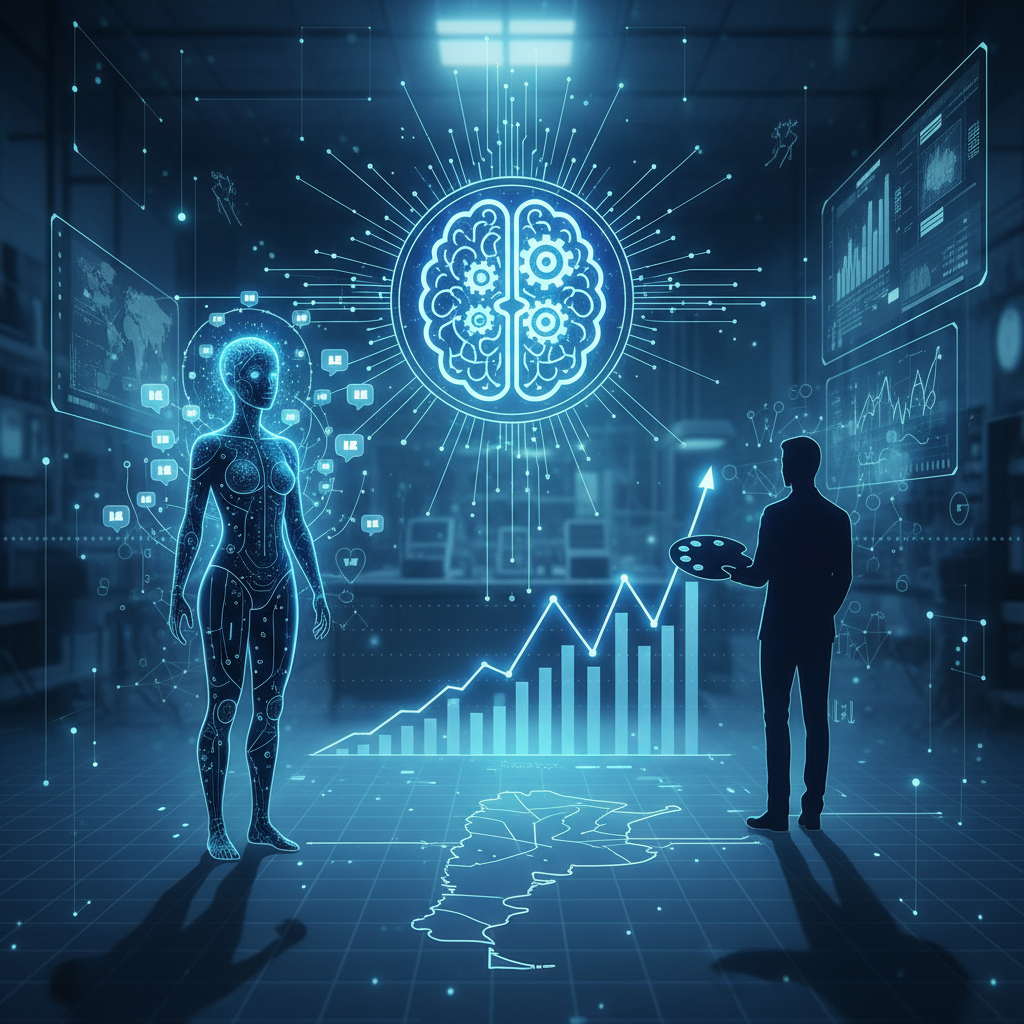
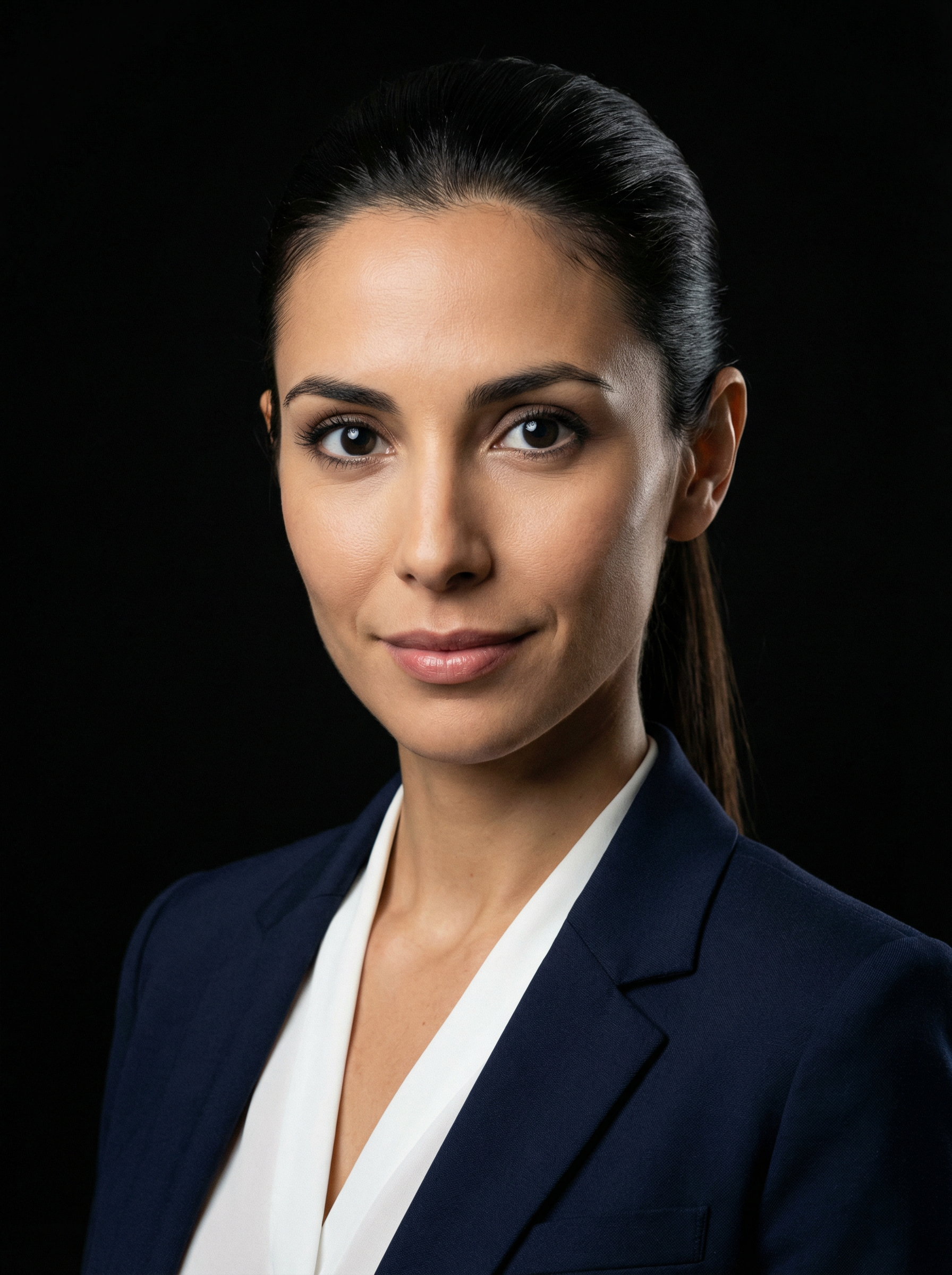
The digital landscape, ever-shifting like the Argentine peso, has introduced a new phenomenon that demands our rigorous attention: the AI influencer. These virtual personalities, crafted from pixels and algorithms, are not merely digital avatars but fully realized personas commanding millions of followers and significant brand deals. This development, which feels both futuristic and unsettlingly present, raises profound questions about authenticity, economic value, and the very nature of influence itself. From Buenos Aires, where the tango of tradition and innovation plays out daily, we must ask: what does this algorithmic allure truly mean for our creative industries and our understanding of celebrity?
Let's look at the evidence. Recent research from institutions like the University of Southern California's Institute for Creative Technologies and Meta AI has illuminated the sophisticated technical underpinnings of these virtual entities. While not a single, groundbreaking paper, the collective advancement in generative adversarial networks (GANs), large language models (LLMs), and neural rendering has converged to create what we now perceive as AI influencers. Researchers have been exploring the uncanny valley for years, but the latest iterations of these models, particularly those leveraging diffusion techniques and advanced facial synthesis, have moved beyond mere novelty. They are now capable of generating hyperrealistic images and videos, complete with nuanced expressions and fluid movements, that are increasingly indistinguishable from human content.
One significant area of progress comes from the work on synthetic media generation. Projects like StyleGAN, initially developed by NVIDIA, have demonstrated remarkable capabilities in creating photorealistic human faces that do not correspond to any real person. Subsequent iterations and related research, often published on platforms like arXiv.org, have refined these techniques, allowing for greater control over age, ethnicity, emotion, and even specific stylistic attributes. This is no longer just about generating a static image; it is about creating a dynamic, consistent persona that can 'live' across various social media platforms.
Why does this matter? For one, the economic implications are staggering. These virtual celebrities do not demand salaries, do not have personal scandals, and can be scaled infinitely. Brands, always seeking efficiency and reach, are increasingly turning to them. Consider the reported multi million dollar advertising revenues generated by some of the most popular AI influencers globally. While exact figures are often proprietary, industry analysts estimate that the market for virtual influencers could reach hundreds of millions of dollars annually, with projections suggesting continued rapid growth. This shift fundamentally alters the landscape for human content creators, particularly in regions like South America where economic precarity is a constant companion. The Argentine perspective is more nuanced here; our artists and creators often rely on their unique human touch, their sabor, to connect with audiences. Can an algorithm replicate that?
The technical details, while complex, are becoming more accessible. At its core, the creation of an AI influencer involves several interconnected AI technologies. First, a robust generative model, often a variant of a GAN or a diffusion model, is trained on vast datasets of human images, videos, and text. This training allows the model to learn the statistical distributions of human appearance, speech patterns, and even stylistic choices. Second, natural language processing (NLP) models, similar to those powering OpenAI's GPT series or Google's Gemini, are used to generate captions, engage in comments, and even simulate conversations. These models are fine-tuned to adopt a specific persona, complete with unique vocabulary and tone. Third, neural rendering techniques are employed to animate these static creations, giving them lifelike movement and expressions for video content. This involves mapping generated faces onto 3D models and animating them using motion capture data or synthesized motion from other AI models. The result is a seamless digital entity that can post, interact, and even 'live stream' with compelling realism.
Who is doing this research? Beyond corporate giants like Meta AI and NVIDIA, academic institutions are crucial. Researchers at Stanford University, MIT, and Carnegie Mellon University, among others, are continually pushing the boundaries of generative AI, synthetic media, and human computer interaction. For instance, the work of Professor Hany Farid at the University of California, Berkeley, on digital forensics and media authenticity, while focused on detection, indirectly highlights the sophistication of current generative capabilities. His research underscores the increasing difficulty in distinguishing between real and synthetic media, a challenge that is central to the AI influencer phenomenon. The ethical frameworks being developed by organizations like the Partnership on AI also grapple with the implications of such advanced synthetic content.
The implications and next steps are multifaceted. For Argentina, a nation with a rich history of artistic expression and a dynamic digital economy, the rise of AI influencers presents both a threat and an opportunity. On one hand, the commodification of personality through algorithms could further devalue human creativity, making it harder for our local artists, actors, and models to compete in a globalized market. The economic instability that often characterizes our region means that any new technology that displaces human labor must be viewed with a critical eye. Buenos Aires has questions Silicon Valley can't answer about how these technologies will impact societies with different economic realities and cultural values.
On the other hand, these tools could empower a new generation of creators. Imagine an Argentine artist using these advanced generative models to create unique digital characters for storytelling, fashion, or even political commentary, bypassing traditional gatekeepers. The democratization of high-quality content creation, while fraught with ethical dilemmas, could open new avenues for expression and economic participation. However, this requires significant investment in digital literacy and infrastructure, areas where Argentina, despite its intellectual capital, still faces considerable challenges.
Regulation will also be critical. As these AI entities become more pervasive, questions of transparency, ownership, and accountability will intensify. Should AI influencers be legally required to disclose their artificial nature? Who is liable when an AI influencer promotes harmful content or engages in deceptive practices? These are not trivial concerns; they strike at the heart of consumer trust and digital ethics. The European Union's AI Act, for example, is beginning to address some of these issues, but a global, coordinated effort will be necessary to navigate this complex terrain.
Ultimately, the rise of AI influencers is a testament to the breathtaking pace of technological progress. Yet, as we marvel at their photorealistic perfection and their algorithmic charm, we must remain vigilant. The true measure of innovation is not merely what it can create, but how it serves humanity, particularly in a world where economic disparities are stark and the value of human connection is paramount. We must ensure that this new wave of digital celebrity does not further erode the authentic voices that define our culture and our communities. The dance between human and machine is just beginning, and we must ensure that humanity leads. For further analysis on the broader implications of AI in creative industries, one might consult Wired's AI coverage. The conversation is far from over, and the stakes, for our societies and our economies, could not be higher.