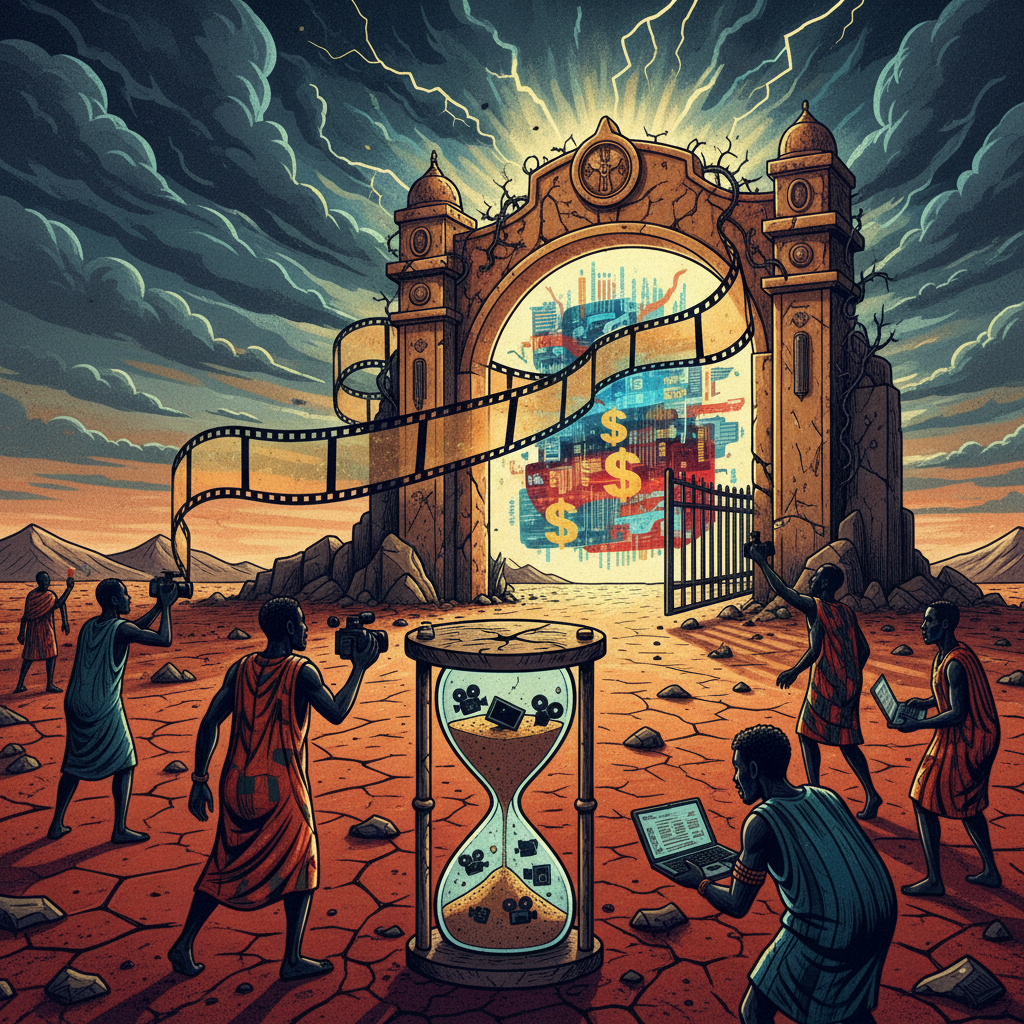
The buzz in Hollywood around AI video generation is deafening. Companies like Runway ML are at the forefront, promising to revolutionize filmmaking, making the impossible achievable with a few prompts and clicks. From pre-visualization to special effects, the narrative is one of boundless creativity and unprecedented efficiency. But from my vantage point here in Accra, I hear a different tune, one that echoes with concern for the future of African storytelling and the livelihoods of our burgeoning creative industries.
This isn't just about Hollywood's next big thing. This affects every single one of us, especially those of us in regions often overlooked in the grand technological narratives. When I see the excitement surrounding Runway ML's capabilities, I can't help but think of the Akan proverb, “Se woamma wo nsa anka aduane a, wonnyaa nkwa” which means, “If you do not get to touch the food, you will not live.” If we are not part of shaping this technology, if we are merely consumers or, worse, rendered irrelevant by it, what future awaits our creative spirit?
Let us break down the risk scenario. Runway ML and its ilk are powerful generative AI tools that can create realistic video footage from text descriptions, images, or even other video clips. They learn from vast datasets of existing visual content, essentially distilling the aesthetics, styles, and conventions of cinema. For Hollywood, this means potentially slashing production costs, accelerating timelines, and enabling visual feats once confined to multi-million dollar budgets. Imagine a director needing a specific shot of a bustling market in Kumasi, Ghana. Instead of flying a crew, securing permits, and hiring local talent, they could theoretically generate it with AI.
Technically, these systems operate on complex neural network architectures, often variants of diffusion models or transformer networks. They are trained on immense quantities of video data, learning the intricate patterns of motion, lighting, texture, and composition. When a user inputs a prompt, the AI synthesizes new video frames by iteratively refining random noise until it matches the description. The sophistication is astounding, improving at a pace that frankly, leaves many breathless. According to reports, the quality of AI-generated video has advanced exponentially in just the last two years, moving from abstract blurs to photorealistic scenes. You can see the rapid progress documented on platforms like TechCrunch regularly.
Now, let us consider the expert debate. On one side, proponents argue that these tools democratize filmmaking. They say it empowers independent creators, reduces barriers to entry, and allows for more diverse voices to tell their stories without the traditional gatekeepers of capital. Sam Altman, CEO of OpenAI, has often spoken about AI's potential to empower individuals, and while Runway ML is not an OpenAI product, the sentiment aligns with the broader vision of generative AI. “These tools are not here to replace human creativity, but to augment it,” stated Dr. Joy Buolamwini, founder of the Algorithmic Justice League, in a recent interview, emphasizing the need for ethical guardrails and inclusive development. Her words resonate deeply with me. It is not about if we use AI, but how and for whom.
However, a growing chorus of critics raises serious alarms. The primary concern is job displacement. Think of the cinematographers, the set designers, the costume artists, the visual effects specialists, the location scouts, the actors, and even the extras who make up the backbone of the film industry. If AI can generate these elements, what becomes of their livelihoods? This is a question that hits particularly hard in economies like Ghana's, where the creative sector is a vital source of employment and cultural expression. Our film industry, though still growing, provides thousands of jobs, from the caterers on set to the sound engineers in post-production. What happens when a significant portion of that work can be done by a machine in California?
Furthermore, there is the insidious risk of cultural homogenization and appropriation. If AI models are primarily trained on Western datasets, as many currently are, what does that mean for the authentic representation of Ghanaian life, culture, and aesthetics? Will AI-generated videos of Ghana perpetuate stereotypes, or worse, erase the nuances of our reality, replacing them with algorithmically derived approximations? “The datasets are the DNA of these models,” remarked Dr. Timnit Gebru, a prominent AI ethics researcher, during a recent panel discussion. “If the DNA is biased, the output will be biased, and it will reinforce existing power structures.” This is not merely an academic point; it is a matter of cultural survival. We have seen how easily narratives can be distorted when they are not told by those who live them. Silence is complicity when our stories are at stake.
The real-world implications for Ghana are profound. Our nascent film industry, often struggling for resources, could find itself competing with a global content machine that operates at a fraction of the cost. Local talent may be sidelined, not because of a lack of skill, but because AI offers a cheaper, faster alternative. This could stifle innovation, discourage investment in local productions, and ultimately lead to a brain drain as our most talented creatives seek opportunities elsewhere. We risk becoming mere consumers of content generated elsewhere, rather than vibrant producers of our own unique stories. The vibrant storytelling tradition we cherish, passed down through generations, could be diluted.
Consider the economic impact. If a significant portion of video production moves to AI, the demand for physical locations, local crews, and traditional services will plummet. This is not just about a few high-profile jobs; it is about the entire ecosystem that supports filmmaking. From the small businesses that supply props to the drivers who transport equipment, a ripple effect could devastate communities that rely on this sector.
So, what should be done? This is where our collective responsibility comes into sharp focus. First, we must advocate for inclusive AI development. This means pushing for datasets that are culturally diverse and representative of global realities, not just a narrow slice of Western media. It means supporting initiatives that train African AI developers and artists to build and wield these tools, ensuring our voices are present at the creation stage. The African Union, through its various initiatives, must prioritize AI literacy and infrastructure development across the continent, ensuring that countries like Ghana are not left behind. We need to build our own capacity, not just import solutions.
Second, we must explore policy and regulatory frameworks that protect human creativity and labor. This could involve discussions around intellectual property rights for AI-generated content, ensuring fair compensation for artists whose work is used to train these models, and even exploring universal basic income or retraining programs for those displaced by automation. The European Union's AI Act, while not perfect, offers a starting point for thinking about comprehensive regulation. We need similar, context-specific frameworks here in Africa. Just as we protect our traditional intellectual property, we must protect our digital creative output.
Third, and perhaps most importantly, we must actively champion and invest in our local creative industries. This means providing funding, training, and platforms for Ghanaian filmmakers, animators, and storytellers to thrive. It means using AI as a tool to enhance our unique narratives, not to replace them. Imagine AI being used to translate films into every local language, making our stories accessible to more people, or to create stunning visual effects that enhance our traditional folklore without erasing its essence. This is the kind of thoughtful integration we should strive for. We must ensure that our cultural heritage, our adinkra symbols, our oral traditions, and our vibrant music are not just data points for algorithms, but living, breathing inspirations for new forms of expression.
The rise of AI video generation is inevitable. But its impact on Ghana, and indeed on Africa, is not predetermined. We have a choice: to be passive recipients of a technology shaped by others, or to actively engage, to demand equity, and to ensure that this powerful tool serves humanity in all its diversity. Our future, our stories, depend on it. This is not just a technological challenge; it is a cultural imperative. We must rise to meet it, with conviction and with a clear vision for a future where technology amplifies, rather than diminishes, our collective human spirit. The time for silence is over. The time for action is now. For more insights on the broader implications of AI, I often consult Wired for their thoughtful analyses.