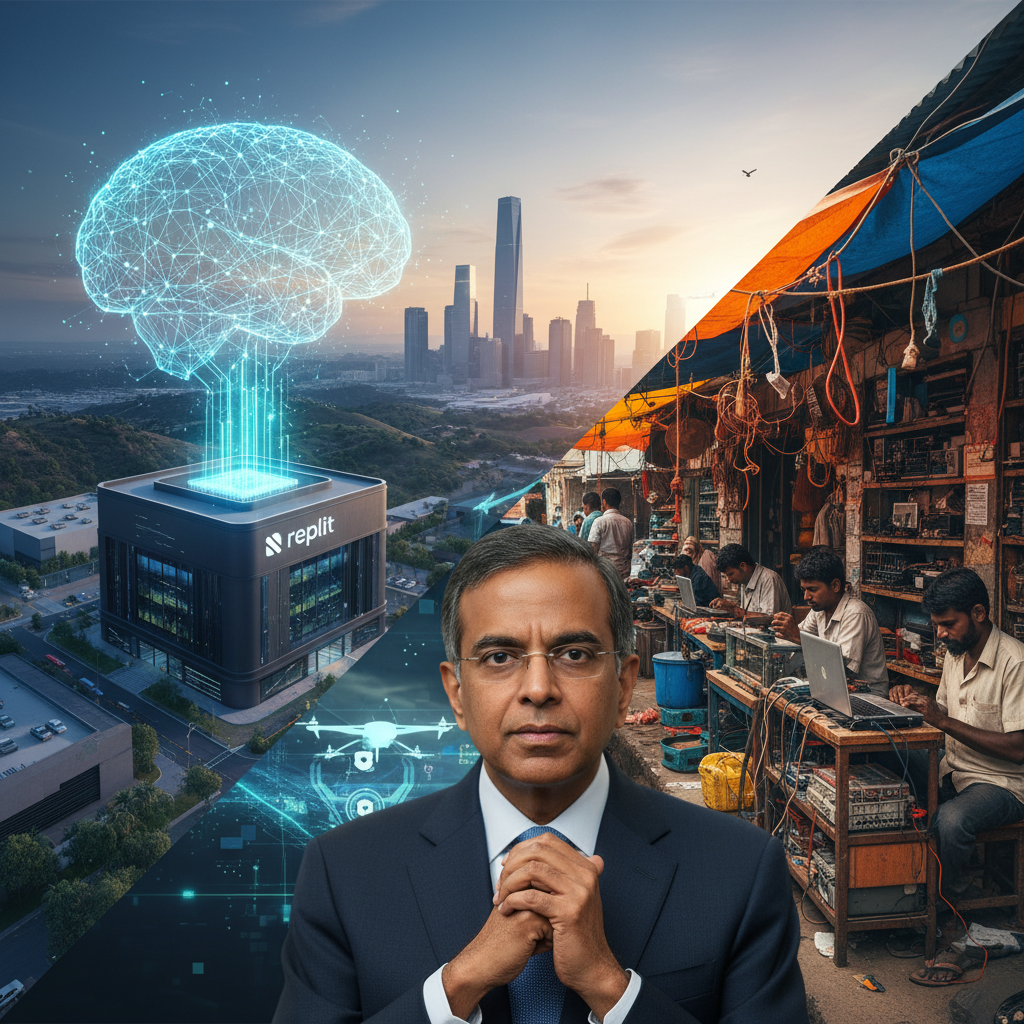

Ah, Replit. Remember Replit? For years, it was that charming little online sandbox where budding coders, students, and even grizzled veterans would quickly spin up a Python script or a JavaScript snippet. A digital playground, really. It was simple, effective, and frankly, a bit quaint in the grand, bombastic scheme of Silicon Valley's 'disrupt or die' mantra. But now, my friends, Replit has decided to grow up, or perhaps, to wear a very expensive AI-powered suit and pretend it always knew how to code itself.
Their recent, rather dramatic, pivot from a mere coding environment to an 'AI-powered software development platform' has certainly raised eyebrows, mine included. It is not just an upgrade; it is a full-blown identity crisis, complete with a shiny new AI assistant named Ghostwriter and a promise to make coding accessible to everyone. File this under 'things that make you go hmm' because, while the marketing is slick, the underlying premise feels suspiciously familiar to anyone who has watched the Indian tech scene evolve over the last few decades.
Let us be clear, the ambition is commendable. Replit wants to turn natural language into working code, automate debugging, and essentially make software development as easy as chatting with a very smart friend. They have secured significant funding rounds, with whispers of valuations soaring past the billion-dollar mark. This is not small potatoes. They are positioning themselves as a direct competitor to traditional Integrated Development Environments or IDEs, and even to the burgeoning field of AI-assisted coding tools from giants like Microsoft's GitHub Copilot, which, let us not forget, is powered by OpenAI's GPT models. Microsoft's CEO, Satya Nadella, has been vocal about the transformative power of AI in developer tools, and Replit is certainly trying to ride that wave, perhaps even trying to outmaneuver it.
But here is where my cynical, yet deeply affectionate, Indian journalist heart starts to chuckle. Silicon Valley discovered what Kerala knew all along, not about AI specifically, but about the sheer ingenuity required to build robust software with limited resources and often, less than perfect tools. We have always been masters of 'jugaad' which is that uniquely Indian art of innovative improvisation, finding clever, often unconventional, solutions to complex problems. Our developers, for generations, have been writing code that is efficient, resilient, and often, surprisingly elegant, not because they had the fanciest AI assistants, but because they had sharp minds and a knack for problem-solving.
Replit's new direction, while couched in the language of cutting-edge AI, feels like an attempt to productize that very human ingenuity. They are saying, 'Hey, we will give you a digital assistant that thinks like a seasoned Indian developer.' Oh, the irony. They are building tools to automate the very cognitive processes that have been honed over decades in places like Bengaluru and Hyderabad. It is like selling a machine that can perfectly replicate a grandmother's secret spice blend; it might be efficient, but it misses the soul.
Consider the impact on the global developer landscape, particularly in India. India is home to one of the largest and most vibrant developer communities in the world. Our tech talent pool is immense, estimated to be over 5.8 million developers, and growing rapidly. Companies like Tata Consultancy Services and Infosys have built empires on the back of this talent. When a platform like Replit promises to democratize coding, it sounds wonderful on paper. But what does it truly mean for the millions who have invested years in mastering the craft? Will it empower them to build faster, or will it devalue the very skills they have painstakingly acquired?
"The promise of AI in coding is undeniable," says Dr. Ananya Sharma, a lead AI researcher at the Indian Institute of Technology Bombay. "It can certainly accelerate development cycles and reduce boilerplate code. However, the real value of a human developer lies in understanding complex requirements, architectural design, and creative problem-solving, not just syntax generation. We must ensure these tools augment, rather than replace, critical thinking." Her point resonates deeply. AI can write a function, but can it truly grasp the nuanced cultural context of an application meant for a rural Indian village? I doubt it.
Replit's strategy also involves a heavy emphasis on community and collaboration, allowing developers to share and remix projects. This, again, is not new. Open-source communities, many with significant Indian contributions, have thrived on this model for decades. GitHub, now owned by Microsoft, is a testament to the power of collaborative coding. Replit is essentially adding an AI layer to an already established collaborative paradigm. It is a smart move, but hardly revolutionary in its social engineering.
"The shift is less about pure innovation and more about market capture," explains Rajesh Kumar, a veteran software architect based in Chennai, who has worked with multinational corporations for over two decades. "They see the massive demand for software and the limited supply of top-tier developers. AI is their answer to scale. But the quality, the security, the maintainability of AI-generated code, that is still a huge question mark. We have seen enough 'quick fixes' in this industry to be wary." Kumar's skepticism is well-founded. The tech world is littered with solutions that promised the moon but delivered only a crater.
Indeed, the security implications alone are staggering. If AI is generating large swathes of code, how do we ensure it is free from vulnerabilities, biases, or even malicious injections? The supply chain for software could become even more opaque, a nightmare for cybersecurity experts. This is especially pertinent in a world grappling with increasing cyber threats, where even a tiny flaw can have catastrophic consequences for national infrastructure or personal data.
Replit's pivot also highlights a broader trend: the relentless pursuit of 'developer productivity' by tech giants. Google, with its Gemini models, and OpenAI, with its advanced GPT series, are all pushing the boundaries of what AI can do in code generation and analysis. NVIDIA is providing the computational backbone for much of this AI boom. The race is on to create the ultimate digital co-pilot, and Replit is simply trying to carve out its niche in this increasingly crowded space. They are betting that their integrated environment will offer a more seamless experience than stitching together various AI tools.
However, the question remains: is this truly about empowering more people to code, or is it about making the existing coding workforce more 'efficient' at the cost of genuine understanding and skill development? Will the next generation of Indian developers become mere prompt engineers, or will they still be encouraged to delve into the intricate logic that underpins their creations? My fear is that we are creating a generation of coders who can build, but do not truly comprehend, much like a driver who can operate a car but has no idea how the engine works.
According to TechCrunch, investments in AI-powered developer tools have skyrocketed by over 300% in the last two years. This indicates a massive belief in this market segment. Yet, the human element, the creativity, the nuanced understanding that comes from years of wrestling with stubborn bugs and elegant solutions, that is not easily quantifiable by venture capitalists or replicable by algorithms. Replit's journey will be fascinating to watch, but I for one, will be keeping a keen eye on whether it truly elevates the craft of software development, or merely automates away its soul. We have seen enough technological promises in India to know that the devil is always in the details, and often, in the implementation.
Ultimately, Replit's bold move is a testament to the irresistible pull of AI in every facet of technology. It is a strategic play in a high-stakes game, aiming to capture a significant share of the developer tools market. But as they chase the dream of automated coding, they might just find that the most valuable asset in software development, human ingenuity, is something that cannot be fully commoditized or coded away. Perhaps, they should visit a bustling tech hub in Kerala; they might learn a thing or two about true innovation there. After all, we have been doing 'more with less' for ages, long before AI became the buzzword of the decade. We simply called it common sense, or perhaps, just good engineering. For more on the broader implications of AI in education, you might find this article interesting: When OpenAI's GPT Enters the Classroom: Is This a Cheating Crisis or the Dawn of a New Educational Era in Dubai? [blocked].