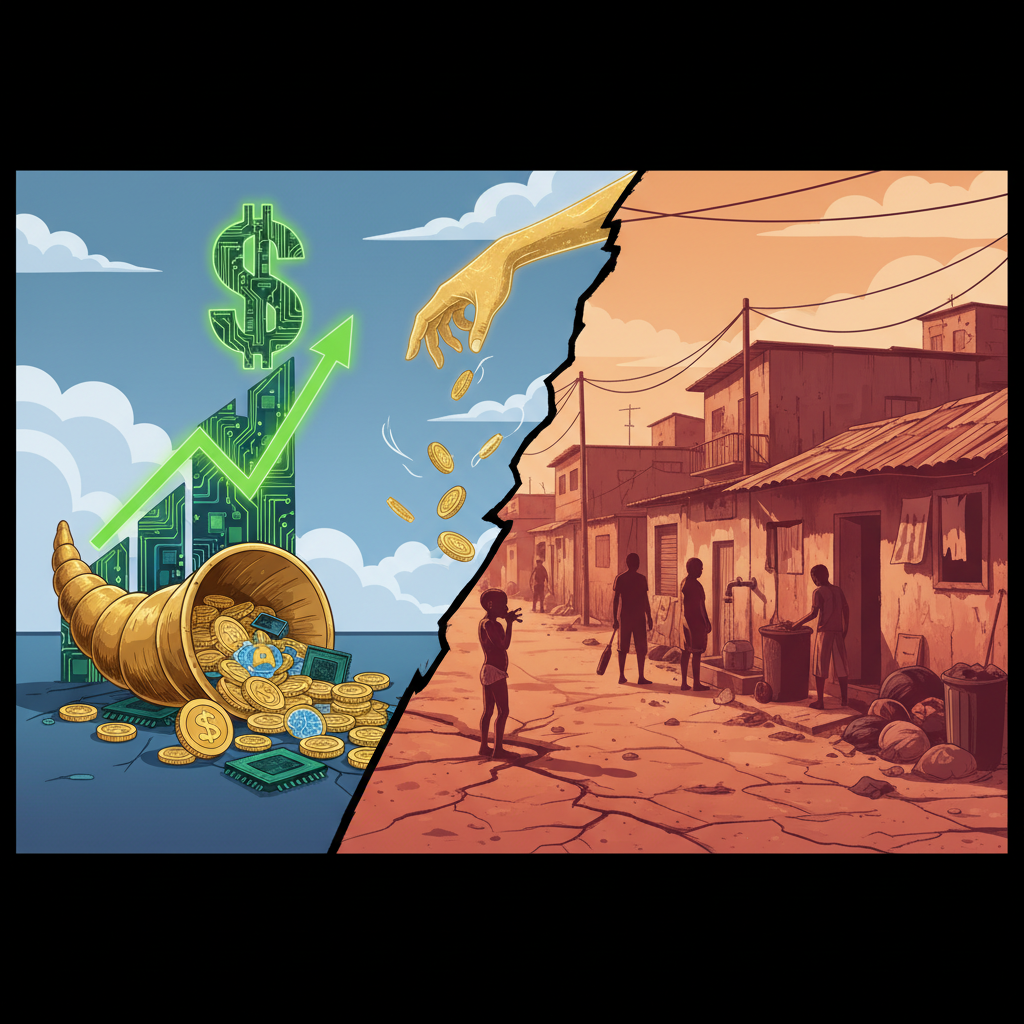
Let's be brutally honest for a moment. While the tech titans of Silicon Valley pop champagne corks over AI's latest breakthroughs and NVIDIA's stock price soars into the stratosphere, many of us are looking at the headlines with a bitter taste. They talk about a new era of prosperity, a technological renaissance. From where I sit in Caracas, it looks suspiciously like the same old story, just with shinier algorithms: the rich get richer, and everyone else is left scrambling for the crumbs. This isn't just an unpopular opinion from Caracas, it's a cold, hard truth.
The narrative spun by the likes of OpenAI and Google DeepMind is one of democratizing intelligence, of tools that empower everyone. But let's follow the money, shall we? The true beneficiaries of this AI boom are not the everyday workers whose jobs are being automated, nor the small businesses struggling to compete with AI-powered giants. No, the real winners are the venture capitalists who poured billions into these startups, the founders who are now household names, and the shareholders of companies like NVIDIA, whose specialized chips are the literal bedrock of this new digital empire. Jensen Huang, NVIDIA's CEO, has seen his company's valuation explode, reportedly surpassing the trillion dollar mark. This isn't an accident; it's a direct consequence of a system designed to concentrate wealth.
We are told AI will create new jobs, that it will free humanity from drudgery. Perhaps. But what kind of jobs? And for whom? The reality we are witnessing is a rapid displacement of existing labor, from customer service to content creation, without a clear, equitable path for those affected. A recent study, widely cited in publications like Reuters, suggested that a significant percentage of current jobs are at risk of automation. This isn't some distant future; it's happening now. The promise of retraining often falls flat, especially in economies like ours, where access to high-quality education and digital infrastructure is already a luxury, not a given.
And let's not forget the sheer cost of entry into this AI gold rush. Developing cutting-edge AI models requires immense computational power, vast datasets, and highly specialized talent. Who has that? Not the struggling entrepreneur in Maracaibo, not the small research lab in Mérida. It's the behemoths: Microsoft, with its deep pockets backing OpenAI; Google, pouring resources into Gemini; Meta, pushing its Llama models. These companies are not just developing technology; they are consolidating power, creating a new form of digital feudalism where access to the most powerful tools is controlled by a select few.
I hear the counterarguments, of course. They say, "Sebastiàn, you're being too pessimistic. Innovation always disrupts. It creates more than it destroys in the long run." They point to historical precedents, the Industrial Revolution, the internet boom. But those shifts, while disruptive, often led to a broader distribution of new opportunities, albeit imperfectly. This AI revolution feels different. The capital requirements are astronomical, the intellectual property is fiercely guarded, and the speed of change is dizzying. The gap between those who own the AI and those who are subject to its influence is widening at an alarming rate.
Consider the impact on Venezuela's tech diaspora. We have brilliant minds, engineers, data scientists, many of whom left the country out of necessity. Venezuela's tech diaspora is reshaping AI globally, contributing to these very innovations in places like Silicon Valley, Berlin, and Dubai. They are building the algorithms, training the models, and designing the systems that are generating this immense wealth. Yet, the benefits rarely trickle back in a meaningful way to the communities they left behind. Their talent enriches foreign corporations, while their home country grapples with the consequences of an increasingly unequal global technological landscape.
This isn't to say AI is inherently bad. The crisis created something unexpected here in Venezuela: a generation of incredibly resilient, resourceful individuals who can innovate with very little. I've seen startups here, despite all odds, using AI for things like optimizing scarce resources or improving local agriculture. But these are often small, localized efforts, dwarfed by the global capital flows that fuel the major players. The problem isn't the technology itself, but the economic structures it's being built upon and within.
As Professor Shoshana Zuboff of Harvard Business School has eloquently argued, we are moving towards a