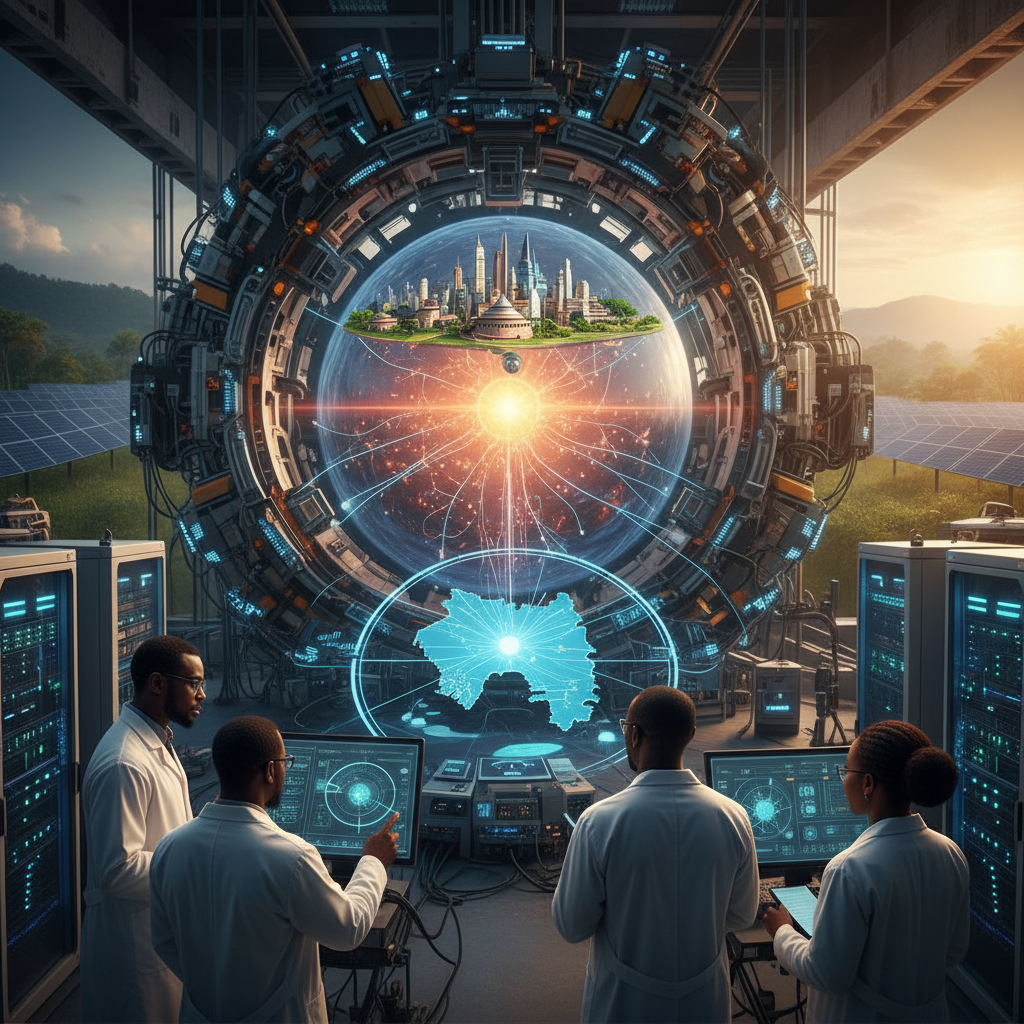
In the bustling markets of Conakry, where the rhythm of daily life is often dictated by the availability of reliable electricity, the concept of limitless, clean energy from nuclear fusion feels like a distant dream, almost a myth. Yet, in the gilded halls of Silicon Valley and the hallowed research institutions of the West, the pursuit of this dream has taken on a new, urgent dimension, powered by the relentless march of artificial intelligence. It is a narrative of profound scientific ambition, one that promises to redefine our energy future, but as a journalist from Guinea, I am compelled to ask: for whom, and at what cost?
The recent pronouncements from major players, notably NVIDIA, regarding their deep involvement in accelerating nuclear fusion research, have sent ripples through the scientific and financial communities. Jensen Huang, NVIDIA's CEO, has often spoken about the transformative power of accelerated computing and AI, and its application to fusion is perhaps the most audacious yet. The core challenge in fusion, as many understand, lies in containing a superheated plasma, hotter than the sun, for long enough to achieve a net energy gain. This is not merely a feat of engineering, it is a grand symphony of physics, materials science, and now, advanced computation.
Traditional methods of plasma control and reactor design have been iterative, painstaking, and often limited by the sheer complexity of the underlying physics. Enter AI. Researchers are now deploying sophisticated machine learning algorithms, particularly deep learning, to model plasma behavior, predict instabilities, and optimize magnetic confinement configurations in real time. The sheer volume of data generated by fusion experiments, such as those at the Joint European Torus (JET) or the Diii-d National Fusion Facility in the United States, is immense. This is precisely where AI, with its capacity to discern patterns and make predictions from complex datasets, is positioned as a game-changer.
One of the most compelling applications involves using AI to manage plasma disruptions, sudden losses of confinement that can damage reactor components. Google's DeepMind, for instance, in collaboration with the Swiss Plasma Center at Epfl, demonstrated in 2022 the use of deep reinforcement learning to control plasma in a tokamak, a donut-shaped fusion device. Their AI agent learned to manipulate magnetic coils to precisely shape and stabilize the plasma, a task previously requiring intricate, pre-programmed control sequences. This was a significant step, moving from reactive control to predictive, adaptive management. "The ability of AI to learn optimal control strategies from complex, dynamic systems like plasma is truly revolutionary," stated Dr. Federico Felici, a senior scientist at the Swiss Plasma Center, in a recent interview with Reuters. "It opens pathways to operating fusion devices closer to their theoretical limits."
NVIDIA's role is primarily in providing the computational backbone. Their powerful GPUs and Cuda platform are becoming indispensable for training the massive neural networks required for these AI models. Simulating plasma behavior, a task that once took months on supercomputers, can now be accelerated significantly, allowing for faster iteration in design and experimental planning. "We are seeing an exponential acceleration in fusion research, directly attributable to the advancements in AI and high-performance computing," remarked Dr. Ian Chapman, CEO of the UK Atomic Energy Authority, during a recent industry summit. "NVIDIA's hardware is enabling us to explore design spaces and operational parameters that were previously inaccessible."
But here's the catch: while the scientific breakthroughs are undeniable, the path from laboratory demonstration to commercial viability remains long and fraught with challenges. The International Thermonuclear Experimental Reactor (iter), under construction in France, is a testament to the global commitment to fusion, but it is also a monument to its immense cost and complexity, with an estimated budget exceeding 20 billion euros and a timeline stretching decades. Even with AI, the fundamental engineering hurdles of materials science, tritium fuel cycle management, and energy extraction are far from solved.
From my vantage point in Guinea, a nation rich in bauxite and gold, but still grappling with fundamental energy access, the narrative of AI-driven fusion feels both inspiring and distant. We have witnessed countless promises of technological salvation that have either bypassed us entirely or arrived with strings attached, often benefiting external powers more than the local populace. The idea that AI, developed in the global North, will unlock a limitless energy source that then democratizes power globally is appealing, but history teaches us caution.
The devil is in the details. Who owns the intellectual property for these AI algorithms and reactor designs? Will the energy, once generated, be affordable and accessible for developing nations, or will it be another commodity controlled by a powerful few? The capital investment required for fusion power plants is staggering, likely in the tens of billions of dollars per facility. For a country like Guinea, where the average annual income is still relatively low, such projects are beyond our current economic reach without significant international partnership, and even then, the terms of such partnerships are critical.
Moreover, the environmental footprint of AI itself, particularly the energy consumption of training large models and running massive data centers, is a growing concern. While fusion promises clean energy, the computational infrastructure enabling its development is not without its own demands. According to MIT Technology Review, the energy cost of training some of the largest AI models can be equivalent to the lifetime carbon emissions of several cars. This paradox must be addressed.
My investigation reveals a pattern: the most significant advancements in AI for fusion are concentrated in well-funded institutions and corporations in North America, Europe, and parts of Asia. While the scientific community is collaborative, the economic and strategic implications of fusion energy mean that the benefits, initially at least, will likely accrue to those who can afford to build and operate these sophisticated facilities. For Guinea, and indeed much of Africa, the immediate priority remains reliable, affordable energy from existing, proven technologies, coupled with sustainable development. The promise of fusion, while tantalizing, must not distract from the pressing need for pragmatic energy solutions today.
Consider the example of our own energy struggles. The Kaleta hydroelectric dam, a source of national pride, has significantly improved electricity access, but it is still not enough. We understand the power of large-scale infrastructure. However, the path to energy independence for Guinea might look less like a multi-billion dollar fusion reactor and more like decentralized solar grids, micro-hydro projects, and efficient distribution networks, perhaps optimized by simpler, locally developed AI applications. The focus must be on solutions that empower our communities, not just on grand scientific endeavors whose benefits may take generations to trickle down, if they do at all.
While I applaud the scientific ingenuity driving AI in nuclear fusion, I remain a skeptic regarding its immediate, equitable impact on nations like Guinea. The real challenge is not just to harness the power of the sun on Earth, but to ensure that this monumental achievement serves all of humanity, not just the privileged few. Without a concerted effort to democratize access, knowledge, and the economic benefits of fusion, this technological marvel risks becoming another chapter in the long history of unequal development. The energy future of Guinea, and indeed the world, demands not just innovation, but also justice and foresight. We must ensure that the light of fusion, when it finally shines, illuminates every corner of the globe, including the vibrant, often overlooked, streets of Conakry.