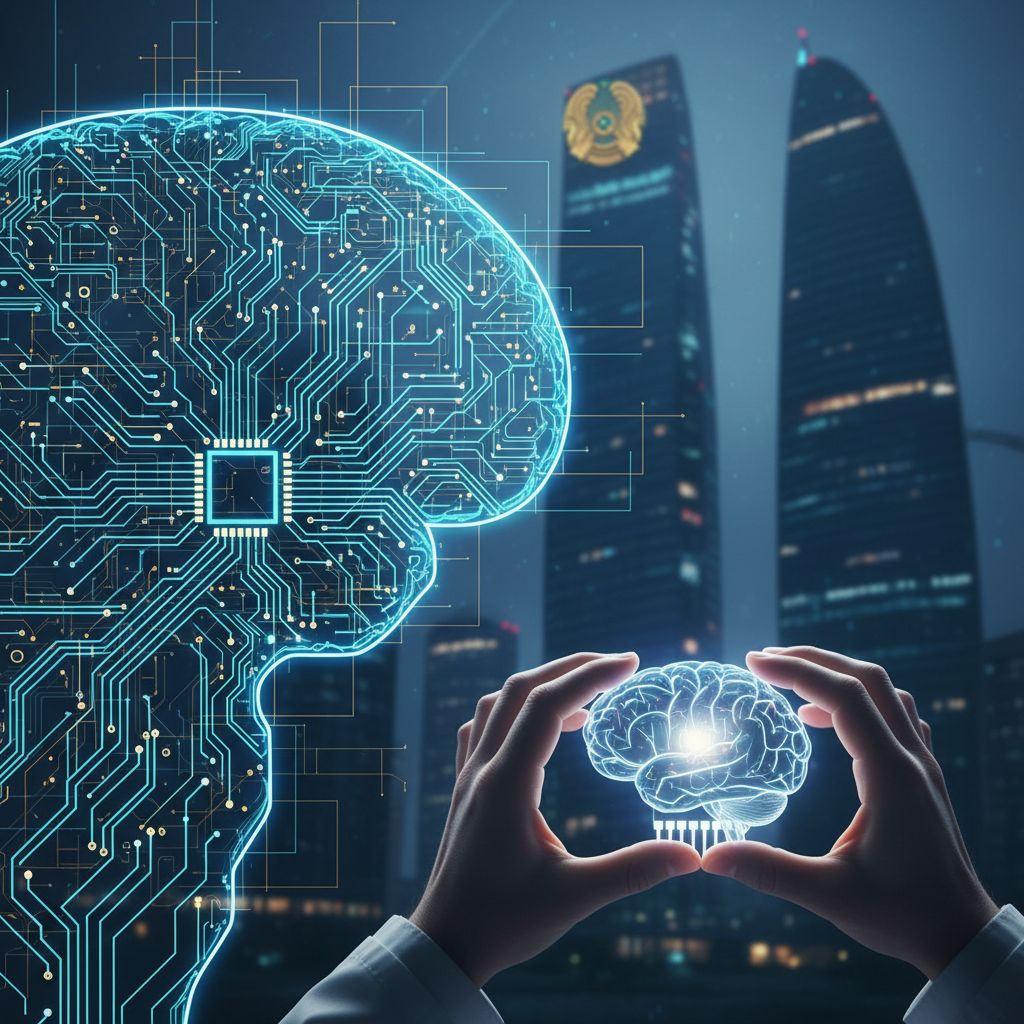

The relentless pursuit of artificial intelligence has pushed the boundaries of conventional computing to their limits. For decades, the digital world has operated on the von Neumann architecture, a system where processing and memory are distinct, leading to a constant, energy intensive data transfer bottleneck. This fundamental design, however efficient for general purpose tasks, struggles to emulate the human brain's remarkable parallel processing and energy efficiency. It is here, in this chasm between silicon and synapse, that neuromorphic computing emerges as a compelling, albeit complex, paradigm shift.
My investigation reveals that this technology, which seeks to mimic the brain's architecture, is not merely an academic curiosity. It represents a strategic frontier in the global AI race, with profound implications for data processing, surveillance capabilities, and even the future of resource extraction, a domain of particular interest in my homeland, Kazakhstan.
The Big Picture: Beyond Bits and Bytes
At its core, neuromorphic computing aims to build chips that function more like biological brains. Instead of separating computation from memory, neuromorphic chips integrate them, allowing for highly parallel, event driven processing. Imagine a vast network of interconnected neurons, each capable of simple computation and memory storage, communicating only when necessary. This contrasts sharply with the traditional CPU, which sequentially fetches instructions and data from memory, processes them, and then stores results, a cycle repeated billions of times per second. The promise of neuromorphic systems lies in their potential to achieve unprecedented energy efficiency and real time learning capabilities, particularly for tasks involving pattern recognition, sensory data processing, and complex decision making.
Major players like Intel, with its Loihi research chips, and IBM, with TrueNorth, have been at the forefront of this research for years. More recently, NVIDIA, a company synonymous with GPU dominance in AI, has also intensified its efforts, recognizing the long term strategic value of brain inspired architectures for future AI workloads. The money trail leads to significant investments in specialized research divisions and partnerships with academic institutions globally.
The Building Blocks: Neurons, Synapses, and Spikes
To understand how neuromorphic computing works, we must first grasp its fundamental components, which draw inspiration directly from neurobiology:
- Spiking Neurons: Unlike artificial neurons in traditional neural networks that output continuous values, neuromorphic neurons are 'spiking neurons.' They remain largely inactive until the sum of their incoming signals crosses a certain threshold, at which point they 'fire' an electrical pulse, or 'spike.' This event driven communication is incredibly energy efficient, as neurons only consume power when actively processing or transmitting information.
- Synapses: These are the connections between neurons. In neuromorphic chips, synapses are often implemented as memory elements that store a 'weight' or 'strength' of connection. Crucially, these synapses can adapt and change their strength over time, a process known as 'plasticity,' directly analogous to how biological brains learn and form memories.
- Network Architecture: Instead of a fixed, layered structure, neuromorphic chips often feature highly interconnected networks, allowing for complex, non linear data flow and parallel processing. This mimics the dense, intricate web of neurons in the brain.
Dr. Dharmendra Modha, Chief Scientist for Brain Inspired Computing at IBM, once articulated the vision, stating, "We want to build a computer that can learn, remember, and process information in a way that is fundamentally different from today's computers." This ambition drives the engineering challenges behind these innovative architectures.
Step by Step: How a Neuromorphic Chip Processes Information
Let us consider a simplified example of a neuromorphic chip processing a stream of sensory data, such as audio:
- Input Encoding: Raw audio signals are converted into a series of electrical spikes. Louder sounds or specific frequencies might trigger more frequent spikes, or spikes from particular input neurons.
- Spike Propagation: These input spikes travel across the network of artificial neurons and synapses. Each synapse modifies the strength of the signal it transmits, based on its current 'weight.'
- Neuronal Firing: If a neuron receives enough incoming spikes within a short timeframe, exceeding its threshold, it 'fires' its own spike. This spike then propagates to other connected neurons.
- Learning and Adaptation (Plasticity): As spikes travel through the network, the synaptic weights are adjusted. A common learning rule, Spike Timing Dependent Plasticity (stdp), strengthens connections between neurons that fire in close temporal proximity, mimicking how our brains reinforce useful pathways. This allows the chip to learn patterns from the incoming data without explicit programming.
- Output Interpretation: The pattern of spikes emerging from the output layer of neurons can be interpreted as a classification, a prediction, or a control signal. For instance, a specific pattern of output spikes might indicate the presence of a particular word in the audio stream.
This continuous cycle of spiking, learning, and adaptation allows neuromorphic systems to process information dynamically and efficiently, much like a living organism. It is a stark contrast to the rigid, clock driven operations of traditional processors.
A Worked Example: Real Time Anomaly Detection
Consider a neuromorphic chip deployed in an industrial setting, monitoring the vibrations of a crucial piece of machinery. Traditional systems would sample vibration data at regular intervals, send it to a central processor, and then run algorithms to detect anomalies. This involves significant data transfer and processing overhead.
A neuromorphic chip, however, could be placed directly on the machinery. Its input neurons would receive vibration data, encoded as spikes. The network would be trained on 'normal' vibration patterns. When the machinery operates normally, the network processes these familiar patterns with minimal energy consumption. If an unusual vibration pattern emerges, the neuromorphic network, through its learned synaptic weights and spiking behavior, would quickly identify this deviation as an anomaly. The energy efficient, event driven nature of the chip means it can operate continuously, consuming very little power, and only trigger an alert when a significant, learned anomaly is detected, doing so in real time at the edge.
This capability is particularly attractive for applications requiring continuous monitoring and rapid response, such as predictive maintenance in Kazakhstan's vast industrial infrastructure, from oil and gas pipelines to mining operations. The ability to process data locally, without constant communication with a cloud server, also offers significant security and privacy advantages.
Why It Sometimes Fails: Limitations and Edge Cases
Despite its promise, neuromorphic computing is not a panacea. Several limitations currently hinder its widespread adoption:
- Programming Complexity: Developing algorithms for spiking neural networks is significantly more challenging than for traditional deep learning models. The event driven nature requires a rethinking of how problems are framed and solved.
- Hardware Maturity: Neuromorphic chips are still largely in the research and development phase. Manufacturing at scale, ensuring reliability, and standardizing interfaces remain significant hurdles. Intel's Loihi, for example, is primarily a research platform.
- General Purpose vs. Specialized: While excellent for specific tasks like pattern recognition and real time learning, neuromorphic chips are not yet suitable for general purpose computation that requires high precision and sequential processing, such as complex mathematical simulations or database management.
- Lack of Standardized Software Ecosystem: The absence of widely adopted programming frameworks and tools, akin to TensorFlow or PyTorch for traditional AI, slows down development and adoption.
As Professor H. Sebastian Seung of Princeton University, a leading researcher in computational neuroscience, noted, "We are still in the very early stages of understanding how the brain computes, and translating that understanding into silicon is an even greater challenge." This candid assessment highlights the long road ahead.
Where This Is Heading: The Future of Cognitive AI
Despite the challenges, the trajectory of neuromorphic computing is clear: towards more autonomous, energy efficient, and context aware AI. Future improvements will likely focus on:
- Hybrid Architectures: Combining neuromorphic cores with traditional CPUs and GPUs to leverage the strengths of both, allowing for specialized processing alongside general purpose computation.
- Advanced Materials: Research into memristors and other novel materials that can more closely mimic biological synapses, offering even greater density and energy efficiency.
- Software Development: The creation of more intuitive programming models and tools will be crucial for unlocking the full potential of these chips.
- Edge AI and IoT: Neuromorphic chips are ideally suited for deployment in power constrained edge devices, enabling intelligent processing directly where data is generated, reducing latency and bandwidth requirements. This could revolutionize everything from smart sensors in agriculture to autonomous drones.
Kazakhstan's digital ambitions hide a complex reality. As a nation rich in natural resources, particularly rare earth minerals vital for advanced electronics, Kazakhstan finds itself at a crossroads. The development of sophisticated AI hardware, including neuromorphic chips, relies heavily on these materials. The strategic importance of these resources, coupled with the potential for neuromorphic technology to enhance everything from resource management to national security, means that our government and research institutions are keenly observing these developments. The quiet hum of these brain inspired processors could one day power the next generation of intelligent systems, shaping our digital future in ways we are only just beginning to comprehend. The race is on, and the stakes, particularly for nations navigating the complex currents of global technological power, are exceptionally high. For more on the broader implications of AI hardware, one might consider the discussions surrounding NVIDIA's role in the global AI landscape. The very fabric of our digital sovereignty may depend on understanding these intricate technological shifts.
The integration of neuromorphic principles into mainstream computing could redefine what is possible for artificial intelligence, moving us closer to systems that can learn and adapt with the fluidity of the human mind. This is not merely an incremental improvement, but a foundational shift, promising a future where AI is not just faster, but fundamentally smarter and more efficient. The journey from silicon to synapse is long, but the potential rewards are immense, particularly for nations like Kazakhstan seeking to carve out their own technological destiny. For a deeper dive into the research, MIT Technology Review frequently covers these advancements. We are witnessing the dawn of a new era in computing, one that promises to reshape our world in profound and unexpected ways. The implications for digital rights, surveillance, and economic power are still unfolding, and it is imperative that we understand the underlying technology driving these changes.