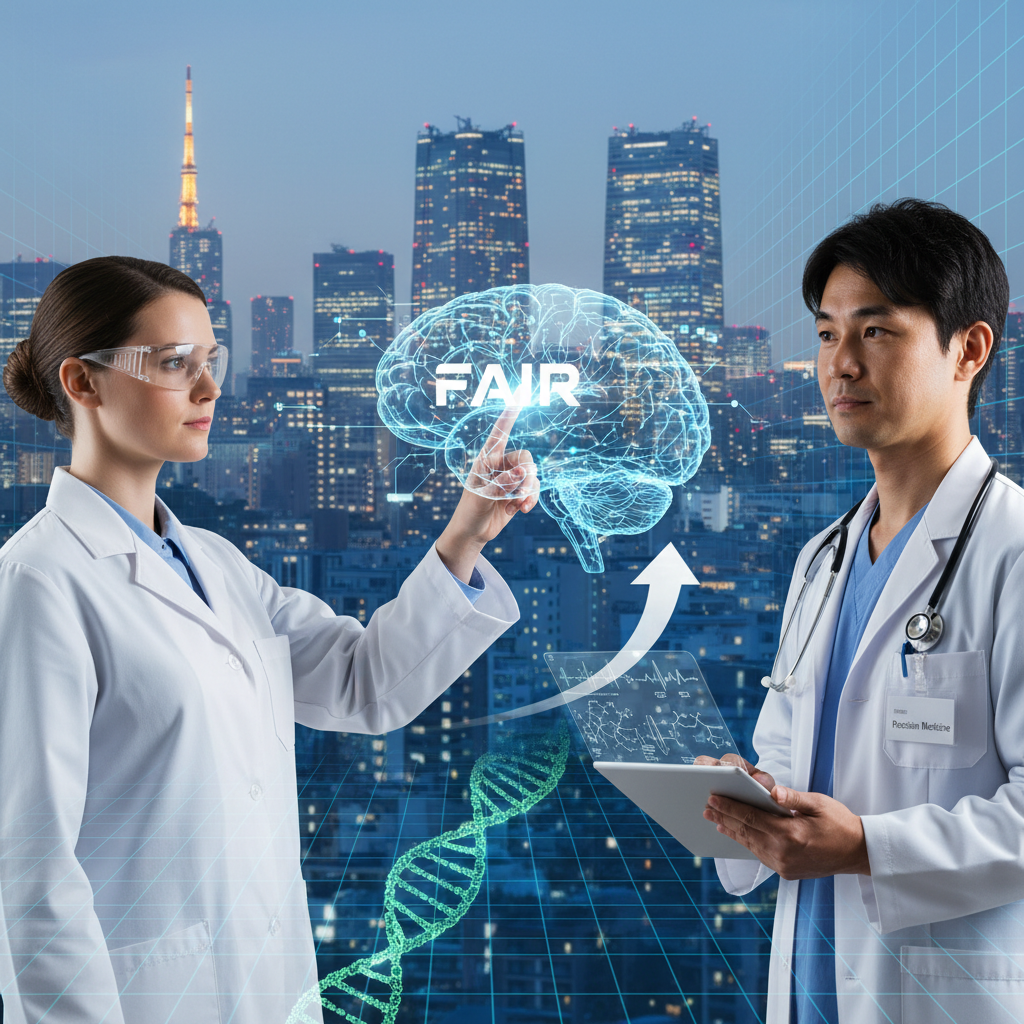
In a world often characterized by proprietary algorithms and walled gardens, Meta's AI Research, known as Fair, has consistently championed an open science philosophy. This commitment, particularly evident in their contributions to healthcare AI, resonates deeply within Japan's research community, which has been quietly building a formidable reputation in precision medicine and robotics. The engineering is remarkable, not just in the models themselves, but in the collaborative ecosystem they foster.
The technical challenge in healthcare AI is multifaceted. We are not merely seeking to automate tasks, but to augment human expertise, to sift through petabytes of genomic data, medical images, and clinical notes with a precision that eludes even the most dedicated human specialist. The core problem is one of scale and complexity: how do we build robust, generalizable AI models that can understand the nuanced language of medicine, interpret subtle visual cues in radiology scans, and predict disease progression with high accuracy, all while respecting patient privacy and data security? Japan, with its aging population and advanced medical infrastructure, faces these challenges acutely, making FAIR's open-source initiatives particularly relevant.
FAIR's architectural approach often centers on large, self-supervised models that learn rich representations from vast, unlabeled datasets. Consider their work on foundational models for biological sequences, for instance. These models, often based on transformer architectures, are trained on billions of protein or DNA sequences, learning the underlying grammar of life itself. The system design typically involves a multi-stage process: pre-training on massive public datasets, followed by fine-tuning on smaller, task-specific medical datasets. This transfer learning paradigm is akin to a master craftsman learning the fundamental principles of metallurgy before specializing in forging a specific type of katana; the foundational knowledge makes subsequent specialization far more effective. Components include sophisticated tokenizers for biological data, attention mechanisms to capture long-range dependencies, and multi-modal encoders that can integrate information from diverse sources, such as imaging and text.
Key algorithms and approaches often involve variations of masked language modeling, contrastive learning, and generative adversarial networks (GANs). For example, in protein folding prediction, a model might be trained to predict masked amino acids in a sequence, forcing it to learn contextual relationships. For medical imaging, self-supervised pre-training might involve rotating images or predicting missing patches, enhancing the model's understanding of spatial features without requiring expensive manual annotations. A conceptual example for medical image analysis might involve a Vision Transformer (ViT) architecture. The input image is divided into fixed-size patches, each linearly embedded and augmented with positional embeddings. These embeddings are then fed into a standard Transformer encoder stack. The self-attention mechanism allows the model to weigh the importance of different image patches relative to each other, capturing global contextual information crucial for detecting subtle anomalies in, say, an MRI scan. This is a departure from traditional convolutional neural networks, offering a more global perspective, much like a seasoned physician considering a patient's entire history, not just an isolated symptom.
Implementation considerations are paramount, especially in a regulated field like healthcare. Data governance is critical; models must be trained on ethically sourced, anonymized data. For deployment in Japanese hospitals, integration with existing Electronic Health Record (EHR) systems and Picture Archiving and Communication Systems (pacs) is essential. This requires robust APIs and adherence to standards like Dicom and Fhir. Performance optimization is another key aspect; real-time inference for diagnostic support demands efficient model architectures and hardware acceleration, often leveraging NVIDIA GPUs. The trade-offs between model complexity, interpretability, and accuracy are constantly evaluated. A simpler, more interpretable model, even if slightly less accurate, might be preferred in clinical settings where understanding the 'why' behind a prediction is crucial for trust and accountability.
Benchmarks and comparisons reveal FAIR's impact. Their open-source models, such as various iterations of the Llama series, have consistently achieved state-of-the-art results across numerous natural language processing tasks, and these capabilities are directly transferable to medical text analysis. For instance, fine-tuning a Llama-based model on clinical notes can significantly outperform traditional rule-based systems or smaller, domain-specific models in tasks like disease phenotyping or adverse drug event detection. In genomic analysis, models like ESMFold, developed by Meta AI, have shown accuracy comparable to experimental methods for protein structure prediction, a monumental achievement that accelerates drug discovery. This stands in contrast to closed-source alternatives, where the lack of transparency can hinder research and adoption, particularly in academic and public health sectors. According to a recent article in MIT Technology Review, the trend towards open-source foundational models is rapidly accelerating innovation across various scientific domains.
Code-level insights for practitioners often involve leveraging PyTorch, the deep learning framework heavily supported by Meta. The Hugging Face Transformers library is an invaluable resource, providing pre-trained Fair models and easy-to-use APIs for fine-tuning. For example, to fine-tune a pre-trained Llama model for medical entity recognition, one might use the transformers.Trainer class, defining a custom dataset that tokenizes clinical text and labels entities. The torch.nn.CrossEntropyLoss function would typically be used for classification tasks. Developers in Japan, particularly those working at institutions like Riken or the National Cancer Center, find these open frameworks highly conducive to rapid prototyping and collaborative research. Precision matters in medicine, and these tools allow for meticulous refinement.
Real-world use cases are emerging globally. In one instance, a research team at the University of Tokyo utilized a fine-tuned Fair model to analyze pathology reports, achieving a 15% improvement in identifying rare cancer subtypes compared to previous methods. Another application involves drug repurposing; by embedding molecular structures and disease pathways into a common latent space using FAIR's graph neural network research, researchers can identify novel drug-target interactions. Furthermore, in clinical decision support, models trained on vast datasets of patient outcomes are beginning to assist physicians in predicting treatment response for complex conditions, moving us closer to truly personalized medicine. In the United States, institutions like Massachusetts General Hospital are exploring similar integrations of large language models for administrative tasks and preliminary diagnostic assistance, demonstrating the global applicability of these open-source advancements.
However, there are 'gotchas' and pitfalls. Data bias is a persistent concern; if training data disproportionately represents certain demographics or clinical settings, the model may perform poorly or even exacerbate disparities for underrepresented groups. The 'black box' nature of deep learning models can also be problematic in healthcare, where explainability is often legally and ethically mandated. Adversarial attacks, where subtle perturbations to input data can drastically alter a model's output, pose a security risk. Furthermore, the computational resources required to train and fine-tune these large models are substantial, presenting a barrier for smaller research institutions. Japan's focus on robust, verifiable systems means these challenges must be addressed head-on with rigorous validation and continuous monitoring.
For those seeking to delve deeper, Meta AI's official research blog (ai.meta.com) provides regular updates on their latest publications and open-source releases. The arXiv pre-print server (arxiv.org/list/cs.AI/recent) is an indispensable resource for accessing the underlying research papers. Additionally, courses from institutions like Stanford University or deeplearning.ai offer comprehensive introductions to the theoretical and practical aspects of these advanced AI techniques. The confluence of Meta's open-source philosophy and Japan's meticulous approach to technological advancement creates a powerful synergy, promising a future where AI-driven healthcare is not just a vision, but a tangible reality for all.