
Walk through the bustling Rood Woko market in Ouagadougou, and you will see a thousand transactions happening simultaneously, each with its own subtle negotiation, its own history, its own context. This is intelligence in action, fluid and efficient, far removed from the brute force calculations of today's dominant AI. It makes you wonder: can machines ever truly mimic this kind of complex, low-power, real-time understanding? This is the promise of neuromorphic computing, a field that aims to build AI chips inspired by the human brain's architecture.
For years, the AI world has been dominated by graphics processing units, or GPUs, from companies like NVIDIA. These powerful chips excel at parallel processing, crunching vast amounts of data for tasks like training large language models. But they are also energy hungry and, frankly, overkill for many real-world, localized AI applications, especially in regions where power is a precious commodity. Neuromorphic chips, however, are designed differently. Instead of separating processing and memory, they integrate them, mimicking the brain's neurons and synapses. This allows for highly efficient, event-driven computation, consuming significantly less power.
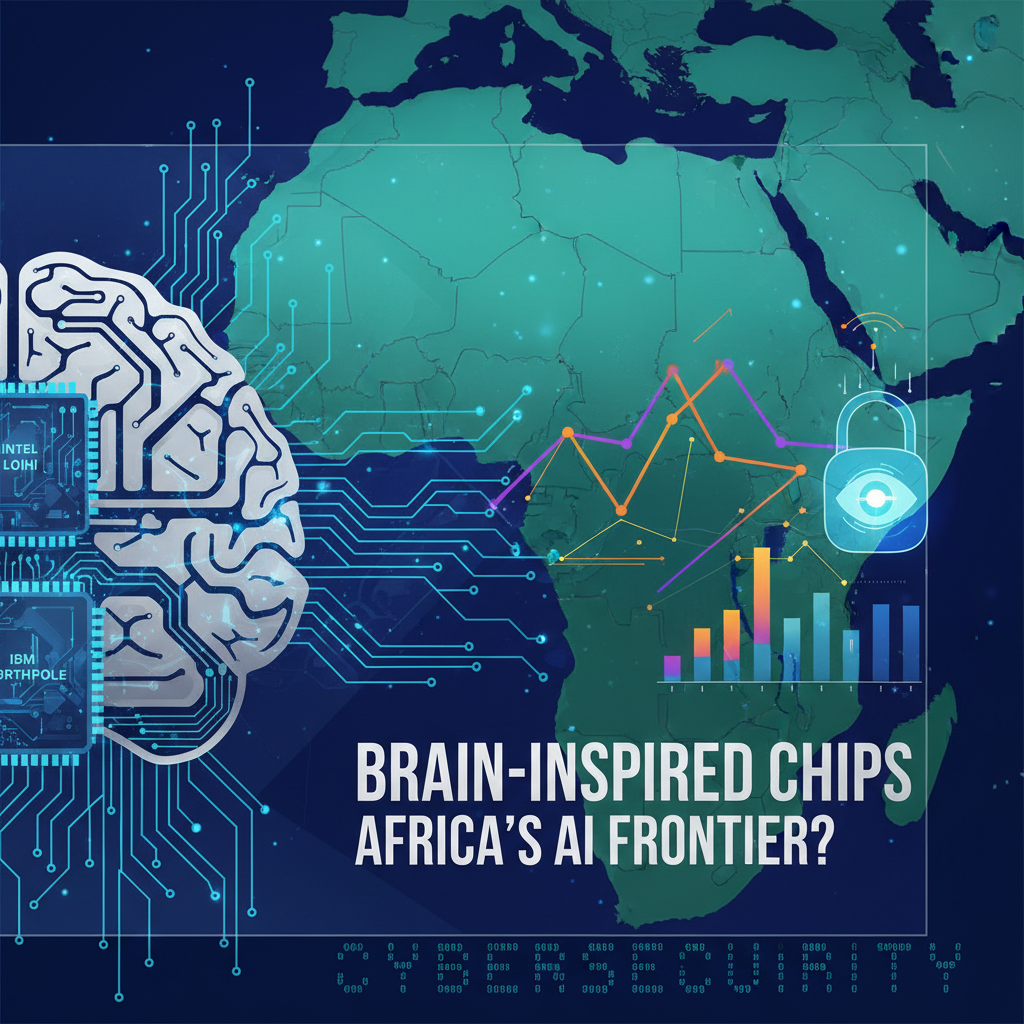
Is this just another Silicon Valley fantasy, or does it hold genuine potential for places like Burkina Faso, where every watt counts? Here's what actually happened. The concept is not new. Researchers have been dreaming of brain-like computers for decades. Early efforts were largely academic, but in recent years, major players have started investing heavily. Intel, for example, has been developing its Loihi research chip for over five years, now in its third iteration, Loihi 3. IBM has its NorthPole processor. These are not general-purpose chips; they are specialized hardware designed for specific AI tasks like pattern recognition, anomaly detection, and real-time sensor data processing, all with remarkable energy efficiency.
Consider the numbers. A typical GPU might consume hundreds of watts, sometimes even kilowatts, when running complex AI models. A neuromorphic chip like Intel's Loihi 2, according to published research, can achieve similar inference tasks with milliwatts of power. That is a difference of several orders of magnitude. For a small agricultural cooperative in a remote Burkinabé village, where electricity might come from a small solar array, this efficiency is not a luxury, it is a necessity. It could mean the difference between deploying an AI solution to monitor crop health or having no AI at all.
Dr. Dharmendra Modha, IBM Fellow and Chief Scientist for Brain-Inspired Computing, has been a long-time advocate. He stated in a recent interview, "The brain is a marvel of energy efficiency. If we can capture even a fraction of that in silicon, we can unlock AI applications that are simply not feasible with today's architectures." IBM's NorthPole chip, unveiled in 2023, boasts 256 cores and 22 billion transistors, designed for high-performance, low-power inference. It reportedly achieves 25 times higher energy efficiency and 4,000 times lower latency than conventional GPUs for certain tasks. These are not small improvements; they are transformative for edge computing.
However, the path to widespread adoption is not without its challenges. The software ecosystem for neuromorphic computing is still nascent. Most AI developers are trained on traditional CPU and GPU architectures and frameworks like PyTorch and TensorFlow. Adapting to event-driven, spiking neural networks, which are the foundation of neuromorphic systems, requires a different mindset and new tools. "The biggest hurdle is programming these things," explained Dr. Laura De Palma, a neuro-inspired computing researcher at the University of Zurich, speaking at a recent AI conference. "It is not just about porting existing models; it is about rethinking how we design algorithms for these new architectures." This is a significant barrier for many developers, especially those without deep expertise in neuroscience or specialized hardware.
Despite these hurdles, the potential applications are compelling. Imagine smart sensors deployed across the Sahel, using neuromorphic chips to detect early signs of desertification or monitor water levels in boreholes, processing data locally and only transmitting critical alerts. This would reduce bandwidth requirements, crucial in areas with limited connectivity, and minimize power consumption. In healthcare, neuromorphic chips could power portable diagnostic devices, performing real-time analysis of medical images or biosignals without needing to connect to a distant cloud server. This decentralization of AI could be a game-changer for rural clinics.
Companies like SynSense, a Swiss startup, are already commercializing neuromorphic vision sensors for industrial and automotive applications, focusing on low-power, real-time processing. While these are not yet widely adopted in Africa, the underlying technology is maturing. The reality on the ground is that while the big tech companies like Google and OpenAI are pushing the boundaries of large, centralized AI models, the real impact for many communities will come from efficient, distributed AI at the edge. This is where neuromorphic computing could shine.
For Burkina Faso, a country grappling with climate change, food security, and limited resources, the shift towards ultra-efficient AI is more than an academic exercise. It is a practical necessity. Our agricultural sector, which employs over 80 percent of the population, could benefit immensely from localized AI that does not demand massive energy infrastructure. The Ministry of Agriculture and Hydro-Agricultural Development, for instance, could explore pilot projects using neuromorphic sensors for precision farming, optimizing water usage and detecting crop diseases early. The initial investment in specialized hardware and training would be significant, but the long-term gains in efficiency and resilience could be substantial.
The verdict? Neuromorphic computing is not a fad. It is a fundamental shift in how we design AI hardware, driven by the increasing energy demands and latency limitations of conventional architectures. While it is not going to replace GPUs for training massive foundation models anytime soon, it is poised to become the new normal for a specific, yet incredibly important, class of AI applications: those that require extreme energy efficiency, real-time processing, and operation at the edge. For countries like Burkina Faso, where resource constraints are a daily reality, this technology offers a tangible pathway to harness AI's power without breaking the bank or the grid. The challenge now is to build the bridges between this cutting-edge research and the practical needs of our communities. MIT Technology Review often covers the long-term implications of such foundational shifts, and this one feels particularly relevant to our future. The future of AI here, I believe, will be less about who has the biggest data center, and more about who can do the most with the least power, right where it is needed. For more on the technical side of these developments, one can look at ArXiv for the latest research papers. And for a broader view of AI's impact, Reuters often provides excellent industry analysis. The key is to move beyond the hype and focus on what truly works, what truly serves the people.