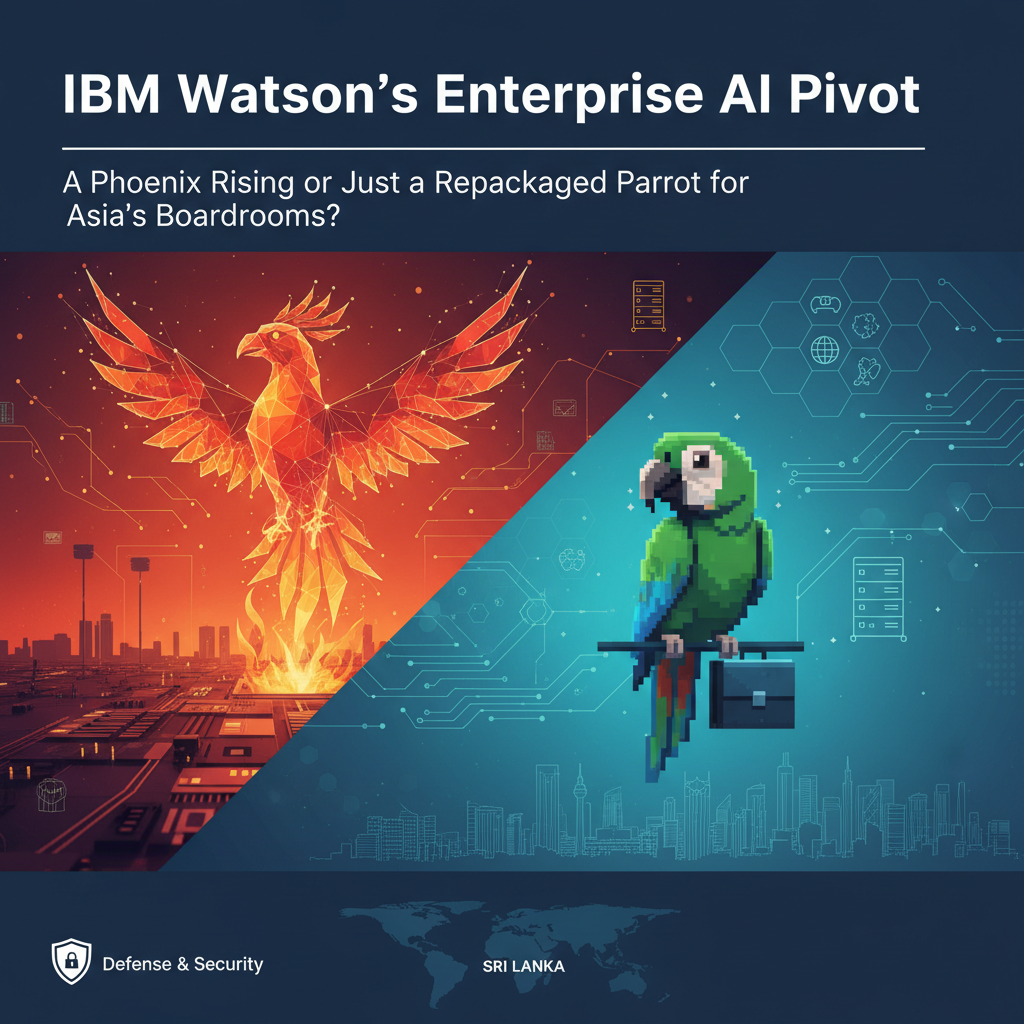

For years, the name IBM Watson conjured images of a supercomputer triumphing on Jeopardy, a harbinger of a new era in artificial intelligence. Yet, the reality that followed was often less spectacular, a series of ambitious projects that, for many, failed to deliver on the initial hype. Now, in April 2026, IBM is making another significant push, repositioning Watson not as a standalone AI marvel, but as the backbone for an expansive enterprise AI consulting market. The question, particularly pertinent for rapidly developing economies like Sri Lanka, is whether this pivot is a genuine renaissance or simply a more sophisticated iteration of the same old song.
I’ve been tracking this for months, observing the subtle shifts in IBM’s messaging and market strategy. The narrative has moved decisively away from general-purpose AI and towards specialized, industry-specific solutions, often delivered through a consulting model. This is not a small adjustment; it is a complete reorientation for a technology giant that once promised to cure cancer and revolutionize customer service with a single, omniscient platform. The promises don't match the reality of its past performance, and any new claims deserve rigorous scrutiny.
Historically, Watson’s journey has been fraught with challenges. Its initial foray into healthcare, particularly with Watson Health, faced significant criticism for its high cost, limited efficacy, and difficulty integrating into existing clinical workflows. Reports surfaced of doctors finding its recommendations unhelpful or even incorrect, leading to a reported $480 million write-down in 2022 and the eventual sale of significant assets from that division. Similar struggles were noted in other sectors, where the complexity of deployment and the need for vast, clean datasets often proved insurmountable for many enterprises. The allure of a cognitive system was strong, but the practical application often fell short.
Fast forward to today, and IBM is leveraging the current generative AI boom, much like its competitors, but with a distinct emphasis on its consulting arm, IBM Consulting. The strategy is clear: provide tailored, proprietary AI models and services built on the Watsonx platform, rather than selling a monolithic AI product. This involves assisting companies with everything from data preparation and model fine-tuning to ethical AI governance and large-scale deployment. According to IBM’s latest earnings reports, their consulting segment has seen consistent growth, with AI-related engagements reportedly a significant driver. While specific figures for Watsonx adoption are often bundled, analysts estimate that AI consulting now contributes a substantial portion to this growth, potentially in the high single-digit billions annually.
But does this actually work? Here in Sri Lanka, where businesses are eager to embrace digital transformation but often grapple with limited budgets and a nascent digital infrastructure, the appeal of a comprehensive, guided AI implementation is understandable. Local conglomerates, from apparel manufacturers to financial institutions, are exploring how AI can optimize supply chains, enhance customer experience, and drive efficiency. However, the cost and complexity remain formidable barriers. Many enterprises are still grappling with basic data hygiene, a prerequisite for any meaningful AI deployment.
“The challenge for companies like IBM is not just about building powerful AI, but about making it truly accessible and beneficial for businesses that may not have Silicon Valley resources,” remarked Dr. Rohan Samarajiva, a prominent Sri Lankan economist and telecommunications policy expert. “Our local context demands solutions that are not only technologically advanced but also economically viable and culturally sensitive. A one-size-fits-all approach simply will not work.” Dr. Samarajiva’s observation underscores the critical need for localized understanding, something that global consulting firms sometimes overlook.
Globally, the enterprise AI consulting market is projected to reach hundreds of billions of dollars in the coming years, with major players like Accenture, Deloitte, and Capgemini also vying for market share alongside tech giants such as Google Cloud and Microsoft Azure. IBM’s differentiation lies in its legacy enterprise relationships and its deep industry expertise, particularly in sectors like finance, healthcare, and government. They are pitching Watsonx as an open, hybrid cloud platform, capable of running models from various providers, including their own foundational models, and integrating with existing enterprise systems. This flexibility is a direct response to past criticisms of Watson’s closed architecture.
However, skepticism persists. “IBM has a history of overpromising and underdelivering with Watson,” stated Dr. Kate Crawford, a leading AI researcher and author, in a recent interview with Wired. “While their pivot to a consulting-led model is strategically sound, the fundamental questions about the efficacy and ethical implications of their proprietary AI remain. Enterprises need transparency, not just a black box solution.” Her point is well taken; the shift in business model does not inherently resolve the core technological and ethical dilemmas that AI presents.
Furthermore, the competitive landscape is fiercer than ever. Startups are emerging with specialized generative AI solutions, often at a fraction of the cost and with greater agility. Companies like OpenAI and Anthropic are rapidly advancing their foundational models, which many enterprises are opting to fine-tune themselves or through smaller, more nimble consulting firms. Microsoft’s Copilot offerings, deeply integrated into its ubiquitous enterprise software suite, present a formidable challenge, making AI adoption seem like a natural extension rather than a complex, bespoke project.
Even in Sri Lanka, local tech firms and university research groups are developing their own niche AI solutions, often more attuned to the specific linguistic and cultural nuances of the region. The University of Moratuwa, for instance, has several projects focused on natural language processing for Sinhala and Tamil, areas where global models often struggle without extensive local fine-tuning. This localized expertise can sometimes outmaneuver the broad strokes of a global consulting behemoth.
My verdict, after careful consideration, is that IBM’s reinvention of Watson and its push into enterprise AI consulting is a necessary strategic move, but its success is far from guaranteed. It addresses some of the past failures by focusing on integration, customization, and a service-oriented approach. However, the ghost of past Watson disappointments still lingers, and the market is saturated with powerful, agile competitors. For businesses in Sri Lanka and across Asia, the choice will come down to more than just brand recognition; it will be about demonstrable value, cost-effectiveness, and a clear path to return on investment. The burden of proof remains squarely on IBM to show that this time, the promises will indeed match the reality, and that Watson can truly deliver transformative AI, not just another consulting engagement. The journey from a Jeopardy champion to a reliable enterprise partner is long, and the path is still fraught with uncertainty. The market will demand tangible results, not just sophisticated sales pitches.
For further insights into the broader AI industry landscape, particularly concerning new entrants and their strategies, consider exploring articles on TechCrunch. The rapid pace of innovation means that what is cutting-edge today can be obsolete tomorrow, and a skeptical eye is always warranted.