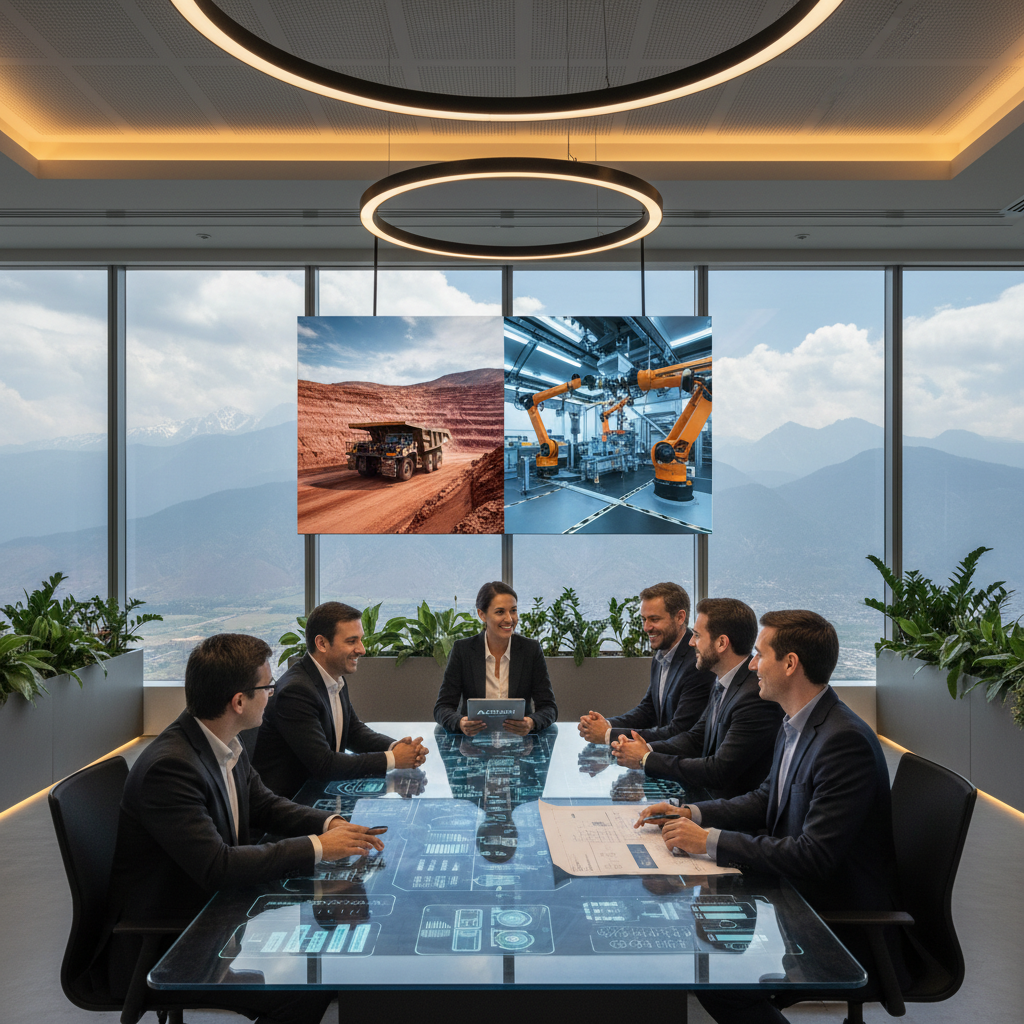

The air inside Codelco's Ministro Hales division, nestled in the vast, arid expanse of the Atacama Desert, is thick with the metallic tang of copper and the hum of colossal machinery. But look closer, and you will see something else, something almost invisible: data. This is not your abuelo's mine, nor is it the future; it is very much the present, and a significant part of that present involves a New York based company called Augury.
Augury, a firm specializing in AI powered machine health and performance, has been quietly making inroads into some of the world's most demanding industrial environments. Their recent collaboration with Codelco, the Chilean state owned copper behemoth and the world's largest copper producer, is a fascinating case study in how AI is not just optimizing, but fundamentally transforming, traditional heavy industries. For a journalist like me, who has seen many a tech promise evaporate quicker than a pisco sour in the desert sun, this partnership is worth a closer look.
The Company Today: A Symphony of Sensors and Algorithms
Imagine a massive gyratory crusher, a beast of a machine that chews through tons of ore. In the past, its sudden breakdown could halt operations for days, costing millions. Today, thanks to Augury's technology, Codelco's engineers are getting a heads up, often weeks in advance, about potential failures. Augury's system uses a combination of wireless sensors attached to critical machinery, collecting vibration, temperature, and magnetic data, which is then fed into their AI algorithms. These algorithms, trained on a massive dataset of machine behaviors, can detect subtle anomalies that human eyes and traditional monitoring systems would miss.
“The impact has been profound,” says Patricio Vergara, Codelco’s Vice President of Operations for the North Division, in a recent interview. “We are moving from reactive maintenance to truly predictive maintenance, reducing unplanned downtime significantly. It is not just about saving money; it is about safety and operational continuity.” This is not just some fancy Silicon Valley talk; this is about keeping the lights on, literally, in a country that relies heavily on its mining exports.
The Origin Story: From Israel to Industrial Heartlands
Augury was founded in 2011 by Saar Yoskovitz, the CEO, and Gal Shaul, the CTO. Their initial vision was to bring the power of predictive analytics to everyday machines. They started with a focus on Hvac systems, but quickly realized the immense potential in larger, more complex industrial settings. Their technology is rooted in machine learning and advanced diagnostics, allowing them to create digital fingerprints of machines and predict their health. Over the years, they have raised substantial capital, including a Series E round in 2021 that reportedly valued the company at over $1 billion, with investors like Insight Partners and Qualcomm Ventures seeing the vast market potential in industrial AI. Their journey from a startup to a unicorn highlights the growing appetite for practical AI solutions in sectors often considered slow to adopt new tech.
The Business Model: Subscription to Stability
Augury operates on a Software as a Service, or SaaS, model. Customers like Codelco pay a subscription fee for the sensors, the cloud based platform, and the AI driven insights. This allows companies to avoid large upfront capital expenditures and instead integrate the solution as an operational expense. The value proposition is clear: by preventing costly breakdowns, optimizing maintenance schedules, and extending asset life, Augury's service often pays for itself many times over. They also offer a diagnostic service, where their in house experts provide detailed analysis and recommendations based on the AI's findings, adding another layer of value.
Key Metrics: Growth and Global Reach
While exact revenue figures for private companies like Augury are often kept under wraps, industry reports and their funding rounds suggest significant growth. They boast a customer base that includes major players in food and beverage, pharmaceuticals, and, of course, heavy industry. Their sensors monitor hundreds of thousands of machines globally, processing billions of data points daily. The company has expanded its operations, with offices in New York, Israel, and Germany, reflecting its international ambitions. The fact that they are now deeply embedded in a critical operation like Codelco's speaks volumes about the robustness and reliability of their technology.
The Competitive Landscape: A Crowded but Niche Field
The industrial AI space is not without its contenders. Companies like PTC, Siemens, and GE Digital offer various industrial IoT and predictive analytics platforms. Startups like Senseye, now part of Siemens, also focus on predictive maintenance. However, Augury differentiates itself through its deep specialization in machine health, its proprietary sensor technology, and its focus on a comprehensive, full stack solution that includes both hardware and software. Their AI models are specifically tuned for the nuances of machine vibration and acoustic analysis, giving them an edge in diagnosing complex mechanical issues. As one analyst from TechCrunch put it,