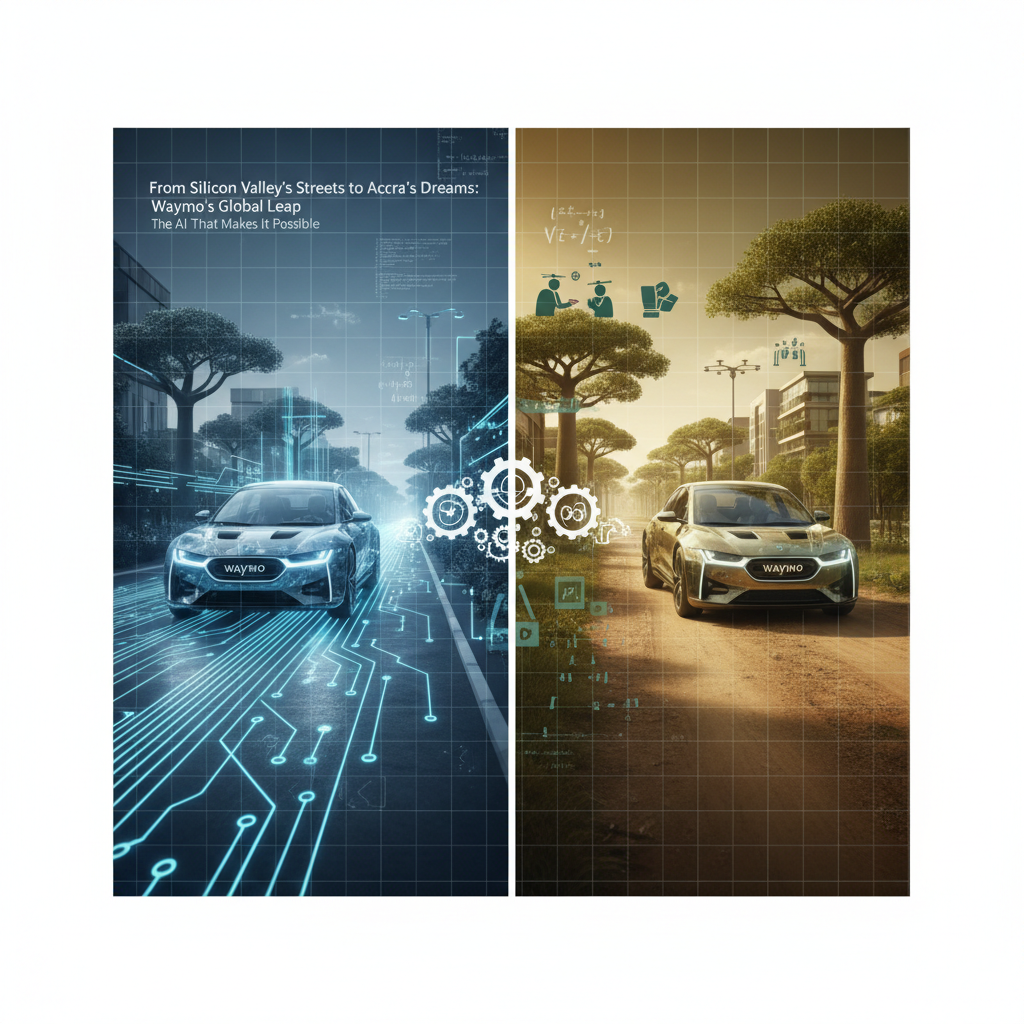

My friends, let me tell you, the future is not just coming, it is practically knocking on our doors with a polite, automated chime. Here at DataGlobal Hub, we are always looking ahead, and right now, my eyes are fixed on something truly revolutionary: Google's Waymo, the autonomous driving pioneer, is not just expanding its robotaxi service, it is gearing up for a global footprint. This is bigger than anyone realizes, and it is built on some of the most mind-bending AI research happening today.
Imagine a city where traffic jams are a distant memory, where public transport is seamlessly integrated with on-demand, self-driving vehicles, and where every journey is safer, cleaner, and more efficient. For many in Accra, this sounds like a dream, but the advancements in AI perception, prediction, and planning that Waymo is leveraging are bringing this dream closer to reality, not just in Phoenix or San Francisco, but potentially across continents.
The Breakthrough: From Local Mastery to Global Scalability
For years, the challenge for autonomous vehicles was not just driving, but driving everywhere. The sheer complexity of diverse urban environments, varying traffic laws, unpredictable human behavior, and differing infrastructure across cities made scaling a nightmare. However, recent breakthroughs, particularly in areas like generalized perception models and robust simulation platforms, are changing the game. Waymo's latest expansion plans, including whispers of new international markets, are a testament to this underlying scientific progress.
At the heart of this scalability is a shift from highly localized, hand-tuned mapping and behavioral rules to more generalized, AI-driven understanding of driving environments. Researchers at Waymo and institutions like Carnegie Mellon University's Robotics Institute have been pushing the boundaries of what is called 'scene understanding' and 'predictive modeling'. Instead of programming a car for every single scenario, the AI is now learning to infer and adapt from vast datasets, making it far more versatile.
Why This Matters: Beyond Just Taxis
Now, why should we in Ghana, or anywhere in Africa for that matter, care about robotaxis in Arizona? Because the underlying technology, the very fabric of this AI, is transferable. It is about more than just moving people; it is about transforming logistics, emergency services, and even agricultural transport. Think about the impact on our bustling markets, the efficiency gains for small businesses, or even how it could revolutionize healthcare access in remote areas. The numbers don't lie: efficient transportation infrastructure is a key driver of economic growth, and AI-powered mobility could be the catalyst we need.
According to a report by the African Development Bank, improving transport infrastructure could boost Africa's GDP by up to 2% annually. When we talk about Waymo's advancements, we are talking about the potential for a paradigm shift in how we approach urban and rural mobility, creating opportunities for local entrepreneurs and innovators to build complementary services. Ghana is proving the skeptics wrong every day with its vibrant tech scene, and this kind of foundational AI opens up new avenues for our brilliant minds.
The Technical Details: A Glimpse Under the Hood
Let us get a little technical, but I promise to keep it exciting. The core of Waymo's system relies on an intricate dance between several AI components. First, there is perception, where a suite of sensors, lidars, radars, and high-resolution cameras, feed massive amounts of data into deep neural networks. These networks, often based on architectures like transformers or convolutional neural networks, are trained on petabytes of real-world and simulated driving data to identify everything from pedestrians and cyclists to traffic lights and road signs, even in challenging weather conditions.
Recent research from Google's DeepMind, often collaborating with Waymo engineers, has focused on improving these perception systems to be more robust to 'long-tail' events, those rare but critical situations that traditional rule-based systems struggle with. Papers published in venues like NeurIPS and Icra detail advancements in multi-modal sensor fusion, where information from different sensors is combined intelligently to create a more complete and reliable understanding of the environment. For example, a paper titled