The wind whips across the steppe, carrying dust and the scent of distant herds. Here in Mongolia, we have always valued resilience and practicality. When I look at the big tech companies in Silicon Valley, I often wonder if they understand what 'practical' truly means for us. Two names dominate the conversation about advanced AI: OpenAI and Anthropic. They are both building powerful large language models, the kind that can write code, answer complex questions, and even help diagnose illnesses. But their core philosophies are as different as a gers' felt walls are from a skyscraper's glass and steel, and understanding these differences is crucial, especially when we talk about something as vital as healthcare.
At its heart, the debate between Anthropic and OpenAI is about how we build powerful AI and what guardrails we put in place. OpenAI, with its high-profile CEO Sam Altman, has largely pursued a strategy of 'deploy fast and iterate.' Their approach has been to push the boundaries of AI capability, releasing models like GPT-3 and GPT-4 to the public quickly, gathering feedback, and then refining them. The idea is that widespread public use will help them understand and mitigate risks faster. They believe in the transformative power of AI and want to get it into people's hands as soon as possible, even while acknowledging the potential for misuse. Their recent focus, especially with Microsoft's significant investment, has been on general artificial intelligence, aiming for systems that can perform any intellectual task a human can.
Anthropic, co-founded by former OpenAI researchers Dario Amodei and Daniela Amodei, takes a more cautious, 'safety-first' approach. They are deeply concerned about the potential for advanced AI to cause harm, whether through bias, misuse, or unintended consequences. They champion what they call 'Constitutional AI,' a method where AI models are trained not just on data, but also on a set of guiding principles or a 'constitution' that helps them align with human values and avoid harmful outputs. Their flagship model, Claude, reflects this philosophy, often exhibiting more conservative responses and a greater emphasis on ethical reasoning. They believe that capability without robust safety mechanisms is a dangerous path.
The Building Blocks: What Makes These AIs Tick?
Both OpenAI's GPT series and Anthropic's Claude are built on the same fundamental technology: transformer neural networks. Imagine these as incredibly complex digital brains that learn from vast amounts of text data. They are designed to predict the next word in a sequence, and by doing this millions of times, they learn grammar, facts, reasoning patterns, and even some semblance of 'understanding.'
- Massive Datasets: Both companies feed their models enormous libraries of text and code from the internet, books, and other sources. This is like giving a student every book in the National Library of Mongolia and telling them to read it all.
- Transformer Architecture: This is the engine. It allows the AI to weigh the importance of different words in a sentence, understanding context and relationships over long distances in text. Think of it as a highly sophisticated pattern recognition system.
- Training: This is where the AI learns. It tries to predict the next word, and if it's wrong, it adjusts its internal connections. This process, called backpropagation, happens billions of times over weeks or months, requiring immense computing power, often from NVIDIA GPUs.
- Fine-tuning and Alignment: This is where the philosophies diverge. OpenAI uses a technique called Reinforcement Learning from Human Feedback (rlhf), where human reviewers rate the AI's responses, guiding it towards more helpful and harmless outputs. Anthropic also uses Rlhf but adds their 'Constitutional AI' layer, which involves the AI evaluating its own responses against a set of ethical principles, essentially self-correcting based on a predefined moral framework. This is a crucial distinction, especially for sensitive applications like healthcare.
Step by Step: AI in a Mongolian Healthcare Scenario
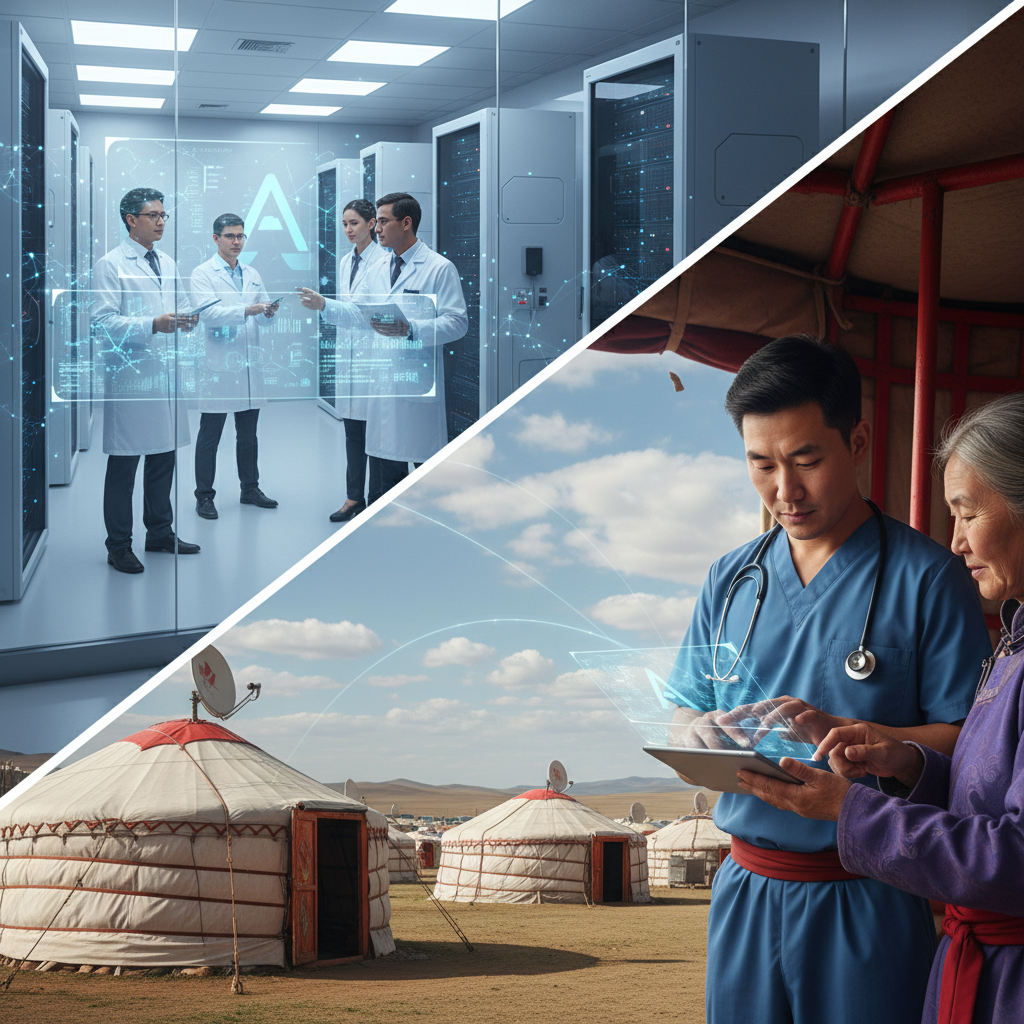
Let's consider a practical example: a doctor in a remote soum, perhaps in Dornogovi province, needs to quickly access information about a rare disease or interpret complex lab results. Connectivity can be spotty, and specialists are often hundreds of kilometers away. This is where the steppe meets the server farm.
Scenario: A local doctor, Dr. Tsetseg, has a patient presenting with unusual symptoms. She suspects a rare parasitic infection common in some livestock, but needs to confirm diagnostic criteria and treatment protocols.
OpenAI's GPT-4 Approach:
- Input: Dr. Tsetseg types the patient's symptoms, lab results, and her initial suspicion into a GPT-4 powered medical assistant interface.
- Processing: GPT-4 rapidly searches its vast knowledge base, cross-referencing symptoms with known diseases, pulling up relevant research papers, and suggesting diagnostic tests.
- Output: The AI provides a comprehensive summary, including differential diagnoses, recommended tests, and standard treatment guidelines. It might also highlight recent research that could be relevant. The emphasis is on speed and breadth of information.
- Doctor's Role: Dr. Tsetseg uses this information as a powerful assistant, but she is ultimately responsible for verifying the information and making the final decision. The AI is a tool to augment her knowledge.
Anthropic's Claude Approach:
- Input: Similar to GPT-4, Dr. Tsetseg enters the patient's data into a Claude-powered system.
- Processing: Claude also accesses its knowledge base. However, during its generation process, it constantly checks its proposed responses against its 'constitution' which includes principles like 'do no harm,' 'avoid speculation,' and 'prioritize patient safety.' If a potential diagnosis is uncertain or could lead to harmful treatment, Claude might flag it or refuse to give a definitive answer without more data.
- Output: Claude provides a detailed, evidence-based response, but it will likely include caveats about diagnostic uncertainty, potential biases in the data, and a strong recommendation to consult with a human specialist, especially for rare or complex cases. It might even refuse to offer a treatment plan directly, instead focusing on providing verified information for the doctor to interpret.
- Doctor's Role: Dr. Tsetseg receives a highly vetted, cautious, and ethically aligned response. Claude acts more like a conservative medical textbook that highlights risks and uncertainties, ensuring the doctor is fully aware of limitations.
Why it Sometimes Fails: Limitations and Edge Cases
No AI is perfect, especially in the complex world of medicine. Both approaches face challenges.
- Data Bias: If the training data is predominantly from Western populations, the AI might struggle with diseases or genetic predispositions more common in Mongolia. This can lead to misdiagnoses or inappropriate recommendations. For example, a model might not recognize a specific local plant poisoning if it wasn't in its training data.
- Hallucinations: Both models can 'hallucinate,' meaning they confidently present false information as fact. This is a critical risk in healthcare. Anthropic's constitutional approach aims to reduce this, but it's not eliminated.
- Lack of Context: AI doesn't understand the nuances of a patient's socio-economic situation, their family history beyond what's explicitly stated, or cultural beliefs that might impact treatment adherence. A doctor in Mongolia understands these things deeply.
- Over-reliance: The biggest danger is doctors or patients over-relying on AI without critical human oversight. As Dr. Batbayar Ganbold, head of the Mongolian National Center for Communicable Diseases, once told me, 'Technology is a tool, not a replacement for a doctor's judgment. Especially here, where every patient has a story that numbers alone cannot tell.'
Where This is Heading: Practical Innovation for Mongolia
For a nation like Mongolia, with its vast distances and often limited access to specialized medical care, AI offers immense potential. The contrasting philosophies of OpenAI and Anthropic present a choice, or perhaps, a blend of approaches. We need AI that is powerful and accessible, like OpenAI's vision, but also rigorously safe and ethically aligned, as Anthropic advocates.
Practical innovation here means leveraging these tools to extend the reach of healthcare, not to replace human expertise. Imagine AI assistants helping nurses in remote clinics triage patients, providing up-to-date medical information, or even assisting in basic diagnostic imaging interpretation. This is not about cutting corners, but about empowering our healthcare professionals.
'The key is not just what the AI can do, but how it is built and how it is integrated into our existing systems,' says Professor Enkhjargal Purevdorj, a bioethics researcher at the National University of Mongolia. 'We must demand transparency and accountability from these developers. MIT Technology Review has highlighted these ethical debates, and they are even more critical for us.'
Ultimately, the future of AI in healthcare, particularly in regions with unique challenges, will likely involve a hybrid model. We need the raw power and accessibility that OpenAI champions, but tempered by the rigorous safety and ethical alignment that Anthropic prioritizes. It is about finding that balance, ensuring that these powerful tools serve humanity, rather than the other way around. Mongolia's challenges are unique and so are its solutions, and our approach to AI must reflect that grounded reality. The goal is to make healthcare more accessible and effective for every citizen, from the bustling streets of Ulaanbaatar to the most isolated herder's ger, without compromising on safety or ethics. The conversation between these AI giants is not just a Silicon Valley debate; it's a global one with very real implications for our health and well-being. More on the broader implications of AI in healthcare can be found on The Verge. We need to pay attention, and we need to demand that these powerful tools are built with our specific needs in mind. For more on how AI is being used in specific medical fields, you might find this article on creative AI in mental wellness interesting: From Tokyo's Neon Glow to Algorithmic Empathy: How Dr. Kenji Tanaka Built 'Kokoro AI' Into a $750 Million Beacon for Mental Wellness [blocked].