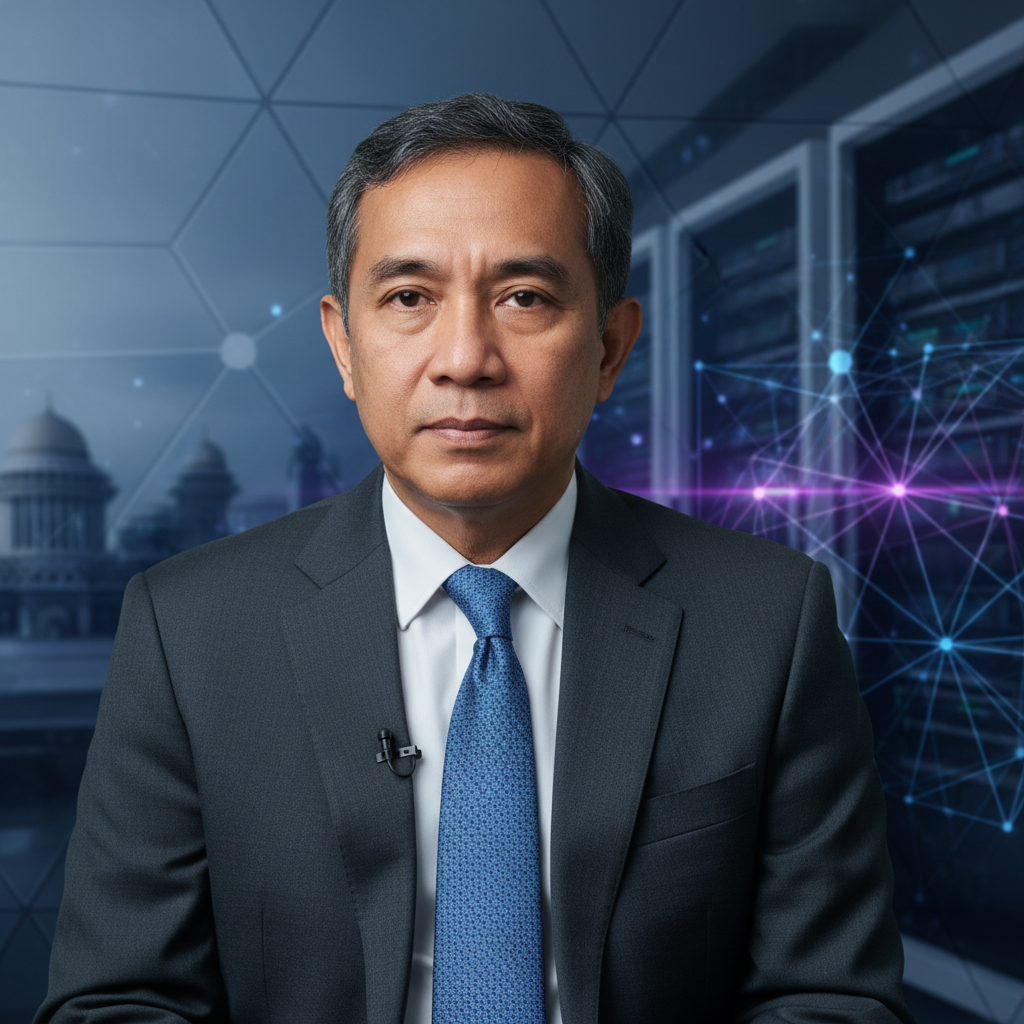
The air in Putrajaya always feels a little different, a blend of ambition and serene planning. It is a city built for purpose, much like the vision Dr. Azlan Shah holds for artificial intelligence in Malaysia. I met him in his office at the newly established Malaysian National AI Safety Institute (MyNAISI), a space that felt both cutting edge and distinctly Malaysian, with intricate songket patterns subtly woven into the decor.
Dr. Azlan, a man whose calm demeanor belies a formidable intellect, greeted me with a warm smile. He is not your typical tech guru, all buzzwords and bravado. Instead, he speaks with the measured cadence of someone who understands the profound implications of his work. His journey, from a kampung boy fascinated by electronics to a leading voice in global AI governance, is a testament to Malaysian ingenuity.
“We often talk about AI safety as a global challenge, and it is,” Dr. Azlan began, gesturing towards a holographic display showing complex neural network architectures. “But the solutions, the practical implementation, must be rooted in local context. For Malaysia, a nation rich in diversity, this means ensuring AI systems are not just robust, but also equitable and culturally sensitive.”
His institute, MyNAISI, launched in late 2025 with an initial government allocation of RM 150 million, is a pioneering effort in Southeast Asia. Its mandate is clear: to develop and implement rigorous testing protocols for AI systems before they are deployed in critical sectors like healthcare, finance, and national security. This is not just about preventing catastrophic failures, he explained, but about building public trust, a commodity more valuable than any algorithm. Let me explain why this matters for Southeast Asia.
“Think of it like this,” he offered, leaning forward slightly. “When we build a bridge, we do not just trust the engineer’s calculations. We test the materials, we simulate loads, we have independent inspectors. Why should AI, which can impact millions of lives, be any different? We are building digital bridges, and they need to be just as sound.”
MyNAISI’s approach is multi-faceted. They are developing a 'Digital Sandbox for AI Assurance,' a secure environment where AI models, from large language models like OpenAI’s GPT-4 or Google’s Gemini to specialized predictive analytics tools, can be put through their paces. This includes adversarial testing, bias detection, and robustness evaluations against unexpected inputs. “We are actively collaborating with major AI developers, including teams from Anthropic and even local startups, to ensure our testing methodologies are comprehensive and relevant,” Dr. Azlan stated, citing a recent partnership with a Malaysian-based AI firm specializing in agricultural analytics.
One of the most surprising revelations from our conversation was MyNAISI’s focus on 'cultural alignment testing.' Dr. Azlan elaborated, “An AI model trained predominantly on Western datasets might inadvertently perpetuate biases when deployed in a Malaysian context. For example, a medical diagnostic AI might misinterpret symptoms if it is not exposed to the genetic predispositions or lifestyle factors prevalent in our diverse population. Our team, which includes sociologists and anthropologists, works to identify and mitigate these ‘cultural blind spots’ before deployment.” He proudly mentioned that MyNAISI has already identified and helped developers correct over 20 instances of potential cultural bias in AI models slated for public sector use, ranging from language nuances in chatbot responses to image recognition systems failing to accurately identify diverse facial features.
“The architecture is fascinating,” I remarked, noting the institute’s unique blend of technical and humanities expertise. “How do you balance the need for rapid AI innovation with the imperative for safety?”
“It is a delicate dance, like a traditional Malay joget,” he chuckled. “Innovation cannot be stifled, but neither can safety be an afterthought. Our goal is to be an enabler, not a roadblock. By providing clear guidelines and robust testing frameworks, we aim to accelerate responsible innovation. Companies that pass MyNAISI’s certification will gain a significant competitive advantage, signaling their commitment to ethical and safe AI.” He mentioned that the institute is already seeing a 30 percent increase in applications for certification since its public launch, a clear indicator of industry buy-in.
Dr. Azlan believes Malaysia is positioning itself perfectly to become a regional leader in AI safety. “We have the talent, the political will, and a unique multicultural fabric that demands a nuanced approach to AI governance. Our experiences here can serve as a blueprint for other Asean nations. We are actively engaging with counterparts in Singapore and Indonesia to harmonize standards, fostering a safer digital economy across the region.”
His vision extends beyond national borders. He foresees a future where AI safety institutes globally share data, methodologies, and even adversarial examples to collectively raise the bar for AI trustworthiness. “Imagine a global network, like an Interpol for AI safety, where we can quickly identify and neutralize emerging threats from malicious AI or unforeseen systemic risks,” he mused, his eyes alight with possibility. “That is the ultimate goal: a world where AI serves humanity, safely and equitably.”
As our conversation drew to a close, Dr. Azlan spoke about the human element. “Ultimately, AI safety is about people. It is about protecting our citizens, preserving our values, and ensuring that this transformative technology uplifts everyone.” He pointed to a small, framed calligraphy on his wall, a verse from the Quran emphasizing justice and responsibility. “That is our guiding principle here.”
Malaysia’s proactive stance, spearheaded by figures like Dr. Azlan Shah, offers a compelling model for global AI governance. It is a reminder that while the technology itself might be universal, its safe and ethical integration requires a deep understanding of local contexts and human values. The journey is long, but with leaders like Dr. Azlan, Malaysia is building a future where AI is not just powerful, but also profoundly trustworthy. For more insights into global AI safety efforts, you can follow developments on TechCrunch or MIT Technology Review. The discussions around the EU AI Act, for example, often touch upon similar themes of risk assessment and compliance, as detailed by Reuters.
MyNAISI’s efforts are a crucial step in ensuring that as AI becomes more pervasive, it remains a tool for progress, not a source of unforeseen peril. It is a testament to the idea that with foresight and collaboration, we can indeed design a safer digital tomorrow. The stakes are high, but the commitment in Putrajaya is unwavering. We are not just testing algorithms, we are testing the future. There's a lot to learn from how different regions are approaching this, and Malaysia's model is certainly one to watch closely. While this article focuses on Malaysia's specific initiatives, the broader conversation around AI safety and defense is global, touching upon various aspects including cybersecurity and ethical deployment, as explored in articles like Telecom AI Orchestration [blocked] which delves into the secure management of complex AI systems in telecommunications.