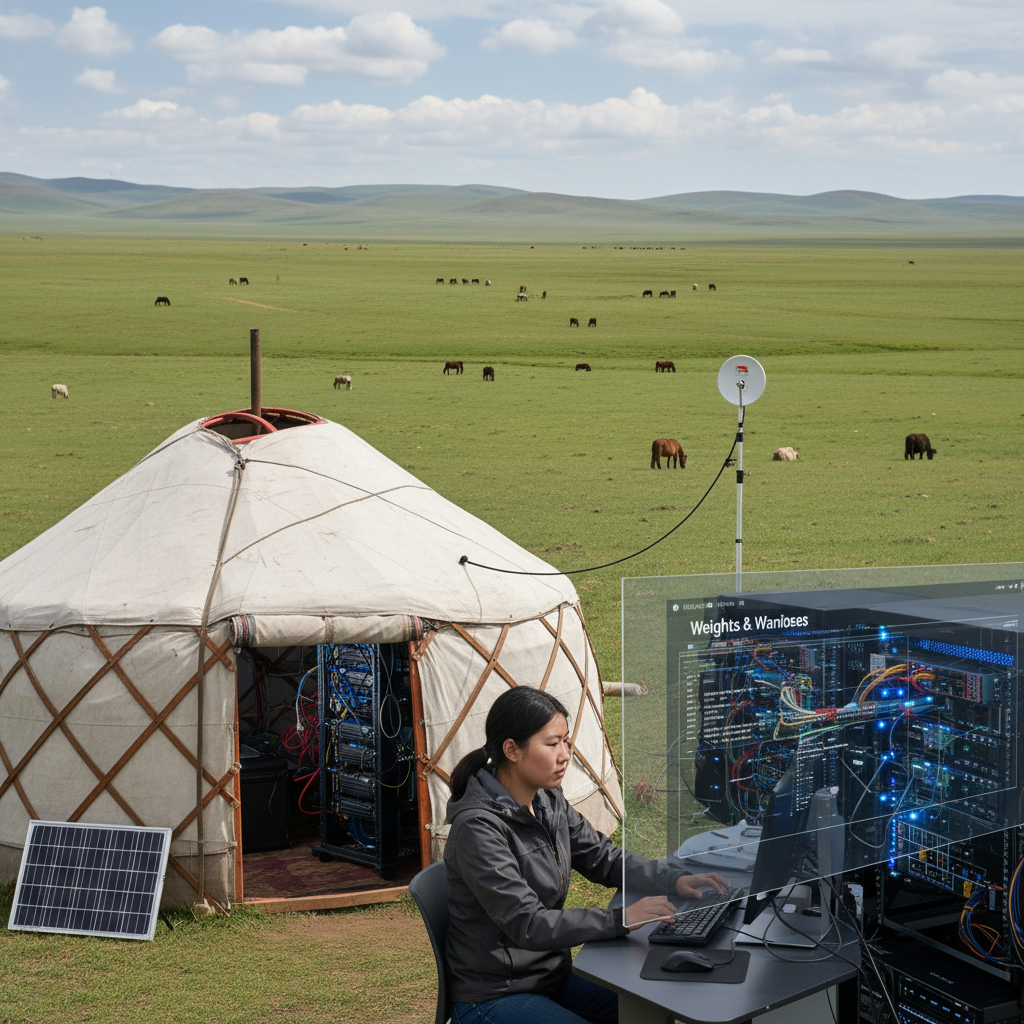

The wind whips across the vast Mongolian steppe, carrying with it the scent of juniper and the distant bleating of sheep. It is a landscape that demands resilience, where every resource is carefully managed, and every tool must prove its worth. Here, in this land of extremes, technology is not a luxury; it is a necessity, a bridge across immense distances and harsh conditions. So, when I see a platform like Weights & Biases gaining traction among our nascent but ambitious AI communities, I pay attention. It is not about hype; it is about practical innovation.
For years, our local AI developers, often working in small teams spread across Ulaanbaatar or even from remote herder communities with satellite internet, faced a common problem: how to manage the chaos of machine learning experiments. Training models, tracking parameters, comparing results, and collaborating effectively can be a nightmare, especially when you are dealing with limited bandwidth or intermittent power. This is where MLOps, or Machine Learning Operations, comes in, and specifically, why Weights & Biases has become such a critical tool, not just globally but right here in Mongolia.
Weights & Biases, often abbreviated as W&B, offers a suite of tools for experiment tracking, model versioning, dataset versioning, and collaborative dashboards. It is designed to bring order to the often-messy process of AI development. Think of it as the central nervous system for an AI project, allowing researchers and engineers to log everything from hyperparameter sweeps to model performance metrics in a structured, visual way. This is not just about pretty graphs; it is about reproducibility and efficiency, two things that are paramount when resources are scarce.
Globally, the adoption figures for W&B tell a compelling story. According to a recent report, over 500,000 machine learning practitioners and researchers are now leveraging the platform, including teams at major tech companies like OpenAI, NVIDIA, and Google DeepMind. This widespread adoption underscores its utility in complex, large-scale AI projects. But its value extends far beyond the Silicon Valley giants. Here, in Mongolia, where we might not have the same scale, the need for robust MLOps is arguably even greater.
“In Mongolia, our AI talent is sharp, but our infrastructure can be challenging,” explained Dr. Enkhjargal Batbayar, head of the AI research lab at the National University of Mongolia. “We cannot afford to waste computational cycles or human effort on poorly tracked experiments. Weights & Biases allows our students and researchers to work more efficiently, sharing results and insights even when they are geographically dispersed. It brings a level of professionalism and reproducibility that was difficult to achieve before.” Her words resonate deeply; Mongolia's challenges are unique and so are its solutions, often relying on smart tools that maximize impact.
One of the key benefits we are seeing locally is in the development of AI models for resource management and environmental monitoring. For instance, a team at the Mongolian Academy of Sciences is using satellite imagery and machine learning to predict pasture degradation, a critical issue for our nomadic herders. They are training convolutional neural networks to identify changes in vegetation cover. Without a system like W&B, tracking the hundreds of experiments with different satellite bands, model architectures, and training schedules would be nearly impossible. W&B provides the single source of truth, allowing them to compare model versions, understand which features are most impactful, and ultimately deploy more accurate predictive tools.
Another example comes from the mining sector, a cornerstone of our economy. Companies are increasingly looking to AI for optimizing drilling patterns, predicting equipment failure, and even analyzing geological data. These are complex, data-intensive tasks. “When you are dealing with terabytes of sensor data from a mine site and running dozens of deep learning models, you need a robust system to manage it all,” stated Ganbold Purev, a lead data scientist at Erdenet Mining Corporation. “Weights & Biases has become our go-to for tracking model lineage and ensuring that our deployed AI systems are performing as expected. It is about reducing operational risk and improving profitability.” This practical application of AI, supported by MLOps, is a testament to its real-world impact.
The platform's ability to integrate with popular frameworks like TensorFlow, PyTorch, and JAX is a significant advantage. This flexibility means that teams are not locked into a specific ecosystem, allowing them to choose the best tools for their particular problem. The visual dashboards also simplify the process of communicating complex model performance metrics to non-technical stakeholders, which is crucial for securing funding and demonstrating value.
Moreover, the collaborative features of W&B are especially valuable in our context. With many researchers and engineers working remotely, often across different time zones, having a shared workspace where everyone can see the latest experiments, logs, and model artifacts fosters a sense of teamwork. It is like having a digital ger, a central hub where everyone can gather and share their progress, even if they are physically hundreds of kilometers apart. This is where the steppe meets the server farm, bridging traditional ways of life with cutting-edge technology.
Looking ahead, the MLOps landscape is only going to become more critical. As AI models grow in complexity and are deployed in increasingly sensitive applications, the need for robust governance, reproducibility, and continuous monitoring will intensify. Companies like Weights & Biases are at the forefront of providing these essential capabilities. Their recent integrations with cloud providers like AWS and Google Cloud, as highlighted in TechCrunch's AI section, further solidify their position as a foundational layer for AI development.
For Mongolia, embracing such platforms is not just about staying current with global tech trends; it is about building a sustainable, data-driven future. It is about empowering our scientists and engineers to solve local problems with global-standard tools. The journey from raw data to deployed, reliable AI models is long and arduous, but with the right MLOps platform, it becomes a manageable path. It is a clear example of how practical innovation can thrive even in the most demanding environments, providing real solutions to real challenges. The future of AI here depends on tools that are not just powerful, but also pragmatic and adaptable.