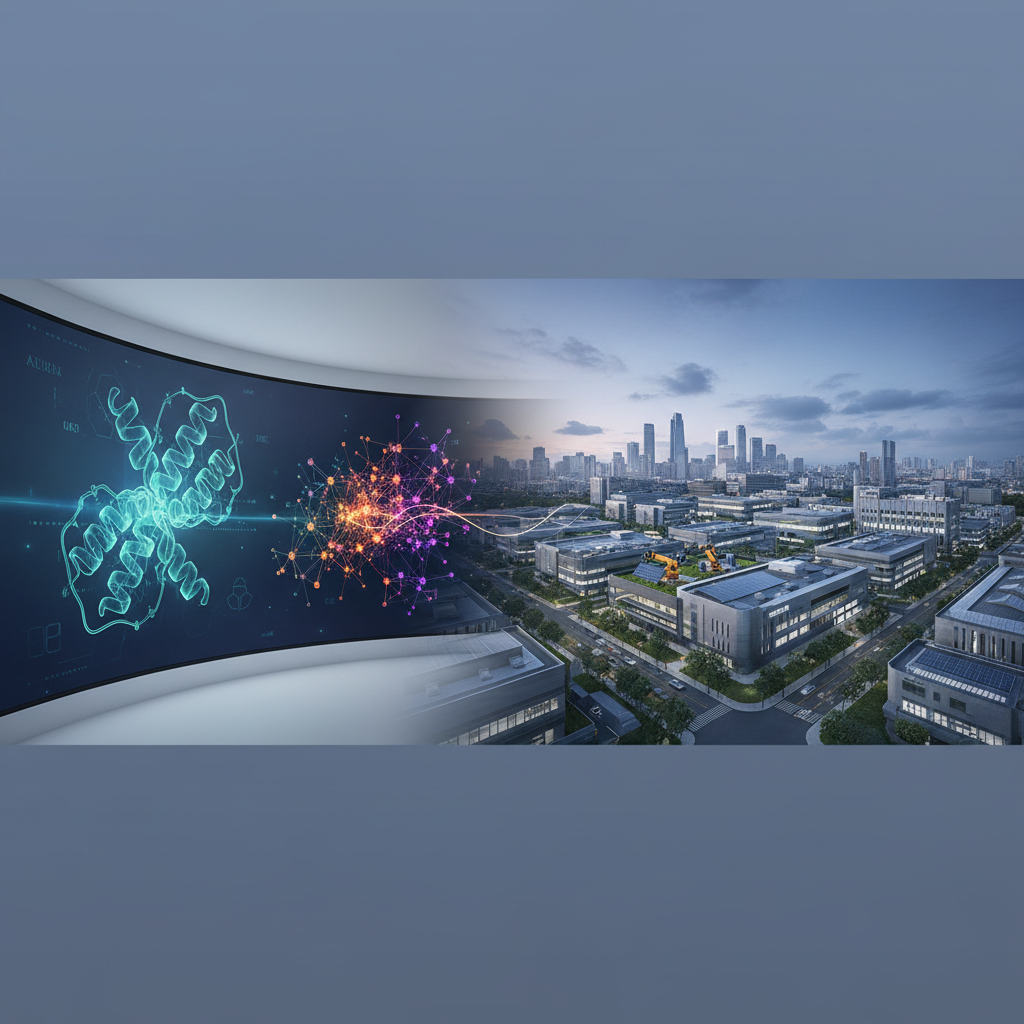

For decades, the protein folding problem stood as one of biology's grand challenges, a Gordian knot of molecular interactions that stumped even the most brilliant minds. Imagine trying to predict the precise, three dimensional structure of a complex origami swan by only knowing the sequence of the paper folds. This is the essence of protein folding, a process critical to understanding life itself and, by extension, designing new medicines and advanced materials. Today, however, artificial intelligence has not merely untangled this knot, it has begun to weave entirely new fabrics of scientific possibility. The Korean approach to AI, particularly in this domain, is fundamentally different, emphasizing robust hardware integration and practical, industrial applications.
The Technical Challenge: Decoding Nature's Blueprint
Proteins are the workhorses of life, performing myriad functions from catalyzing reactions to providing structural support. Their function is inextricably linked to their precise 3D shape. A single misfolded protein can lead to debilitating diseases, such as Alzheimer's or Parkinson's. Predicting this structure from an amino acid sequence, a process known as the protein folding problem, has historically relied on experimental methods like X-ray crystallography, NMR spectroscopy, and cryo-electron microscopy. These methods are labor intensive, time consuming, and often prohibitively expensive, taking months or even years per protein structure. The sheer combinatorial complexity, where even a small protein of 100 amino acids has an astronomical number of possible configurations, made brute-force computational approaches infeasible.
Architecture Overview: The Neural Network as a Molecular Cartographer
The paradigm shift arrived with deep learning. Systems like Google DeepMind's AlphaFold, and subsequently AlphaFold 2, revolutionized the field by framing protein folding as a sequence-to-structure prediction problem. At its core, the architecture typically involves a transformer-based neural network, akin to those powering large language models, but specialized for biological sequences. This network takes an amino acid sequence as input and predicts inter-residue distances and orientations. These predictions are then used by a structure module, an iterative geometric network, to construct the final 3D protein model.
Consider the architecture as a sophisticated mapping system. First, an 'embedding' module converts the linear amino acid sequence into a rich, high dimensional representation. This is often augmented with evolutionary information, derived from multiple sequence alignments (MSAs), which capture co-evolutionary patterns among residues. These patterns are crucial, as residues that are functionally or structurally close often mutate together across different species. This information is then fed into an 'attention' mechanism, allowing the model to weigh the importance of different amino acids and their interactions, much like a seasoned cartographer focusing on key landmarks. Finally, a 'refinement' network iteratively adjusts the predicted structure, minimizing an energy function that reflects physical plausibility, until a stable, accurate conformation is achieved.
Key Algorithms and Approaches: Beyond Simple Prediction
The success of AlphaFold 2, for instance, stemmed from several algorithmic innovations. The 'EvoFormer' block, a key component, combines attention mechanisms over both sequence and MSA dimensions. This allows the model to simultaneously reason about individual amino acids and their evolutionary context. Crucially, it predicts not just the final structure, but also a distribution of possible structures, along with a confidence metric, known as Predicted Local Distance Difference Test pLDDT, for each residue. This pLDDT score is vital for assessing the reliability of the prediction.
Another significant approach involves diffusion models, similar to those used in image generation. These models learn to reverse a diffusion process, starting from a noisy, random protein structure and gradually denoising it into a plausible, folded state. This generative approach holds immense promise for de novo protein design, where the goal is to create entirely new proteins with desired functions, rather than just predicting existing ones. This is where the intersection with materials science becomes particularly potent, as we can design proteins with novel properties for industrial applications.
Implementation Considerations: The Hardware Imperative
Deploying these complex models requires substantial computational resources. Training AlphaFold 2, for example, involved hundreds of NVIDIA A100 GPUs over several weeks. For inference, while less demanding, high performance computing infrastructure remains essential. South Korean enterprises, acutely aware of the hardware bottleneck, have invested heavily. Samsung Bioepis, a biopharmaceutical joint venture, has reportedly scaled its GPU clusters significantly, integrating NVIDIA DGX systems to accelerate its drug discovery pipelines. "Samsung's latest move reveals a deeper strategy to not just consume AI, but to be a foundational enabler of its most demanding applications," states Dr. Kim Min-joon, Head of AI Research at Samsung Advanced Institute of Technology. This commitment to hardware is a hallmark of the Korean industrial strategy.
Memory management, distributed training frameworks like PyTorch Distributed or TensorFlow Distributed, and efficient data loading pipelines are critical. The sheer size of protein sequence databases, such as UniProt and PDB, necessitates robust data engineering. Furthermore, the development of specialized libraries and optimized kernels for GPU acceleration is an ongoing area of research, often spearheaded by companies like NVIDIA in collaboration with academic institutions.
Benchmarks and Comparisons: A Leap Forward
Before AlphaFold, traditional homology modeling and threading methods could achieve reasonable accuracy for proteins with close evolutionary relatives. Ab initio methods, which attempt to fold a protein from scratch based purely on physical principles, struggled with all but the smallest proteins. AlphaFold 2, however, dramatically surpassed these benchmarks, achieving accuracy comparable to experimental methods for many proteins. In the Critical Assessment of protein Structure Prediction Casp competition, AlphaFold 2 consistently outperformed all other methods, effectively solving the