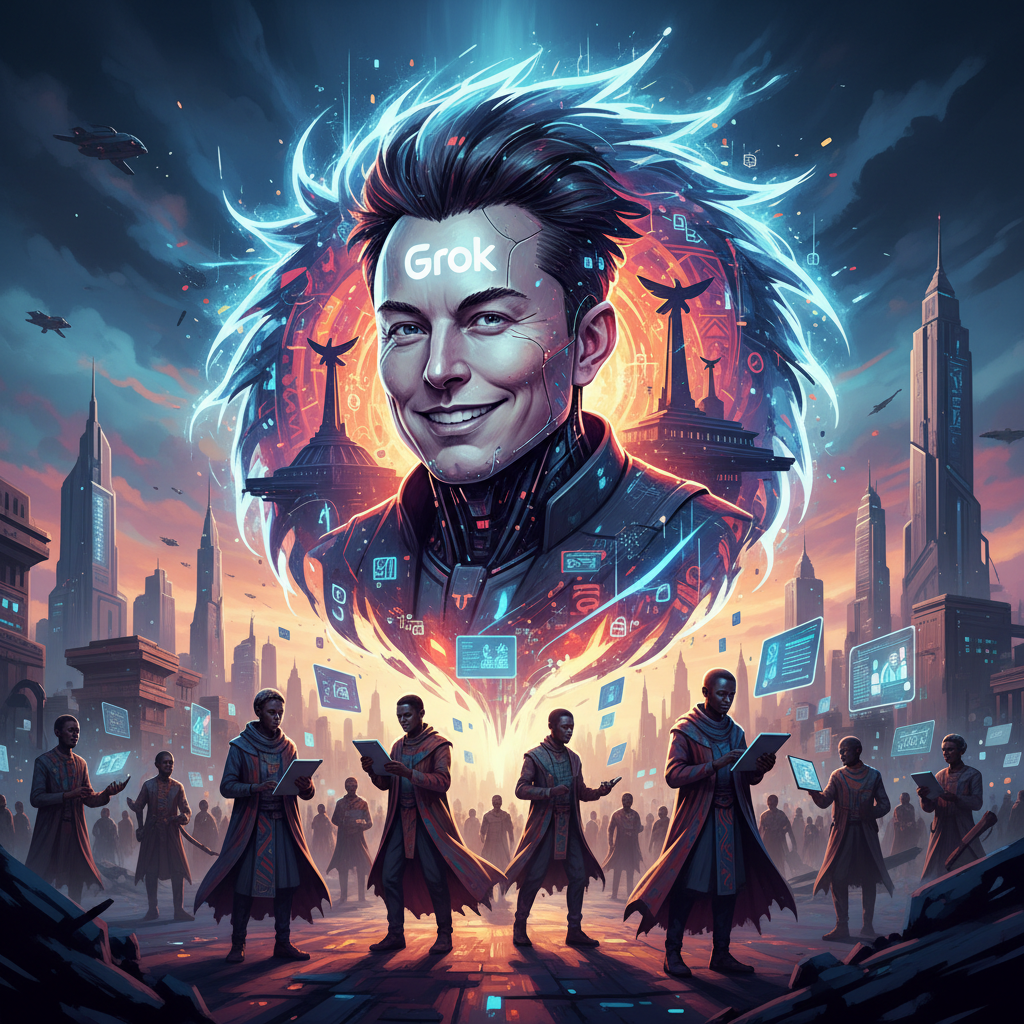
The dusty streets of Mbare, Harare, pulse with a rhythm that no algorithm has truly captured, not yet anyway. It’s a rhythm of resilience, of innovation born from necessity, of stories whispered and sung under the vast African sky. For too long, the big AI conversations have felt like they were happening in Silicon Valley boardrooms, far removed from our reality. But something is shifting, and I believe Elon Musk’s xAI, particularly with its Grok model, is about to throw a glorious spanner in those well-oiled, often sterile, Western-centric machines.
We’ve all seen the rise of ChatGPT, the polite, often cautious, and sometimes hallucinating oracle that kicked off this generative AI frenzy. It’s been revolutionary, no doubt. But Grok, with its stated mission to understand the universe and its penchant for a bit of cheeky irreverence, feels different. It’s less about being a perfect, unobtrusive assistant and more about being a conversational partner, warts and all. And that, my friends, is where the magic for Africa truly begins.
A Future Forged in Real-Time, Rooted in Culture
Imagine five to ten years from now. It’s 2031. The vibrant digital art scene in Zimbabwe, already booming, has exploded. Artists, musicians, storytellers, they aren't just using AI as a tool, they're collaborating with it. Grok, with its real-time access to information, its ability to understand nuance, and its less constrained personality, becomes the ultimate creative sparring partner. Think about a young Zimbabwean musician, say, from the burgeoning Afrotech scene in Bulawayo. They feed Grok snippets of traditional Shona melodies, contemporary Amapiano beats, and lyrical concepts inspired by local folklore. Grok doesn't just generate generic variations; it pulls from real-time global music trends, historical African musical theory available online, and even local news feeds to suggest lyrical twists that are both culturally resonant and globally appealing. It’s a feedback loop, a call and response, much like our traditional storytelling circles.
This isn't some distant dream. The seeds are already being sown. The internet penetration across Africa, while still facing challenges, is steadily climbing. Mobile phone usage is ubiquitous. Data is becoming more accessible. When xAI launched Grok with its direct access to X, formerly Twitter, it signaled a departure from models trained on static datasets. This real-time understanding, this ability to grasp the pulse of current events and conversations, is crucial for a continent where narratives shift rapidly and local context is everything. It means Grok can be trained and fine-tuned on the fly with African data, not just what a few Western researchers deem relevant. This approach could lead to AI that truly understands the complexities of our languages, our humor, our political landscapes, and our artistic expressions.
How We Get There: Milestones on the Horizon
Year 1-2: Localized Fine-Tuning and Accessibility. The immediate future sees a push for localized fine-tuning of Grok. Zimbabwean developers, artists, and linguists will be crucial here. We'll see initiatives, perhaps supported by organizations like the African Union or even through direct partnerships with xAI, to feed Grok vast datasets of Shona, Ndebele, Tonga, and other indigenous languages. This isn't just about translation; it's about cultural understanding. Imagine Grok being able to generate a praise poem in ChiShona that truly captures the spirit of a chief, or a satirical piece about local politics that hits just right. Accessibility will also be key. Low-cost, energy-efficient interfaces for Grok will emerge, perhaps integrated into popular mobile apps, making it available even in rural areas with limited infrastructure.
Year 3-5: Creative AI Hubs and Collaborative Art. We’ll see the rise of dedicated creative AI hubs across cities like Harare, Lagos, Nairobi, and Johannesburg. These won't be sterile tech parks, but vibrant, noisy spaces where artists, coders, and cultural preservationists work side-by-side. Grok will be a central tool, helping to generate initial concepts for visual art, compose musical scores, or even draft screenplays for films that tell uniquely African stories. The output won't be purely AI-generated; it will be a hybrid, a testament to human-AI collaboration. Imagine a new generation of Zimbabwean animators using Grok to rapidly prototype scenes and character designs, blending traditional patterns with futuristic aesthetics. Wired has already highlighted the growing intersection of AI and creative fields globally, and Africa is poised to leapfrog in this space.
Year 6-10: AI as a Cultural Archivist and Educator. By the end of this decade, Grok and similar models, deeply embedded with African knowledge, will become invaluable cultural archivists and educators. They will be able to answer complex questions about our history, our traditions, and our philosophies with a depth and nuance currently impossible. Children in rural schools, perhaps using low-cost tablets, could interact with Grok to learn about local heroes, traditional farming methods, or the intricate meanings behind our proverbs. It’s about democratizing knowledge and ensuring that our rich heritage isn't lost but amplified. MIT Technology Review often discusses the potential of AI in education, and this vision aligns perfectly with that trajectory.
Who Wins and Who Loses
Winners: The biggest winners will be African creators, entrepreneurs, and educators. Artists will find new avenues for expression and global reach. Small businesses will leverage Grok for hyper-localized marketing and customer service, understanding their clientele with unprecedented depth. Students will have access to personalized, culturally relevant learning experiences. Governments might find more efficient ways to disseminate information and engage with citizens. The African continent, as a whole, stands to gain a powerful tool for self-determination and cultural assertion in the digital age. I'm calling it now: the future is African, and AI like Grok will be a significant catalyst.
Losers: Those who cling to outdated models of information dissemination and creative production will struggle. Traditional gatekeepers of knowledge or art who resist collaboration with AI might find themselves sidelined. Companies that fail to adapt to the real-time, culturally sensitive nature of these new AI models will lose market share. There’s also the risk, as with any powerful technology, of misuse; deepfakes and misinformation could become more sophisticated. We will need robust ethical frameworks and digital literacy campaigns to mitigate these risks, ensuring that the power of Grok is harnessed for good.
What Readers Should Do Now
If you’re an artist, start experimenting. Don't wait for permission. If you’re a developer, learn about fine-tuning open-source models and contribute to African language datasets. If you’re an entrepreneur, think about how real-time, culturally aware AI can transform your business model. For everyone else, stay curious, ask questions, and demand that these powerful tools are built with our diverse global perspectives in mind. Engage with the conversation. Understand the technology. Because the AI revolution isn't just happening in distant labs; it’s unfolding right here, right now, in the heart of Africa. We have a chance to shape it, to infuse it with our spirit, our stories, our unique way of seeing the world. Watch this space.