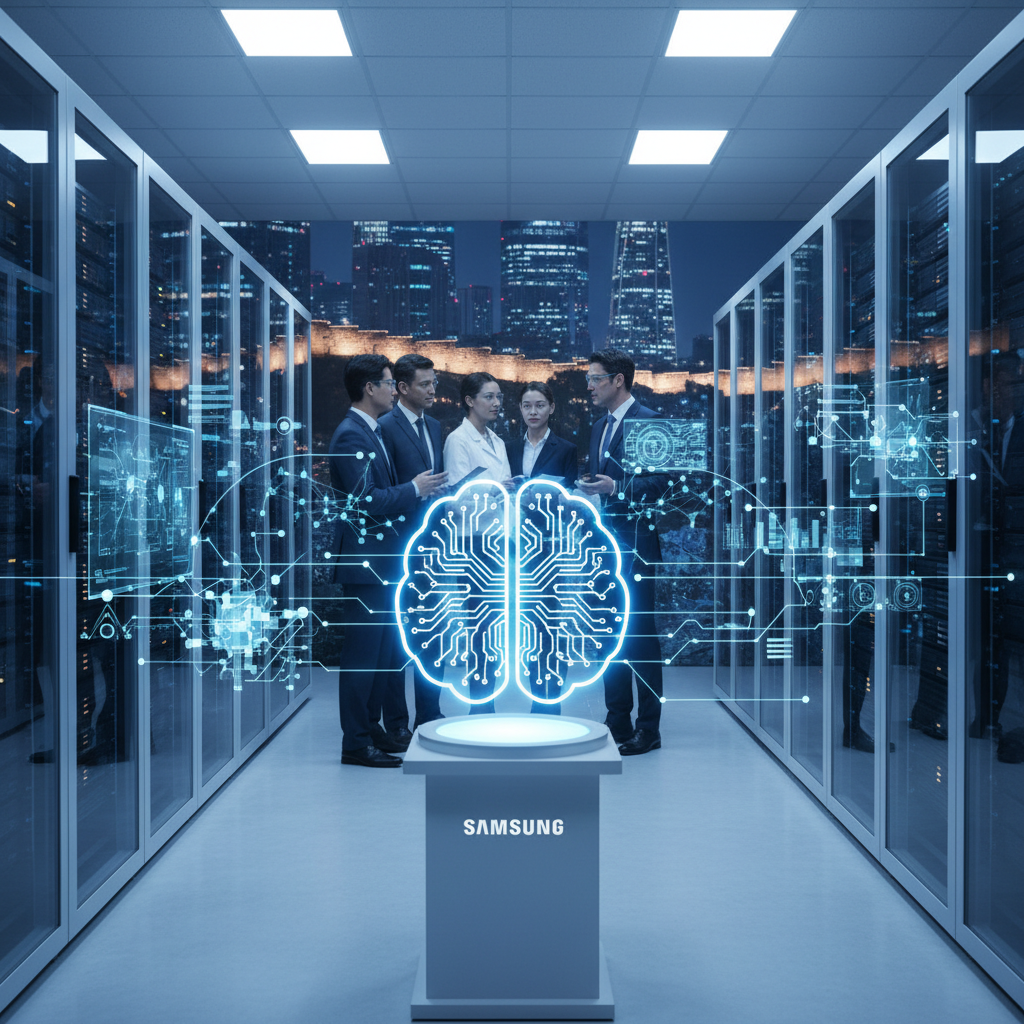

Let's be blunt: most of what passes for artificial intelligence today, especially in the public consciousness, is little more than glorified pattern matching. Large language models, for all their impressive fluency, are essentially sophisticated statistical engines predicting the next token. They excel at correlation, not causation. They mimic understanding, but do not truly reason. This isn't just an academic quibble, it's a fundamental limitation, particularly when we talk about critical applications like defense and security. When lives are on the line, or national infrastructure is at stake, we need systems that can deduce, infer, and adapt based on underlying principles, not just probabilities. And frankly, everyone's wrong about this if they think simply scaling up current models will get us there.
The technical challenge is immense: how do we build AI that can grasp abstract concepts, perform counterfactual reasoning, and make decisions in novel, unpredictable environments? This is where the real breakthroughs are happening, often far from the Silicon Valley spotlight. Seoul has a different answer, and it's rooted in a more holistic, systems-thinking approach, particularly within conglomerates like Samsung and their deep ties to national defense research.
Architecture Overview: The Hybrid Cognitive Model
The current paradigm shift involves moving towards hybrid cognitive architectures. These systems integrate symbolic AI methods, which are excellent for explicit knowledge representation and logical inference, with connectionist approaches, like neural networks, which handle perception and pattern recognition. Think of it as combining the best of both worlds: the robust, explainable reasoning of traditional AI with the flexibility and learning capabilities of modern deep learning.
One promising architecture being explored by research divisions within Samsung SDS and Hanwha Systems, often in collaboration with institutions like Kaist, is the Hierarchical Relational Graph Network (hrgn). At its core, Hrgn attempts to build a dynamic knowledge graph that isn't just static data, but a living, evolving representation of relationships and causal links. It comprises several key components:
- Perceptual Front-End: This is typically a suite of specialized deep neural networks, often transformer-based, for processing raw sensory data, whether it's visual feeds from drones, acoustic signatures, or network traffic logs. Its job is to extract entities, attributes, and low-level relationships.
- Relational Graph Constructor (RGC): This component takes the extracted information and dynamically builds a graph. Nodes represent entities (e.g., 'enemy combatant', 'weapon system', 'network anomaly', 'friendly asset'), and edges represent relationships (e.g., 'is_located_at', 'is_targeting', 'is_communicating_with', 'precedes'). Crucially, these relationships are not just learned patterns, but are often seeded with domain-specific ontologies and rules.
- Symbolic Reasoning Engine (SRE): This is the brain of the operation, employing techniques like Answer Set Programming (ASP) or first-order logic. It operates on the knowledge graph, performing logical deductions, consistency checks, and constraint satisfaction. For instance, if a rule states 'if entity A is hostile and entity B is targeting A, then B is also hostile', the SRE can infer this new relationship.
- Hypothesis Generation and Evaluation Module (hgem): When faced with uncertainty or novel situations, the Hgem proposes multiple plausible interpretations or courses of action. It leverages probabilistic graphical models (like Bayesian networks) to assign confidence scores to hypotheses and uses the SRE to check for logical consistency against the current knowledge graph.
- Adaptive Learning and Feedback Loop: This module continuously refines the RGC's ability to extract relationships and the SRE's rules based on observed outcomes and human expert feedback. This is not just backpropagation; it involves symbolic learning techniques to generalize rules from examples.
Key Algorithms and Approaches
Within the Hrgn, several algorithms are critical. For the RGC, Graph Neural Networks (GNNs) are paramount. They allow the system to learn representations of nodes and edges by aggregating information from their neighbors, making them ideal for relational inference. For example, a GNN might learn that a specific type of radar signature, when co-located with a particular vehicle type, indicates a high-value target.
The SRE relies heavily on Knowledge Graph Embeddings (KGEs). These embed the entities and relations of the knowledge graph into a continuous vector space, allowing for efficient similarity calculations and rule application. For instance, a rule might be represented as a vector transformation: embedding(head) + embedding(relation) ≈ embedding(tail).
Consider a conceptual example for a defense scenario:
FUNCTION HRGN_Reasoning(sensor_data, current_knowledge_graph):
 // Step 1: Perception
 percepts = PerceptualFrontEnd(sensor_data) // e.g., {'drone_1': {type: 'UAV', location: 'N37.5, E127.0', signature: 'IR_heat_spike'}, ...}

// Step 2: Relational Graph Construction
 new_entities, new_relations = RGC(percepts)
 updated_graph = current_knowledge_graph.add(new_entities, new_relations)
 // Example new_relation: ('drone_1', 'is_approaching', 'critical_infrastructure_A')

// Step 3: Symbolic Reasoning
 inferences = SRE(updated_graph)
 // Example inference: IF ('drone_1', 'is_approaching', 'critical_infrastructure_A') AND ('drone_1', 'is_unidentified', True)
 // Then ('drone_1', 'is_potential_threat', True)
 updated_graph.add(inferences)

// Step 4: Hypothesis Generation and Evaluation
 hypotheses = HGEM(updated_graph, 'What is the most likely intent of drone_1?')
 // Example hypothesis: {'intent': 'reconnaissance', confidence: 0.7}, {'intent': 'attack', confidence: 0.3}

// Step 5: Adaptive Learning (offline or online with human feedback)
 // Refine RGC weights and SRE rules based on ground truth

Return updated_graph, hypotheses
FUNCTION HRGN_Reasoning(sensor_data, current_knowledge_graph):
 // Step 1: Perception
 percepts = PerceptualFrontEnd(sensor_data) // e.g., {'drone_1': {type: 'UAV', location: 'N37.5, E127.0', signature: 'IR_heat_spike'}, ...}

// Step 2: Relational Graph Construction
 new_entities, new_relations = RGC(percepts)
 updated_graph = current_knowledge_graph.add(new_entities, new_relations)
 // Example new_relation: ('drone_1', 'is_approaching', 'critical_infrastructure_A')

// Step 3: Symbolic Reasoning
 inferences = SRE(updated_graph)
 // Example inference: IF ('drone_1', 'is_approaching', 'critical_infrastructure_A') AND ('drone_1', 'is_unidentified', True)
 // Then ('drone_1', 'is_potential_threat', True)
 updated_graph.add(inferences)

// Step 4: Hypothesis Generation and Evaluation
 hypotheses = HGEM(updated_graph, 'What is the most likely intent of drone_1?')
 // Example hypothesis: {'intent': 'reconnaissance', confidence: 0.7}, {'intent': 'attack', confidence: 0.3}

// Step 5: Adaptive Learning (offline or online with human feedback)
 // Refine RGC weights and SRE rules based on ground truth

Return updated_graph, hypotheses
Implementation Considerations and Benchmarks
Implementing such a system requires significant computational resources, particularly for the GNN and KGE components. NVIDIA's latest H200 GPUs are becoming standard for training, but inference also demands specialized hardware for real-time operation. The Korean government's investment in domestic AI chip development, through initiatives like the 'K-AI Semiconductor Strategy', aims to address this, reducing reliance on foreign suppliers for sensitive defense applications. This is a strategic imperative, as noted by Dr. Kim Dong-jin, a lead researcher at the Agency for Defense Development, who stated,