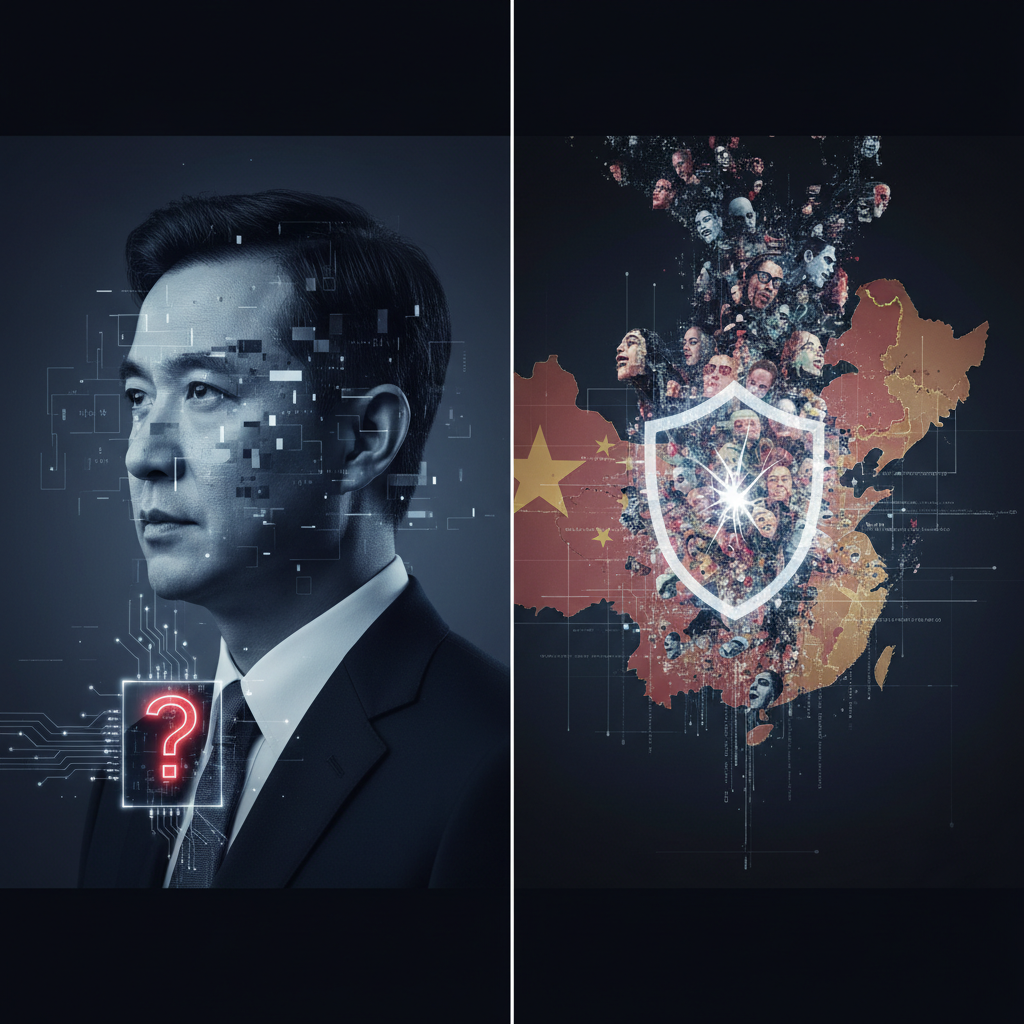

The digital battlefield of modern politics is no longer confined to traditional media or even social platforms. Today, a new, insidious weapon has emerged: the AI-generated deepfake. This technology, capable of fabricating hyper-realistic audio, video, and images, poses an existential threat to the integrity of elections worldwide. As a journalist based in China, I've watched closely as our domestic AI ecosystem, with giants like Baidu and Tencent, has advanced at a dizzying pace. The question is not if this technology will be used, but how, and what role our own tech powerhouses will play in this unfolding drama.
The Technical Challenge: Crafting a Convincing Lie
The core problem deepfake technology addresses is the creation of synthetic media that is indistinguishable from authentic content. This involves manipulating or generating human faces, voices, and even entire body movements to convey messages the original person never uttered or actions they never performed. In an election context, this means a candidate could be made to appear to endorse a rival, make a racist remark, or engage in illicit activities, all without ever doing so. The speed of dissemination on platforms like WeChat and Douyin in China, or Facebook and X globally, means a deepfake can go viral before fact-checkers even begin their work. The damage, once done, is often irreversible.
Architecture Overview: The Deepfake Forge
At the heart of most deepfake generation lies a class of artificial intelligence models known as Generative Adversarial Networks, or GANs. Imagine two neural networks locked in a perpetual game of cat and mouse. One network, the 'generator,' tries to create fake content, like a forged painting. The other, the 'discriminator,' acts as a critic, trying to distinguish between real content and the generator's fakes. Through this adversarial training, both networks improve: the generator becomes better at creating convincing fakes, and the discriminator becomes better at spotting them. This architecture is often augmented with Autoencoders or Variational Autoencoders (VAEs) for encoding and decoding facial features, or with transformer-based models for speech synthesis, similar to those used by OpenAI's GPT series or Baidu's Ernie Bot.
For video deepfakes, the process typically involves:
- Face Swapping: Replacing a source face with a target face. This is often done by extracting facial landmarks, aligning faces, and then using a GAN to generate the new face, seamlessly blending it into the target video.
- Facial Re-enactment: Manipulating the facial expressions and head movements of a person in a video to match those of a source video or audio track.
- Voice Cloning: Synthesizing speech in a target person's voice, often using text-to-speech models trained on extensive audio datasets of the target individual.
Key Algorithms and Approaches: The Devil in the Details
Let's delve a bit deeper. For face swapping, a common approach involves a two-stage process. First, a face detection algorithm, often based on convolutional neural networks (CNNs) like Mtcnn (Multi-task Cascaded Convolutional Networks), identifies faces in both source and target videos. Then, facial landmarks (eyes, nose, mouth corners) are extracted. These landmarks guide the alignment and warping of the source face onto the target. The real magic happens with the generator network, which often employs U-Net like architectures to generate high-resolution, context-aware facial textures. The discriminator, on the other hand, learns to identify inconsistencies in texture, lighting, and facial geometry that betray a fake.
Consider the pseudocode for a simplified GAN training loop for image generation:
# Initialize Generator (G) and Discriminator (D) networks
# Define loss functions (e.g., Binary Cross-Entropy)
# Define optimizers (e.g., Adam)

for epoch in range(num_epochs):
 for real_images in data_loader:
 # Train Discriminator
 noise = generate_random_noise()
 fake_images = G(noise)

 d_loss_real = D(real_images) # D tries to classify real as real
 d_loss_fake = D(fake_images.detach()) # D tries to classify fake as fake
 d_loss = d_loss_real + d_loss_fake

 d_loss.backward() # Backpropagate and update D's weights
 d_optimizer.step()

 # Train Generator
 noise = generate_random_noise()
 fake_images = G(noise)

 g_loss = D(fake_images) # G tries to fool D into classifying fake as real

 g_loss.backward() # Backpropagate and update G's weights
 g_optimizer.step()
# Initialize Generator (G) and Discriminator (D) networks
# Define loss functions (e.g., Binary Cross-Entropy)
# Define optimizers (e.g., Adam)

for epoch in range(num_epochs):
 for real_images in data_loader:
 # Train Discriminator
 noise = generate_random_noise()
 fake_images = G(noise)

 d_loss_real = D(real_images) # D tries to classify real as real
 d_loss_fake = D(fake_images.detach()) # D tries to classify fake as fake
 d_loss = d_loss_real + d_loss_fake

 d_loss.backward() # Backpropagate and update D's weights
 d_optimizer.step()

 # Train Generator
 noise = generate_random_noise()
 fake_images = G(noise)

 g_loss = D(fake_images) # G tries to fool D into classifying fake as real

 g_loss.backward() # Backpropagate and update G's weights
 g_optimizer.step()
This simplified example illustrates the core adversarial process. More advanced deepfake models incorporate perceptual loss functions, attention mechanisms, and multi-scale discriminators to produce even more convincing results. For voice cloning, techniques like Tacotron 2 or WaveNet are often used, with speaker embeddings extracted from a small sample of the target voice to imbue the synthesized speech with the target's unique timbre and prosody.
Implementation Considerations: The Cost of Deception
Developing high-quality deepfake technology is resource-intensive. It demands vast datasets of faces and voices, significant computational power (often leveraging NVIDIA GPUs), and sophisticated model architectures. Training a robust deepfake model can take weeks on clusters of A100 or H100 GPUs. The datasets themselves are a critical component. For instance, creating a convincing deepfake of a public figure requires hours of their video and audio footage, which is increasingly available online. The real story is in the supply chain, not just the algorithms. Access to high-quality data and powerful hardware is what truly differentiates state-sponsored actors or well-funded groups from amateur pranksters.
On the other side, detecting deepfakes is an equally complex challenge. Detectors often rely on identifying subtle inconsistencies: flickering artifacts, unnatural eye movements, distorted facial contours, or discrepancies in head pose and lighting. However, as generation techniques improve, detection methods must also evolve. This creates an arms race, where new generation methods quickly bypass existing detectors.
Benchmarks and Comparisons: The Evolving Battlefield
Benchmarks for deepfake generation often focus on perceptual quality (how real does it look/sound to human observers) and quantitative metrics like Fréchet Inception Distance (FID) for image quality or Mel-cepstral distortion (MCD) for audio quality. In the detection arena, metrics like accuracy, precision, recall, and F1-score are used. Companies like Google DeepMind and Meta AI have invested heavily in both generation and detection research, often publishing their findings on platforms like arXiv.
Compared to traditional video manipulation, deepfakes offer unprecedented realism and automation. What once required skilled visual effects artists and hours of work can now be achieved with a few lines of code and a trained model. This democratization of sophisticated forgery is what makes it so dangerous.
Code-Level Insights: Frameworks and Libraries
For developers looking to experiment or build deepfake detection tools, popular frameworks include TensorFlow and PyTorch. Libraries like OpenCV are crucial for video processing and facial landmark detection. Specific deepfake projects often leverage pre-trained models from Hugging Face or implement custom GAN architectures. For example, dlib is excellent for facial landmark detection, and face_recognition (built on dlib) simplifies face detection and recognition tasks. For audio, librosa and pydub are valuable for processing and manipulating sound files.
Real-World Use Cases: Beyond the Malicious
While the focus is often on malicious use, deepfake technology has legitimate applications. Consider:
- Film and Entertainment: De-aging actors, creating synthetic characters, or dubbing films into multiple languages with the original actor's voice.
- Education: Creating interactive historical figures or virtual tutors.
- Accessibility: Generating personalized avatars for individuals with communication difficulties.
- Digital Avatars: Companies like Tencent are exploring hyper-realistic digital humans for customer service and virtual assistants.
However, the potential for misuse in elections overshadows these beneficial applications. In China, where information control is paramount, the government has already implemented strict regulations on deepfake technology, requiring real-name verification for creators and mandating clear labeling of synthetic content. Beijing isn't saying this publicly, but the underlying concern is not just foreign interference, but also domestic stability.
Gotchas and Pitfalls: The Unintended Consequences
The primary pitfall is the 'liar's dividend': even when a deepfake is debunked, the initial seed of doubt remains. This erodes public trust in all media, making it harder to discern truth from fiction. Another issue is the 'deepfake paradox': the more effective deepfake detection becomes, the more sophisticated deepfake generation must become to evade it, perpetuating an endless cycle. Furthermore, the technology can be used to silence critics or discredit journalists, creating a chilling effect on free speech. We must connect the dots between technological advancement and its societal impact.
Resources for Going Deeper
For those wanting to understand the technical nuances, I recommend exploring research papers on GANs and VAEs, particularly those focusing on image-to-image translation and neural style transfer. The following resources are excellent starting points:
The threat of deepfakes to democratic processes is not a distant concern, but an immediate crisis. As AI continues its relentless march forward, the responsibility falls on technologists, policymakers, and citizens alike to understand, regulate, and combat this powerful tool of deception. The future of our information ecosystem, and indeed, our societies, depends on it.