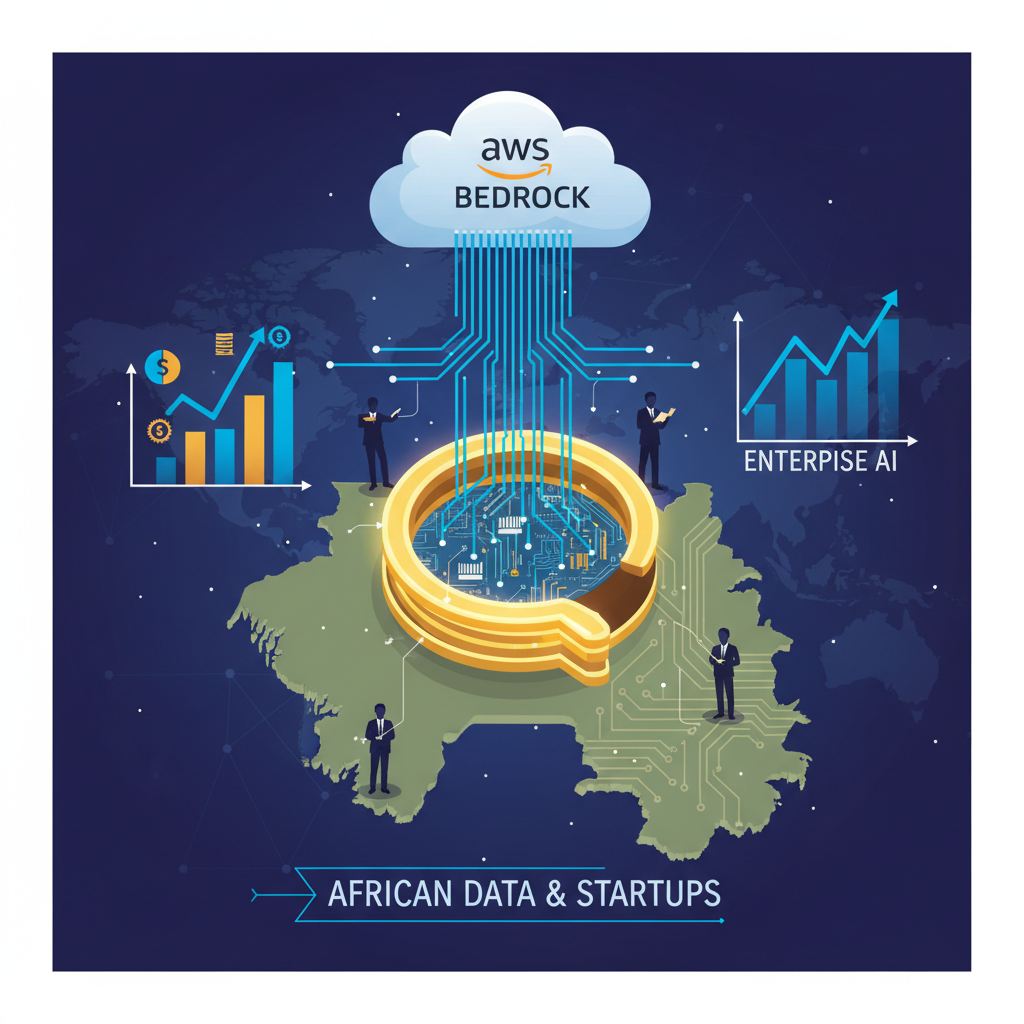

The drumbeat of artificial intelligence echoes across the globe, promising transformation, efficiency, and unprecedented growth. From the bustling markets of Conakry to the financial centers of London and New York, the conversation is dominated by large language models, generative AI, and the infrastructure required to power them. At the heart of this infrastructure race, Amazon Web Services (AWS) has made a formidable play with its Bedrock service, aiming to become the default choice for enterprises seeking to integrate AI into their operations. But here's the catch: as a journalist from Guinea, I question whether this seemingly benevolent offering is truly an equalizer or a sophisticated new form of digital dependency, particularly for developing nations.
For decades, AWS has been the undisputed titan of cloud computing, a digital landlord providing the foundational services upon which much of the modern internet is built. Their strategy with Bedrock is a logical extension of this dominance. Launched with significant fanfare, Bedrock offers a managed service that allows companies to build and scale generative AI applications using a selection of foundation models, including Amazon's own Titan family, as well as offerings from partners like Anthropic, AI21 Labs, and Stability AI. The appeal is clear: abstract away the complexity of model deployment, infrastructure management, and GPU procurement, allowing businesses to focus on application development. This proposition is particularly attractive to enterprises that lack the deep technical expertise or the financial muscle to build and maintain their own AI stacks.
Historically, the narrative of technological advancement often arrives in Africa with a dual promise: progress and control. We have seen it with telecommunications infrastructure, with resource extraction, and now, it appears, with artificial intelligence. The allure of Bedrock, with its 'pay-as-you-go' model and managed services, is undeniable for a nascent tech ecosystem like Guinea's. Small and medium enterprises, government agencies, and even academic institutions could potentially leapfrog traditional barriers to AI adoption. However, the devil is in the details. When a significant portion of our digital future becomes tethered to a single foreign provider, questions of data sovereignty, vendor lock-in, and economic leverage inevitably arise.
According to AWS's own reporting, their cloud services generated over $90 billion in revenue in 2023, a testament to their pervasive reach. Bedrock is designed to further entrench this position, making it easier for existing AWS customers to integrate AI without migrating their data or learning new platforms. “Our goal with Bedrock is to democratize access to generative AI, making it accessible and scalable for every organization, regardless of their size or technical sophistication,” stated Dr. Swami Sivasubramanian, Vice President of Data and Machine Learning at AWS, in a recent industry conference. This statement, while aspirational, must be examined through a critical lens. Democratization, in this context, often means standardization on a proprietary platform.
Consider the implications for data. African nations are increasingly aware of the strategic value of their data. From agricultural insights to public health records, this information is a national asset. When foundation models are fine-tuned or applications are built on Bedrock, where does the intellectual property reside? What are the true costs of egressing data or migrating to an alternative platform should the need arise? These are not trivial concerns. For a country like Guinea, which is still building its digital infrastructure and regulatory frameworks, the long-term implications of such dependencies are profound.
Dr. Ndeye Fatou Ngom, a Senegalese expert in digital policy and data governance, articulated this concern eloquently in a recent panel discussion. “We must be vigilant. The promise of 'easy AI' often comes with an invisible price tag: the erosion of our ability to control our own digital destiny. Relying solely on external cloud providers for foundational AI infrastructure, without developing local capacity and alternative solutions, risks creating a new form of digital colonialism,” she warned. Her words resonate deeply, reminding us of the historical patterns of economic power dynamics.
The global AI landscape is not static. While AWS Bedrock offers a compelling package, competitors are not idle. Microsoft, with its Azure OpenAI Service, and Google Cloud, with its Vertex AI platform, are also vying for enterprise dominance, each offering their own suite of foundation models and managed services. The competition, in theory, should benefit consumers. Yet, the sheer scale and integration of AWS within existing enterprise IT ecosystems make it a formidable force to counter. Many companies are already deeply invested in AWS for their core operations, making the transition to Bedrock a natural, almost inevitable, step.
I dug deeper and found something troubling. While AWS emphasizes data security and privacy, the fundamental control over the underlying infrastructure and model updates remains with Amazon. For Guinean entities, this means trusting a foreign corporation with sensitive data and critical operational logic. What happens if AWS changes its pricing structure dramatically, or if geopolitical tensions impact service availability? These are not hypothetical scenarios in a world increasingly grappling with digital sovereignty. The recent discussions around data localization and the establishment of national cloud infrastructures, even in Europe, underscore this growing anxiety. Reuters has extensively covered these global regulatory shifts.
Moreover, the talent pipeline in Guinea, while growing, still faces significant challenges. While Bedrock lowers the barrier to entry for using AI, it does not necessarily foster the deep engineering expertise required to build, customize, and innovate at the foundational model level. Our universities and technical schools need to train the next generation of engineers not just to consume these services, but to understand their inner workings, to develop local alternatives, and to contribute to the global AI commons. Without this, we risk becoming perpetual consumers rather than co-creators.
The trend of hyperscalers like Amazon offering managed AI services is undoubtedly the new normal for many enterprises globally. The convenience, scalability, and access to cutting-edge models are powerful incentives. However, for African nations, the adoption of such platforms must be accompanied by a robust national strategy for digital sovereignty. This includes investing in local data centers, fostering local AI talent, encouraging open-source alternatives, and establishing clear regulatory frameworks for data governance and intellectual property. The MIT Technology Review often highlights the ethical and geopolitical dimensions of these technological shifts.
In Guinea, we are at a critical juncture. The promise of AI to revolutionize sectors like agriculture, healthcare, and education is immense. Imagine AI-powered tools helping our farmers optimize crop yields or assisting our doctors in diagnosing diseases more accurately. But achieving this vision requires more than just adopting the latest foreign technology. It demands careful consideration of the long-term implications, a commitment to building local capacity, and a steadfast refusal to trade immediate convenience for future autonomy. The question is not whether we should use these powerful tools, but how we can use them to build our own future, on our own terms, rather than merely becoming another node in someone else's global network.