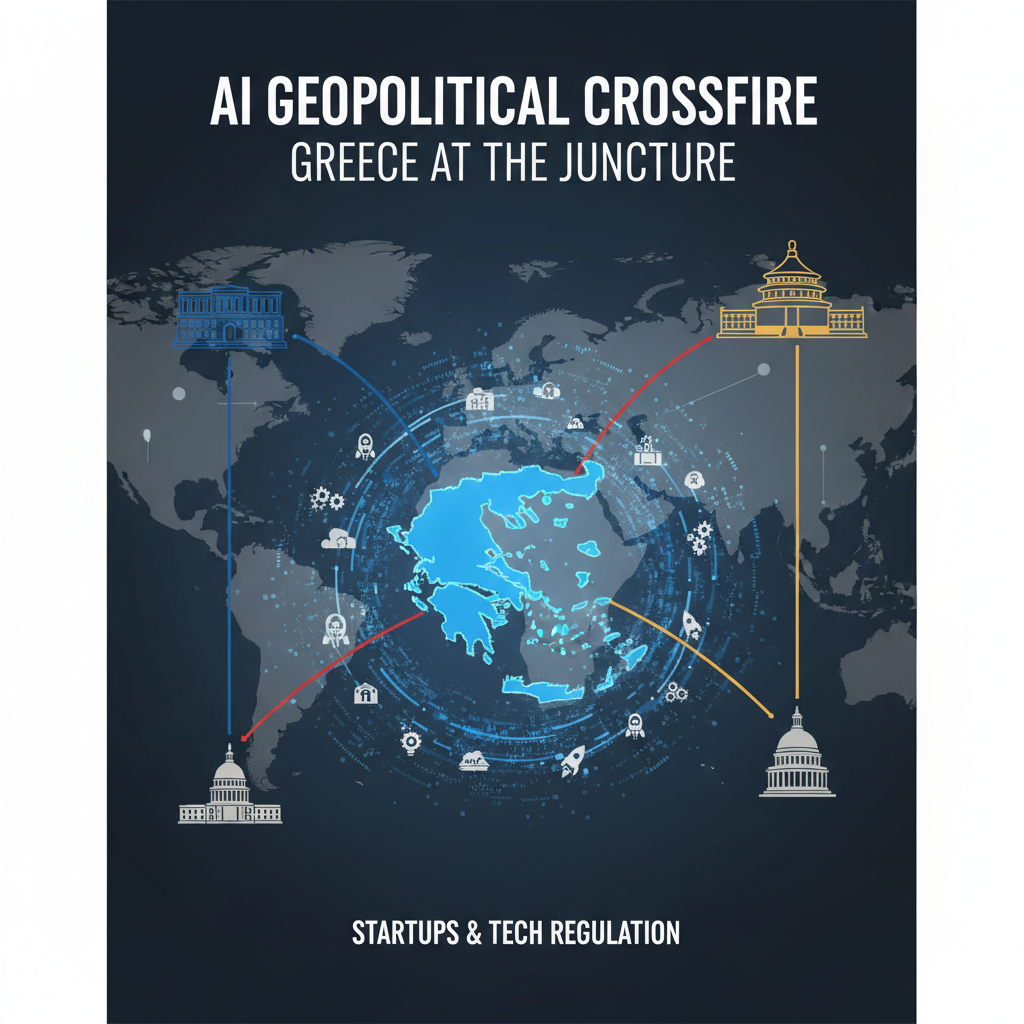
The ancient Greek philosophers, bless their prescient souls, often pondered the nature of governance, the balance of power, and the ethical dilemmas of new technologies. They couldn't have imagined artificial intelligence, of course, but their questions echo loudly in the halls of power today, from Brussels to Washington to Beijing. We are witnessing a geopolitical showdown, not with armies, but with algorithms and legislation, and the stakes are nothing less than the future of human autonomy and innovation.
Is this regulatory fervor a fleeting trend, a knee-jerk reaction to the rapid ascent of OpenAI's GPT models and Google's Gemini, or is it the new normal, a foundational shift in how we build and deploy technology? My gut, honed by decades of observing the world's slow, deliberate march, tells me it is the latter. This is not a fad, my friends, this is the inevitable reckoning.
Let us begin with Europe, always the one for comprehensive, often ponderous, legislation. The European Union's AI Act, finally approved after years of debate, stands as the world's first truly comprehensive legal framework for AI. It categorizes AI systems by risk, from minimal to unacceptable, and imposes stringent requirements on high-risk applications in areas like critical infrastructure, law enforcement, and employment. Think about facial recognition systems in public spaces, for example, or AI used for credit scoring. These will face significant hurdles and oversight. The EU's approach is rooted in its foundational values of human rights, privacy, and democratic oversight, a direct descendant of the Enlightenment ideals that shaped much of Western thought. It aims to foster trust in AI, ensuring it serves humanity rather than subjugating it. This is a bold, ambitious move, and while some critics worry it might stifle innovation, others, like Dr. Ursula von der Leyen, President of the European Commission, have championed it. She stated in a recent address, "Our AI Act is a global first, a blueprint for trustworthy AI that respects our values and promotes innovation." It is a testament to the European belief that technology must serve society, not the other way around.
Across the Atlantic, the United States, with its characteristic dynamism and market-driven philosophy, has opted for a more flexible, executive-order-driven approach. President Biden's executive order on AI, issued in October 2023, laid out a broad framework for safety, security, and responsible innovation. It directs federal agencies to establish new standards, protect privacy, and promote competition. The emphasis here is less on pre-emptive regulation and more on guiding development through federal purchasing power, research funding, and voluntary industry standards. The US approach reflects a desire to maintain its technological leadership, allowing companies like Microsoft, Google, and OpenAI to innovate rapidly, while attempting to mitigate risks as they emerge. Sam Altman, CEO of OpenAI, has often expressed a preference for agile, adaptive regulation, telling reporters, "We need to balance innovation with safety, and a heavy-handed approach too early could stifle the very progress we need." This reflects the Silicon Valley ethos: move fast, break things, then fix them.
Then we turn to China, a behemoth with a distinctly different philosophy. Beijing's approach to AI regulation is characterized by a strong state presence, a focus on national security, and a rapid implementation of rules that often prioritize social stability and economic competitiveness. China has already issued numerous regulations concerning algorithms, deepfakes, and data security, often with a clear mandate for companies to align with state interests. Their regulatory landscape is evolving at a breakneck pace, with an emphasis on controlling content, ensuring data sovereignty, and leveraging AI for surveillance and social governance. This centralized control allows for swift action, but it also raises significant questions about individual freedoms and the potential for algorithmic authoritarianism. The Chinese government sees AI as a strategic imperative, a tool for national rejuvenation and global leadership. Their regulations reflect this ambition, aiming to harness AI's power while tightly controlling its societal impact.
So, we have three distinct paths diverging in the digital forest. Europe, the philosopher king, meticulously crafting rules to protect its citizens. America, the entrepreneurial pioneer, seeking to guide innovation while minimizing friction. China, the pragmatic authoritarian, leveraging AI for state power and control. Each approach has its merits and its perils, and the interplay between them will define the global AI landscape for decades.
For a nation like Greece, nestled at the crossroads of these geopolitical currents, this regulatory showdown is not an abstract debate. It has very real implications. As a member of the European Union, Greece is bound by the AI Act, which means our nascent AI startups and research institutions must comply with its stringent requirements. This presents both challenges and opportunities. On one hand, adherence to high ethical standards could make Greek AI solutions more trusted and appealing in a global market increasingly wary of unregulated tech. On the other hand, the compliance burden could be heavy for small and medium-sized enterprises, potentially slowing their growth compared to their American or Chinese counterparts operating under different rules.
However, I believe Greece has something Silicon Valley doesn't: a deep, historical understanding of ethics, democracy, and the human condition. Athens was the birthplace of democracy, now it's reimagining AI governance. The Mediterranean approach to AI is fundamentally different. We are not just chasing efficiency or profit; we are seeking wisdom, balance, and a technology that enhances human flourishing. Our universities, like the National Technical University of Athens and the Aristotle University of Thessaloniki, are actively engaged in AI research, often with a strong emphasis on explainability, fairness, and human-centric design, aligning perfectly with the EU's ethical framework. We are seeing a rise in startups focused on niche applications, from AI-powered solutions for sustainable agriculture in the Peloponnese to intelligent systems for preserving our vast cultural heritage. These are not the 'move fast and break things' ventures, but rather 'build thoughtfully and endure' enterprises.
The data certainly supports the idea that regulation is here to stay. A recent report by MIT Technology Review indicated that global AI regulation is projected to grow significantly, with over 60 countries reportedly developing or implementing AI-specific policies. This isn't just a Western phenomenon; nations from Brazil to India are also wrestling with how to govern this powerful technology. The sheer volume of legislative activity suggests a permanent shift, not a temporary blip.
Expert opinions vary, of course. Professor Virginia Dignum, a leading AI ethics researcher at Umeå University, has often argued that "ethical guidelines are not enough; we need robust legal frameworks to ensure accountability and prevent harm." Her perspective aligns well with the EU's proactive stance. Conversely, some industry leaders, particularly in the US, voice concerns that over-regulation could push innovation offshore. "We must be careful not to stifle the very engine of progress," remarked a senior executive at a major US tech firm, who preferred to remain unnamed, during a private conversation last month. This tension between innovation and regulation is a constant balancing act.
My verdict? This regulatory showdown is absolutely the new normal. The genie is out of the bottle, and societies are grappling with its immense power. The differences in approach, however, will create a fragmented global AI landscape. Companies operating internationally will face a complex web of compliance requirements, potentially leading to 'regulatory arbitrage' where firms choose jurisdictions with more lenient rules. We might see a balkanization of AI, where different regions develop distinct AI ecosystems tailored to their regulatory environments and societal values. This is not necessarily a bad thing, as it allows for diverse models of AI development, but it will certainly add friction to global collaboration and market access.
For Greece, and indeed for Europe, the commitment to ethical AI is a long-term investment in trust and sustainability. While the US and China might outpace us in raw computational power or sheer scale of deployment, Europe's focus on responsible AI could position us as the global standard-bearer for trustworthy technology. This is our strength, our unique contribution to the digital age. We must embrace it, nurture it, and ensure that our ancient wisdom guides our modern innovations. The future of AI will not be singular; it will be a mosaic, and Europe's piece, with Greece's help, will be one of integrity and human-centric design. The dialogue has just begun, and the world is listening. For more on the ethical implications of AI, you might find this article insightful: When AI Hallucinations Become Legal Precedent: How India Will Lead the Fight Against Algorithmic Deceit, Not Just Silicon Valley's Code [blocked]. The journey ahead is long, but the path is clear: responsible innovation is the only sustainable innovation. Learn more about global AI trends at Reuters Technology.