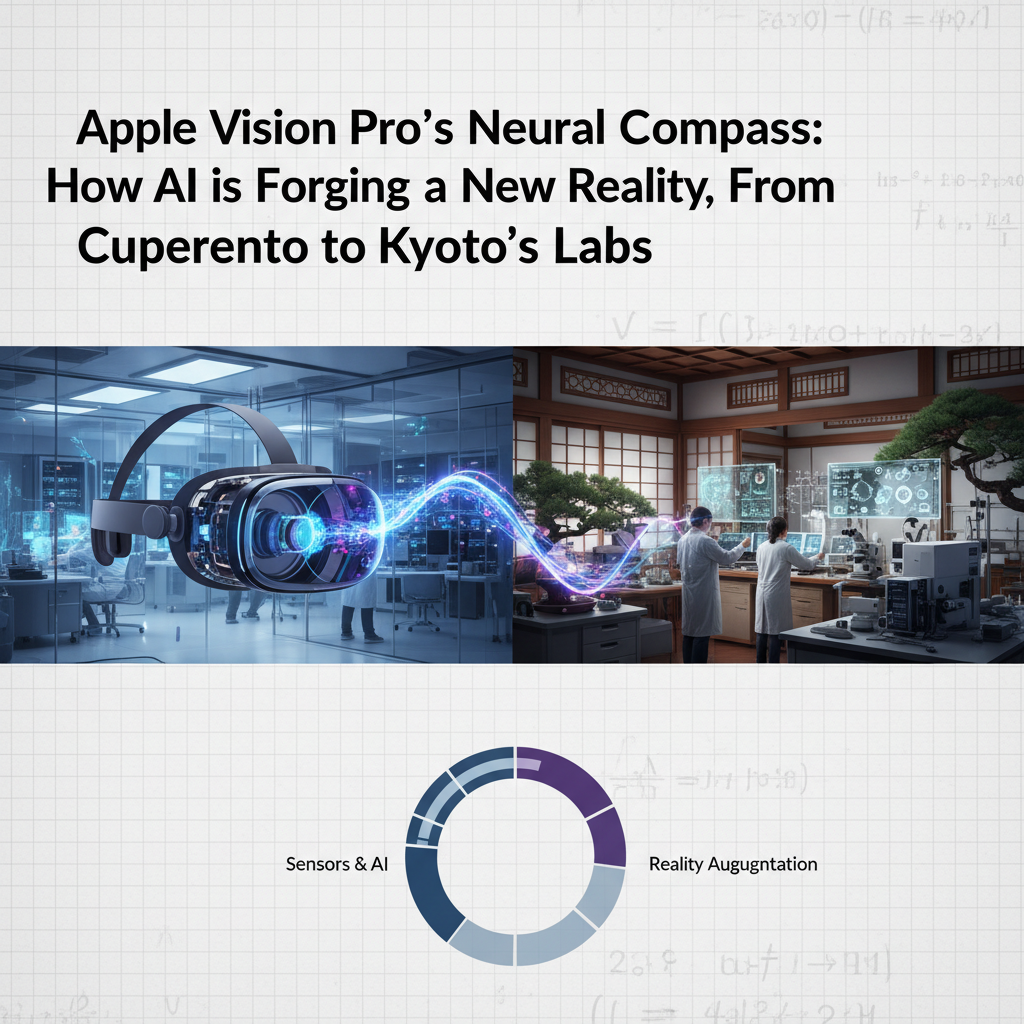

The world has always been a stage for human interaction, but with the advent of spatial computing, that stage is rapidly transforming into a dynamic, intelligent canvas. Apple's Vision Pro, a device many initially perceived as an advanced headset, is revealing itself to be a powerful AI platform, a neural compass guiding us through an augmented reality. This is not simply about projecting digital images onto the physical world, it is about understanding, interpreting, and intelligently augmenting that world in real time, a feat of engineering that resonates deeply with Japan's long-standing dedication to precision and seamless integration.
At the heart of this transformation lies a confluence of sophisticated AI research, particularly in computer vision, neural rendering, and contextual understanding. Imagine a master craftsman, meticulously observing every detail of a delicate ceramic piece. The Vision Pro, through its array of cameras and sensors, performs a similar, albeit digital, observation of your surroundings. It builds a real-time, three-dimensional map, identifying objects, surfaces, and even the subtle nuances of light and shadow. This is far more complex than simple object recognition, it is a continuous, dynamic reconstruction of reality, a digital twin of our immediate environment.
The breakthrough, in plain language, is the seamless integration of high-fidelity sensor data with advanced neural networks to create a 'digital presence' that feels intrinsically linked to our physical one. Researchers have been toiling for years on problems like Simultaneous Localization and Mapping (slam), scene reconstruction, and neural radiance fields (NeRFs). Apple has managed to package these complex computational processes into a wearable device, making them accessible and responsive. The device's R1 chip, dedicated to processing sensor input, works in concert with the M2 chip, which handles the heavy lifting of rendering and AI inference. This dual-chip architecture is a testament to the computational demands of truly immersive spatial AI.
Why does this matter? For decades, Japan has been quietly building the foundational technologies for robotics and automation, emphasizing harmonious human-machine interaction. From FANUC's industrial robots to Honda's Asimo, the goal has always been to extend human capabilities, not replace them. Spatial computing, powered by this new wave of AI, offers an unprecedented extension of our cognitive and interactive abilities. It promises to revolutionize fields from manufacturing and design to education and healthcare. Consider a surgeon practicing a complex procedure in a perfectly simulated operating room, or an architect walking through a digital model of a building on a real construction site. The potential for enhancing human expertise is immense.
Dr. Kenjiro Taura, a distinguished professor at the University of Tokyo's Department of Information Science, emphasized this point recently.