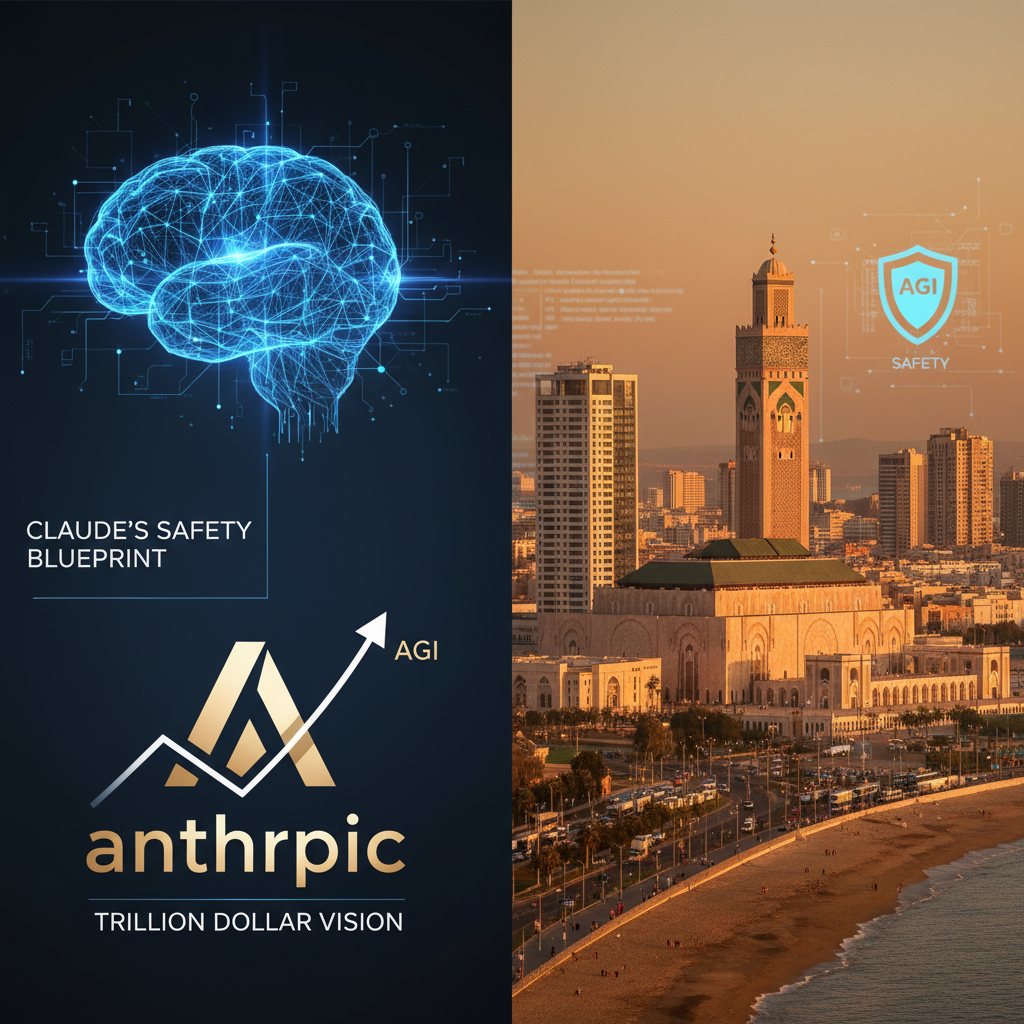
The numbers are dizzying, almost abstract in their scale. Billions, then tens of billions, now whispers of a trillion dollar valuation. Anthropic, the AI research company behind the Claude family of models, has been on a fundraising spree that makes even the most seasoned venture capitalists blink. In a world obsessed with speed and scale, Anthropic has carved out a distinct path, prioritizing 'Constitutional AI' and safety as its North Star in the race to develop Artificial General Intelligence, or AGI. But what does this relentless pursuit of capital and safety truly signify for the future, especially when viewed from a place like Morocco, where the digital future feels both imminent and distant?
Let us not forget the context. In late 2023, Amazon committed up to $4 billion to Anthropic, a move that sent ripples through the tech world. This was followed by Google's reported $2 billion investment, and then, earlier this year, reports of a further $750 million from various investors, pushing Anthropic's valuation towards the $18 billion mark. These are not mere investments, they are declarations of faith, massive bets placed on a future where AI, specifically safe AI, will redefine every aspect of human existence. Dario Amodei, Anthropic's CEO, has consistently articulated a vision where AI systems are not just powerful, but also aligned with human values. 'Our goal is to build AI systems that are safe, helpful, and honest,' Amodei stated in a recent interview, 'and we believe that this approach is not just ethically sound, but also a prerequisite for building truly beneficial AGI.'
This focus on safety, while commendable, also raises questions. Is the emphasis on 'Constitutional AI' a genuine philosophical commitment, or a strategic differentiator in a crowded market dominated by OpenAI's GPT and Google's Gemini? Perhaps it is both. In a landscape where the potential for misuse of advanced AI is a constant concern, a company that positions itself as the guardian of ethical AI could gain a significant competitive edge. The market certainly seems to think so. According to analysts, the global AI market is projected to reach over $1.8 trillion by 2030, a staggering figure that underscores the immense economic stakes involved. Anthropic's substantial funding rounds are not just about building better models, they are about securing a dominant position in this trillion-dollar future.
But let us zoom out from the Silicon Valley boardrooms and look towards the sun-baked landscapes of North Africa. What does this high-stakes game mean for us? Morocco sits at the crossroads of Africa, Europe, and the Arab world and that's our AI superpower. We are not merely observers in this technological revolution, we are potential participants, and indeed, beneficiaries. The development of AGI, even with safety guardrails, will have profound implications for labor markets, education, and economic development globally. Will these advanced AI systems be accessible and adaptable to the unique challenges and opportunities of emerging economies?
Consider the burgeoning tech scene in Casablanca. Our city is becoming the AI capital nobody expected, with a growing ecosystem of startups and research initiatives. Universities like Mohammed VI Polytechnic University (UM6P) are investing heavily in AI research, focusing on applications relevant to African contexts, from agriculture to healthcare. The question is, how do we ensure that the safety frameworks being developed by Anthropic and others are culturally sensitive and globally applicable? An AI constitution written in California might not fully address the nuances of societal values in Rabat or Marrakech.
Data, of course, is the lifeblood of AI. The Sahara is vast, but the data flowing across it is vaster, and it is this data, often unstructured and multilingual, that will be crucial for training truly global AI models. Morocco's linguistic diversity, with its blend of Arabic, French, and Amazigh, presents both a challenge and an opportunity. If AGI is to be truly general, it must understand and interact seamlessly across these linguistic and cultural divides. This is where local expertise, like that being cultivated in Morocco, becomes invaluable.
Dr. Yassine El Khlifi, a leading AI researcher at UM6P, emphasized this point recently. 'The development of AGI cannot be a monolithic effort,' he told me during a recent conference in Rabat. 'It requires diverse perspectives and datasets. Companies like Anthropic must engage with researchers and communities beyond the traditional tech hubs to ensure their safety principles are truly universal and not just reflective of a narrow cultural viewpoint.' His words resonate deeply, highlighting the need for inclusive AI development.
Moreover, the sheer computational power required to train these next-generation models is immense, demanding vast energy resources. This is an area where Morocco, with its ambitious solar energy projects, could play a significant role. Imagine AI data centers powered entirely by renewable energy from the Moroccan desert, contributing to a sustainable future for AGI development. This is not a distant dream, but a tangible possibility within the next decade.
The race to AGI is not just about who builds the most powerful model, but who builds the most responsible one. Anthropic's commitment to safety, backed by billions in funding, sets a high bar. But the true test of this commitment will be its global applicability and its willingness to incorporate diverse voices and values. As we stand on the precipice of this transformative era, it is imperative that the future of AI is shaped by more than just a handful of companies in Silicon Valley. It must be a global endeavor, reflecting the richness and complexity of humanity itself.
The implications for business are equally profound. As companies like Amazon integrate Claude into their vast ecosystems, the demand for AI talent and infrastructure will skyrocket. This presents an enormous opportunity for countries like Morocco to position themselves as key players in the global AI supply chain, not just as consumers, but as innovators and contributors. The digital transformation spurred by AGI will touch every industry, from automotive manufacturing, a sector where Morocco is already a regional leader, to financial services and public administration. The question for us is not if, but how we prepare our workforce and our infrastructure for this inevitable future.
In the grand tapestry of AI development, Anthropic's journey is a significant thread. Their massive funding rounds are not just about financial might, they are about shaping the very ethos of AGI. For us in Morocco, and indeed across Africa, the challenge and the opportunity lie in ensuring that this ethos is one of inclusion, equity, and shared progress. The future of AGI is being written now, and we must ensure our voice is heard in its composition. The stakes are too high to remain silent. For more insights on the broader AI landscape, you might find articles on TechCrunch's AI section or MIT Technology Review particularly informative. The journey to AGI is a marathon, not a sprint, and its impact will be felt for decades to come, not just quarters.