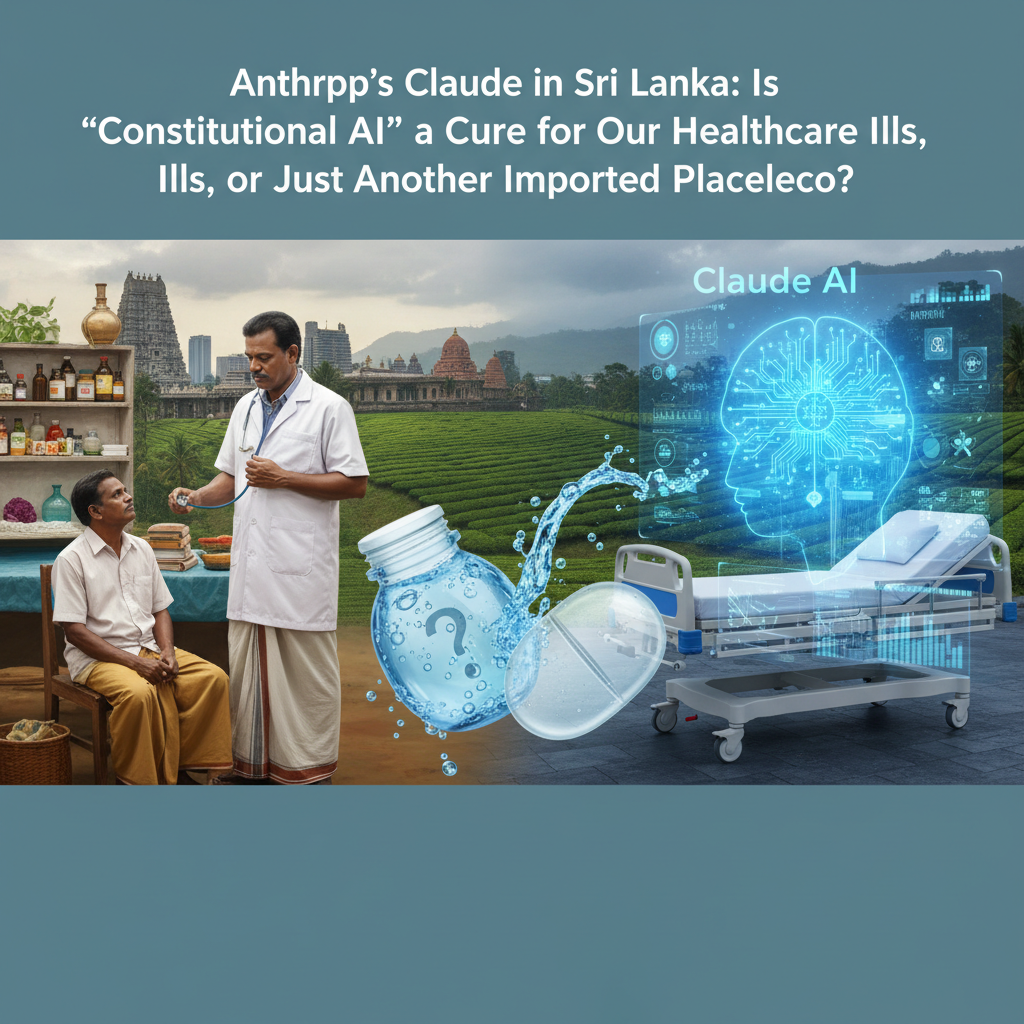
The gleaming promises of artificial intelligence often arrive on our shores like exotic cargo, heralded by marketing blitzes and utopian visions. Yet, here in Sri Lanka, where the realities of resource scarcity and systemic challenges are deeply ingrained, I find myself asking the same fundamental question: does this actually work? The latest contender vying for our attention is Anthropic, with its Claude large language model and the much-lauded 'constitutional AI' approach to safety. The company posits that by imbuing AI with a set of principles, akin to a constitution, it can self-regulate and avoid harmful outputs. A noble aspiration, certainly, particularly as we consider its application in sensitive sectors like healthcare.
I've been tracking this for months, observing the global discourse around AI safety and the increasing pressure on developers to build ethical systems. The concept of constitutional AI, where a model is trained to critique and revise its own responses based on a set of human-articulated principles, offers an intriguing alternative to purely human oversight or reinforcement learning from human feedback. Anthropic claims this method provides a scalable way to align AI behavior with desired ethical norms, reducing the incidence of bias, misinformation, or harmful advice. For a nation like Sri Lanka, grappling with a public health system that serves over 22 million people with finite resources, the allure of an ethically robust AI in healthcare is undeniable.
Consider the potential: an AI assistant for rural doctors, helping diagnose rare diseases; a tool for managing drug inventories, reducing waste; or even a patient-facing chatbot offering preliminary health advice in Sinhala and Tamil, easing the burden on overstretched medical staff. The Ministry of Health, for instance, has recently been exploring digital solutions to enhance service delivery, particularly in remote areas. Dr. Anura Wijesinghe, Director General of Health Services for Sri Lanka, recently commented, "We are cautiously optimistic about AI's role. Our priority is patient safety and equitable access. Any technology we adopt must demonstrably uphold these values, not just in theory, but in every interaction." His skepticism, I believe, is well-founded.
However, the transition from a well-funded Silicon Valley lab to the bustling, often chaotic, environment of a Sri Lankan district hospital is not a trivial undertaking. The 'constitution' guiding Claude is primarily derived from Western philosophical traditions and legal frameworks. Will these principles seamlessly translate to the nuanced cultural, ethical, and socio-economic contexts of Sri Lanka? Our healthcare system, while robust in its reach, operates under unique pressures. The doctor-patient relationship, for example, often carries a strong element of trust rooted in community and traditional values, which an AI, however 'constitutional,' might struggle to replicate or respect.
Here's what the data actually shows, or rather, what it doesn't show definitively for our region. While Anthropic has published impressive benchmarks on Claude's ability to resist harmful prompts in English, there is a distinct lack of empirical evidence demonstrating its performance and ethical alignment when dealing with Sinhala or Tamil medical queries, or when navigating the specific cultural sensitivities prevalent in Sri Lankan healthcare settings. For instance, how would Claude handle a query about traditional Ayurvedic remedies, which are a legitimate and integrated part of our healthcare landscape, without either dismissing them or endorsing unverified claims? The constitutional principles need to be culturally attuned, not just universally applied.
"The promises don't match the reality when it comes to localized application," states Professor Malini Perera, a leading expert in AI ethics at the University of Colombo. "We need to move beyond theoretical alignment. We need rigorous, independent audits of these systems within our specific operational environments. What constitutes 'harm' or 'bias' can vary significantly across cultures and socio-economic strata. An AI trained predominantly on data from developed nations might inadvertently perpetuate biases or offer recommendations that are impractical or even detrimental in our context, given our unique epidemiological profiles and resource constraints." Her point is critical; an AI that suggests an expensive diagnostic test unavailable in a rural clinic, or a treatment regimen that clashes with local dietary practices, is not helpful, no matter how 'safe' it is deemed by its creators.
Furthermore, the very definition of 'safety' in AI is a moving target. Is it merely avoiding toxic language, or does it extend to preventing medical errors, ensuring data privacy in a context where digital literacy varies widely, and promoting health equity? The Sri Lankan Data Protection Act, enacted in 2023, provides a framework, but the practicalities of enforcing it with advanced AI systems are still being explored. Imagine a scenario where Claude, in its pursuit of 'safety,' refuses to provide information on a sensitive health topic, perhaps due to a misinterpretation of local social norms, thereby denying a patient crucial access to information. This could be more harmful than a less 'constitutional' but more context-aware system.
Another critical aspect is the infrastructure required to deploy and maintain such sophisticated AI. Anthropic's Claude, particularly its more powerful iterations, demands significant computational resources. Can Sri Lanka afford the high-end GPUs and cloud infrastructure necessary for widespread deployment? And who will train and maintain these models? We have a burgeoning tech sector, certainly, but the specialized expertise required for ethical AI deployment in healthcare is still nascent. "We cannot simply import a black box and expect miracles," notes Mr. Rohan Fernando, CEO of Lanka AI Solutions, a local AI consultancy. "We need local capacity building, local data, and local oversight. Without that, even the most 'constitutional' AI becomes another dependency, another foreign solution to a deeply local problem." He emphasizes the need for a collaborative approach, perhaps even open-sourcing aspects of the 'constitution' to allow for local adaptation and scrutiny, a point I wholeheartedly endorse.
My investigation suggests that while the concept of constitutional AI is a commendable step towards more responsible AI development, its direct translation to the complex realities of Sri Lankan healthcare is far from guaranteed. The enthusiasm from Silicon Valley often overlooks the ground-level challenges and the imperative for cultural and contextual adaptation. We must demand more than just assurances; we require demonstrable, localized proof of concept, transparent methodologies, and a genuine commitment to co-creation, not just deployment. Until then, the promise of an ethically safe AI, while alluring, remains largely theoretical for the patients and practitioners navigating our healthcare system. The future of AI in Sri Lanka's healthcare will not be written by algorithms alone, but by our ability to critically adapt, question, and integrate these powerful tools with our unique societal fabric. For further insights into global AI developments, one might consult Reuters Technology for broader industry trends or MIT Technology Review for deeper analysis of emerging technologies. The conversation around ethical AI is global, but its impact is profoundly local. We must ensure our voice is heard in shaping its future.