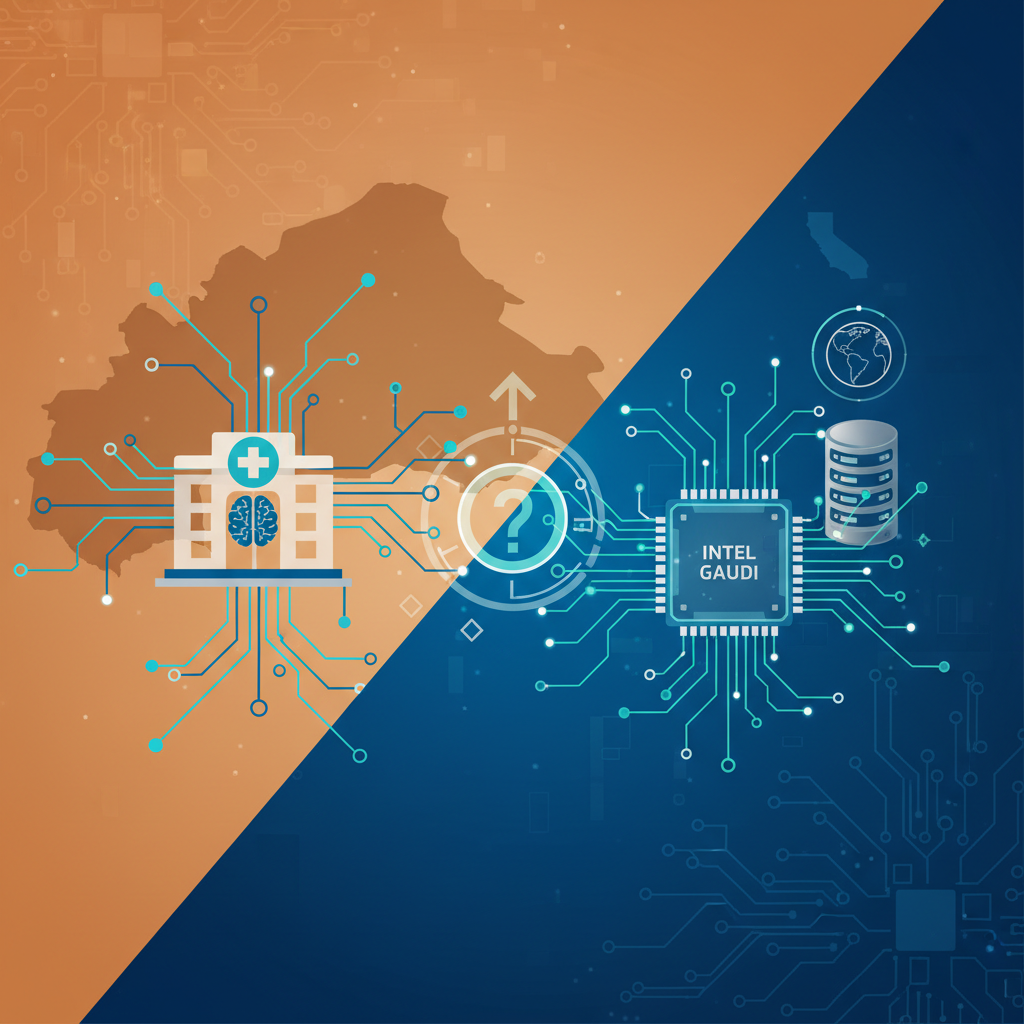
My friends, my family, everyone in Burkina Faso knows the rhythm of life here. It is vibrant, it is resilient, and it is always, always moving forward. But when it comes to healthcare, we often feel the weight of what is missing. Imagine a future where a small clinic in a remote village, powered by the magic of artificial intelligence, can diagnose illnesses with incredible accuracy, faster than ever before. This is not a dream, my friends, this is the promise of AI, and it is a promise that hinges on the very chips we are talking about today.
For a long time, when you thought of powerful computing, you thought of Intel. Their name was synonymous with innovation, with pushing the boundaries of what computers could do. But then, the AI revolution exploded, and suddenly, the landscape shifted. NVIDIA, with its GPUs, became the undisputed champion, the king of the AI hill. Their Cuda platform, their sheer processing power, it felt like they had an unshakeable grip on the future of AI. For us, watching from places like Ouagadougou, it felt like another technology passing us by, another barrier to accessing cutting edge tools.
But Intel, oh, Intel is not one to sit quietly. They are a titan, a giant of the industry, and they have been working tirelessly to catch up, to innovate, to carve out their own space in this thrilling new world. Their answer? The Gaudi series of AI accelerator chips. These are not just any chips; these are designed from the ground up for AI workloads, especially for training those hungry, complex deep learning models that power everything from medical imaging analysis to drug discovery. The question burning in my mind, and I know in the minds of many here, is whether these new chips can truly level the playing field, or if they are just another piece of the puzzle for the tech giants.
Historically, Intel dominated the CPU market, the brains of our computers for decades. But AI, particularly deep learning, demands a different kind of brain. It needs parallel processing on a massive scale, something GPUs excel at. NVIDIA saw this coming, invested heavily, and built an ecosystem that is incredibly hard to penetrate. Their market share in AI accelerators is reportedly well over 80 percent, a truly staggering figure. This dominance means that many of the most advanced AI models and frameworks are optimized for NVIDIA's hardware, creating a kind of 'walled garden' that makes it difficult for competitors to gain traction. It is like everyone is learning to speak one language, and if you do not speak it, your voice is not heard as loudly.
However, Intel’s strategy with Gaudi is different. They are not just trying to build a faster chip, they are trying to build a more accessible one. The Gaudi 2 and the newer Gaudi 3 chips are designed to offer competitive performance at a lower cost, and perhaps more importantly, with a more open software stack. This is crucial. If the tools to build and deploy advanced AI are only available to those with massive budgets, then the benefits will remain concentrated. But if Intel can offer a powerful, cost effective alternative, it could unlock a whole new wave of innovation.
“The cost of AI compute is a significant barrier for many organizations, especially those in emerging markets,” said Dr. Aisha Diallo, a leading AI researcher at the University of Ouagadougou. “If Intel can deliver on its promise of high performance per dollar, it could enable local startups and research institutions to develop solutions tailored to our specific challenges, like diagnosing neglected tropical diseases or optimizing supply chains for essential medicines.” Her words echo what many of us feel here. We need solutions that are not just powerful, but practical and affordable.
Intel has been making some serious moves. They have partnered with companies like Stability AI, a leader in open source generative AI, to optimize their models for Gaudi chips. This focus on open source is a breath of fresh air. It means that the knowledge, the tools, and the power of AI are not locked behind proprietary systems. This changes everything for developers and researchers in places like Burkina Faso, who often rely on open source tools to build their innovations. It is about empowering the local talent, the young minds in our maker spaces who are already coding the future with such passion.
“We are seeing a growing demand for diverse hardware options in the AI ecosystem,” stated Pat Gelsinger, Intel’s CEO, in a recent interview with Bloomberg Technology. “Our Gaudi platform is designed to provide compelling performance and total cost of ownership, giving customers more choice and flexibility.” This sentiment is precisely what we need. Choice fosters competition, and competition drives down costs and pushes innovation further. For healthcare AI, this means potentially more affordable and accessible diagnostic tools, more efficient drug discovery, and better patient outcomes, even in resource-constrained environments.
But is it enough? NVIDIA is not standing still. They continue to innovate at a breakneck pace, releasing new generations of GPUs like the Blackwell platform, which promises even more astronomical performance. The ecosystem they have built, with Cuda as its backbone, is deeply entrenched. Developers are comfortable with it, and switching costs can be high. It is like trying to convince a whole country to switch from driving on the right side of the road to the left; it is a massive undertaking, even if the new way is arguably better.
However, the tide is slowly turning. The industry is realizing that relying on a single vendor for critical AI infrastructure is risky. Companies like Microsoft, Google, and Amazon are all developing their own custom AI chips, like Microsoft’s Maia and Google’s TPUs, to reduce their dependence on NVIDIA and optimize for their specific cloud workloads. This diversification is a clear signal that the market is hungry for alternatives. Intel, with its long history in chip manufacturing and its deep relationships across the enterprise sector, is uniquely positioned to capitalize on this shift.
For us in Burkina Faso, the implications are profound. Imagine a future where medical images, like X-rays and ultrasounds, can be analyzed by AI models running on affordable, locally deployable Intel Gaudi accelerators. This could help overcome the shortage of specialized radiologists in rural areas, providing rapid and accurate diagnoses. We have brilliant young minds, like the students I meet at the Centre National de la Recherche Scientifique et Technologique, who are eager to build these solutions. They are the ones who will take these powerful tools and adapt them to our unique context, to our local languages and our specific health challenges. The revolution is being coded right now, not just in Silicon Valley, but in every corner of the globe.
My verdict? Intel’s fight for relevance with Gaudi chips is far from a fad; it is the new normal. The demand for diverse, cost effective, and powerful AI hardware is only going to grow. While NVIDIA’s dominance will not vanish overnight, Intel’s strategic focus on open source and competitive pricing, especially in sectors like healthcare, presents a genuine opportunity. It is an opportunity for places like Burkina Faso to leapfrog traditional infrastructure limitations and embrace the transformative power of AI. We are not just spectators in this global race; with the right tools and the right spirit, we can be participants, builders, and innovators. This is not just about chips; it is about empowerment, about health, and about a brighter future for all. You can read more about the broader trends in AI hardware on TechCrunch. The future is not just coming, my friends, it is being built, chip by chip, right now.