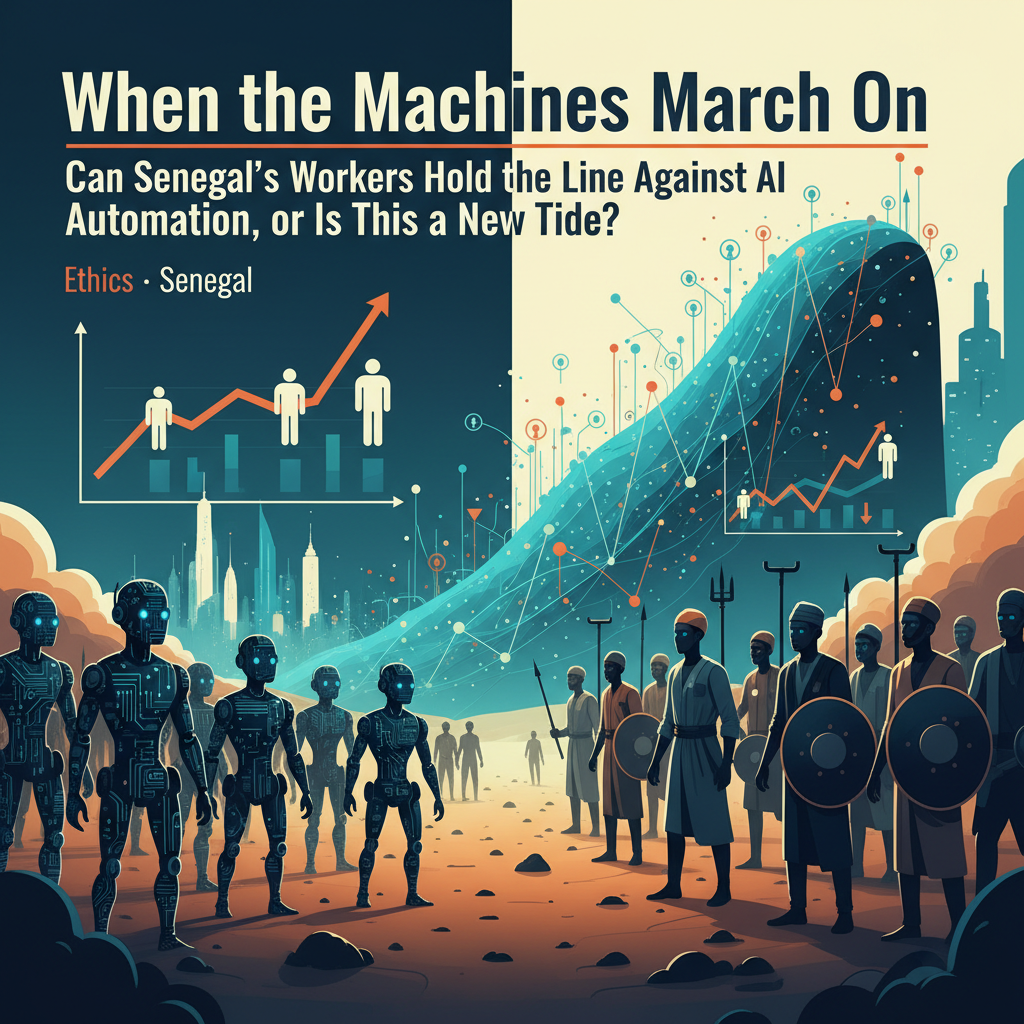

In Senegal, we often say, "Nit nitay garabam," which means "Man is the remedy for man." It speaks to our deep belief in community, in looking out for one another. But what happens when the very fabric of our work, our livelihoods, is threatened not by another person, but by an unseen force, a digital hand reaching into our factories, our call centers, our very lives? This is the question that keeps many awake at night, from the talibés in the street to the ministers in their offices, as artificial intelligence begins to reshape the world of work.
Is this pushback from labor unions and worker movements against AI-driven automation just a passing storm, a temporary resistance to the inevitable, or is it the beginning of a new normal, a fundamental shift in how we negotiate our relationship with technology? I sat down with people from all walks of life, from the docks of Dakar to the burgeoning tech hubs, to understand this complex dance between human labor and intelligent machines.
For generations, the rhythm of life in Senegal, like much of Africa, has been deeply intertwined with manual labor. From the farmers tilling the soil to the artisans crafting their wares, hands have built our nation. Now, the promise, or perhaps the threat, of AI is changing this. Globally, the narrative around AI and jobs has been a rollercoaster. Initially, there was widespread fear of mass unemployment, a robotic apocalypse. Then came the more nuanced view, suggesting AI would augment, not replace, human workers, creating new jobs even as it automated old ones. But the reality, as always, is far more complicated, particularly for economies like ours.
Consider the story of Mariama, a woman whose hands have sorted cashews at a processing plant near Thiès for fifteen years. Her work is meticulous, her eyes sharp, her experience invaluable. Recently, her plant invested in an AI-powered sorting system, promising higher efficiency and reduced waste. "Li xew ci suñuy liggéey, du dara luñu xamoon," she told me, her voice tinged with worry, meaning "What is happening to our work, it is nothing we have known." Her eyes lit up when they told me about the fear among her colleagues, the whispers of reduced shifts, of fewer hands needed. The union, Syndicat des Travailleurs de l'Agro-Industrie (stai), has been actively engaging with management, not to stop the technology, but to ensure fair transitions, retraining, and a share in the increased profits.
This sentiment is not unique to Senegal. Across the globe, from Hollywood writers striking against AI-generated scripts to German factory workers demanding a say in automation implementation, the pushback is palpable. A recent report by the MIT Technology Review highlighted that nearly 60% of global labor unions have either initiated discussions or taken concrete actions regarding AI's impact on their members' jobs and working conditions in the last two years. This represents a significant increase from just five years ago, indicating a growing awareness and organized response.
Historically, technological advancements have always brought about shifts in labor. The Industrial Revolution, the advent of computers, each era saw jobs disappear and new ones emerge. But what makes AI different, many argue, is its pervasive nature and its ability to perform cognitive tasks previously exclusive to humans. As Professor Ousmane Dia, an economist at Cheikh Anta Diop University in Dakar, explained, "The pace of change with AI is unprecedented. Our institutions, our social safety nets, are not built to adapt this quickly. We risk leaving many behind if we do not proactively manage this transition." He emphasized that unlike previous waves of automation, AI can impact white-collar jobs as much as blue-collar ones, creating a broader spectrum of concern.
In the United States, the Screen Actors Guild American Federation of Television and Radio Artists (sag-aftra) went on strike, partly over concerns about AI being used to replicate actors' likenesses without fair compensation. Similarly, the United Auto Workers (UAW) have included AI and automation clauses in their recent negotiations with major automakers like General Motors, Ford, and Stellantis, seeking protections and a share of the productivity gains for their members. These are not small, isolated incidents; they are coordinated efforts by powerful unions to shape the future of work.
Even tech giants are feeling the pressure. Companies like Google and Microsoft, while championing AI, are also facing internal discussions and external scrutiny regarding their own workforce. While they often frame AI as a tool for augmentation, the reality of job displacement in certain roles, particularly in areas like customer service, data entry, and even some programming tasks, is becoming harder to ignore. The rise of sophisticated large language models like OpenAI's GPT-4 and Anthropic's Claude 3 has accelerated this, demonstrating capabilities that were once thought to be years away.
In Senegal, the Confédération Nationale des Travailleurs du Sénégal (cnts), our largest labor federation, has begun holding workshops and dialogues with government bodies and employers. "Our goal is not to resist progress," said Fatou Ndiaye, a senior official at Cnts. "Njang ak jàngale mooy jëmm ji, learning and teaching is the way forward. We must educate our members, empower them, and negotiate for a future where technology serves humanity, not the other way around." She pointed to the need for government investment in digital literacy programs and vocational training tailored to the skills demanded by an AI-driven economy.
One area where this tension is particularly evident is in the gig economy. Platforms like Uber and Glovo, which rely heavily on algorithmic management, are already present in Dakar. While they offer flexibility, they also create a precarious work environment where human workers often feel like cogs in a machine, with little recourse against algorithmic decisions. The struggle for fairer conditions and greater transparency in these platforms, as seen in many European cities, is slowly making its way to our shores. The article "When the Algorithm Becomes the Foreman: How Uber and Bolt's AI Orchestrates Labor in Poland's Gig Economy" at /article/when-the-algorithm-becomes-the-foreman-how-uber-and-bolts-ai-orchestrates-labor-in-polands-gig-economy-monlqjdo [blocked] highlights similar challenges faced by workers elsewhere.
So, is this a fad or the new normal? My analysis, after many conversations and much reflection under the baobab trees, leans heavily towards the latter. This is not a fleeting trend; it is a fundamental re-evaluation of the social contract between labor, capital, and technology. The sheer scale and speed of AI's development mean that its impact will be deep and lasting. Workers are no longer passively waiting to see what happens; they are actively demanding a seat at the table.
Governments, businesses, and unions must collaborate to navigate this new landscape. This means investing in education and retraining programs, fostering a culture of lifelong learning, and exploring new models of wealth distribution that account for AI's productivity gains. It also means establishing ethical guidelines and regulatory frameworks for AI deployment in the workplace, ensuring transparency and accountability.
As the sun sets over the Atlantic, casting long shadows across the fishing boats returning to shore, I am reminded of another Wolof proverb: "Yàlla moo gën a xam li nekk ci suñu kanam, God knows best what is ahead of us." While we cannot predict the future with certainty, we can shape it. The pushback against AI automation is not merely resistance; it is a call for a more human-centered approach to technological progress, a demand for dignity and fairness in an increasingly automated world. This is a story about people, not algorithms, and their unwavering spirit to ensure that the future of work benefits all, not just a select few. The conversations have just begun, and they will only grow louder. The world is watching, and so am I. For more insights into the evolving relationship between technology and society, you can always check out Wired's AI section.