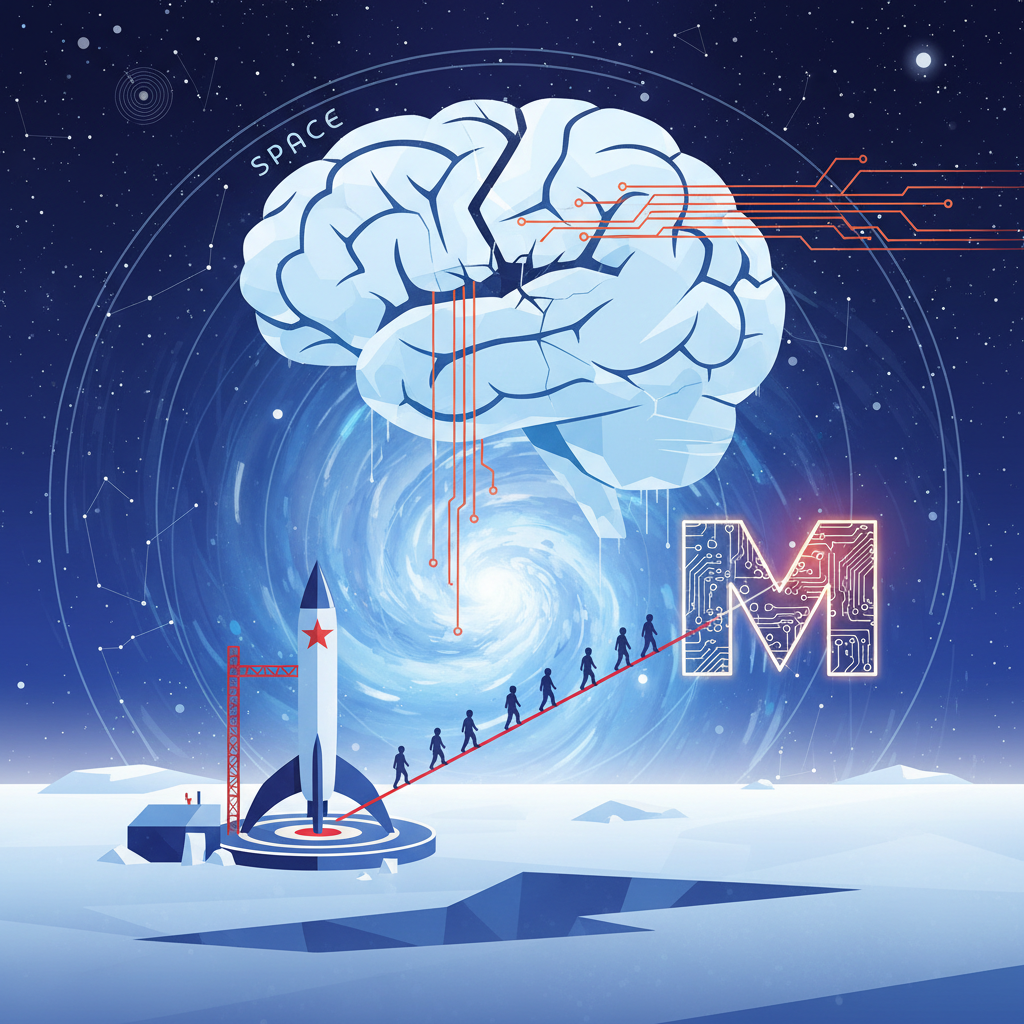

Is the saga of Inflection AI, a startup once valued at $4 billion, now effectively dissolved into Microsoft, a singular anomaly or the chilling harbinger of a new normal in the artificial intelligence sector? This question resonates with particular intensity here at Vostok Station, where the stark realities of resource allocation and the consolidation of expertise are daily concerns. The recent development, where Microsoft not only hired Inflection AI's entire founding team, including CEO Mustafa Suleyman, but also integrated much of its technical staff, represents a strategic maneuver that demands rigorous analysis.
Historically, the technology landscape has witnessed numerous acquisitions, often driven by a desire to absorb intellectual property or eliminate competition. However, the Inflection AI scenario presents a nuanced evolution. This was not a conventional acquisition of assets, but rather a targeted absorption of human capital, a 'talent acquisition' on an unprecedented scale. Inflection AI, backed by significant investments from luminaries such as Reid Hoffman, Bill Gates, and NVIDIA, had aimed to build personal AI, a companion model designed for conversational interaction. Its flagship product, Pi, garnered attention for its empathetic and helpful responses. Yet, despite raising approximately $1.3 billion, the company found itself in a position where its most valuable asset, its people, became the primary target for a tech giant.
Consider the historical parallels. In the early days of computing, talent flowed freely between nascent companies, often driven by the allure of groundbreaking research or the promise of significant equity. However, the sheer scale of investment required for modern large language models, often exceeding hundreds of millions or even billions for compute infrastructure alone, has created an environment where only a handful of entities can truly compete at the frontier. The data from our Antarctic station reveals that the computational demands for training cutting-edge AI models have increased exponentially, doubling approximately every six months, far outstripping Moore's Law. This necessitates access to vast GPU clusters, a resource primarily controlled by a few hyperscalers like Microsoft, Amazon, and Google. This fundamental reality creates a gravitational pull, drawing smaller, well-funded startups into the orbits of larger corporations.
Multiple expert perspectives illuminate this trend. Dr. Anna Petrova, a leading economist specializing in technology markets at the Russian Academy of Sciences, noted, "This isn't merely a brain drain, it's a strategic re-alignment of the entire intellectual infrastructure. Smaller entities, even well-funded ones, struggle to maintain the necessary compute resources and data pipelines required to innovate at the bleeding edge. Microsoft's move was a masterclass in leveraging its existing ecosystem." Her assessment underscores the immense capital expenditure required to train foundation models, a barrier to entry that is becoming increasingly insurmountable for independent players.
Similarly, Professor David Patterson, a Turing Award laureate and distinguished computer scientist, has often spoken about the increasing concentration of AI research within large corporations. While not directly commenting on Inflection, his remarks on the 'AI oligopoly' are pertinent. "The cost of building truly transformative AI models is so high that it naturally funnels talent and resources towards those with the deepest pockets," Patterson stated in a recent interview with MIT Technology Review. "This concentration, while potentially accelerating certain advancements, also poses questions about diversity of thought and the long-term health of the broader AI research ecosystem."
From a corporate strategy standpoint, Microsoft's decision is logical. By bringing Suleyman, a co-founder of DeepMind and Inflection AI, into a leadership role for a new consumer AI division, Microsoft gains not only a highly respected leader but also a team with proven expertise in developing conversational AI. This move strengthens Microsoft's position against competitors like Google and OpenAI, particularly in the race to integrate advanced AI into consumer products and services, such as its Copilot offerings. It is a testament to the adage that in the digital age, talent is the ultimate currency. At -40°C, technology behaves differently, and so too does the talent market. The harsh environment here teaches us that resources are finite, and their efficient allocation is paramount for survival. This principle, it seems, applies equally to the frigid landscape of high-stakes AI development.
However, the implications extend beyond corporate balance sheets. For the broader AI community, this trend raises concerns about innovation and competition. If every promising AI startup eventually becomes an acquisition target for the few tech behemoths, will it stifle the vibrant, independent research that has historically driven many breakthroughs? The allure of a multi-billion dollar valuation and subsequent acquisition can be a powerful motivator for entrepreneurs, but if the ultimate outcome is always absorption, it could lead to a monoculture of ideas, where innovation is primarily dictated by the strategic objectives of a few dominant players.
For regions like Russia and our scientific community in Antarctica, this trend has specific resonance. Our research, often conducted with limited resources compared to global tech giants, relies heavily on open science and the ability to leverage publicly available models and research. The consolidation of cutting-edge AI development within a few corporations could restrict access to foundational technologies, making it harder for independent researchers and smaller nations to contribute meaningfully to the global AI discourse. The Russian AI sector, for instance, has been focusing on developing robust, domestically-sourced AI solutions, and the increasing centralization of foundational models globally presents both a challenge and an impetus for self-sufficiency.
The future of AI, therefore, appears to be bifurcated. On one hand, we will likely see continued rapid advancements, fueled by the immense resources and concentrated talent within these mega-corporations. On the other hand, the space for truly independent, frontier-pushing AI research outside these corporate walls may shrink, leading to a more homogenous technological landscape. This is not to say that innovation will cease, but its vectors may become more predictable, more aligned with commercial imperatives rather than purely scientific exploration.
My verdict, informed by the unforgiving logic of science at the bottom of the world, is that this is not a fad but a new normal. The economic realities of developing advanced AI models are too stark to ignore. The capital intensity, the demand for specialized talent, and the strategic imperative for market dominance will continue to drive this consolidation. We will likely see more instances where the 'implosion' of a highly-funded startup is merely a prelude to its 'rebirth' within a larger entity. The era of the truly independent, world-changing AI lab, operating outside the gravitational pull of the tech giants, may be drawing to a close. This consolidation, while perhaps efficient, demands vigilance to ensure that the pursuit of technological advancement does not inadvertently narrow the pathways for diverse innovation and equitable access to this transformative technology. The question is no longer if the ice will crack, but rather, who will control the waters once it does. For further reading on the dynamics of AI talent, one might consult articles on TechCrunch. The implications for global technological sovereignty are profound, and our observations from the Antarctic underscore the importance of understanding these shifts, not just for economic competitiveness, but for the very future of scientific inquiry and human progress.