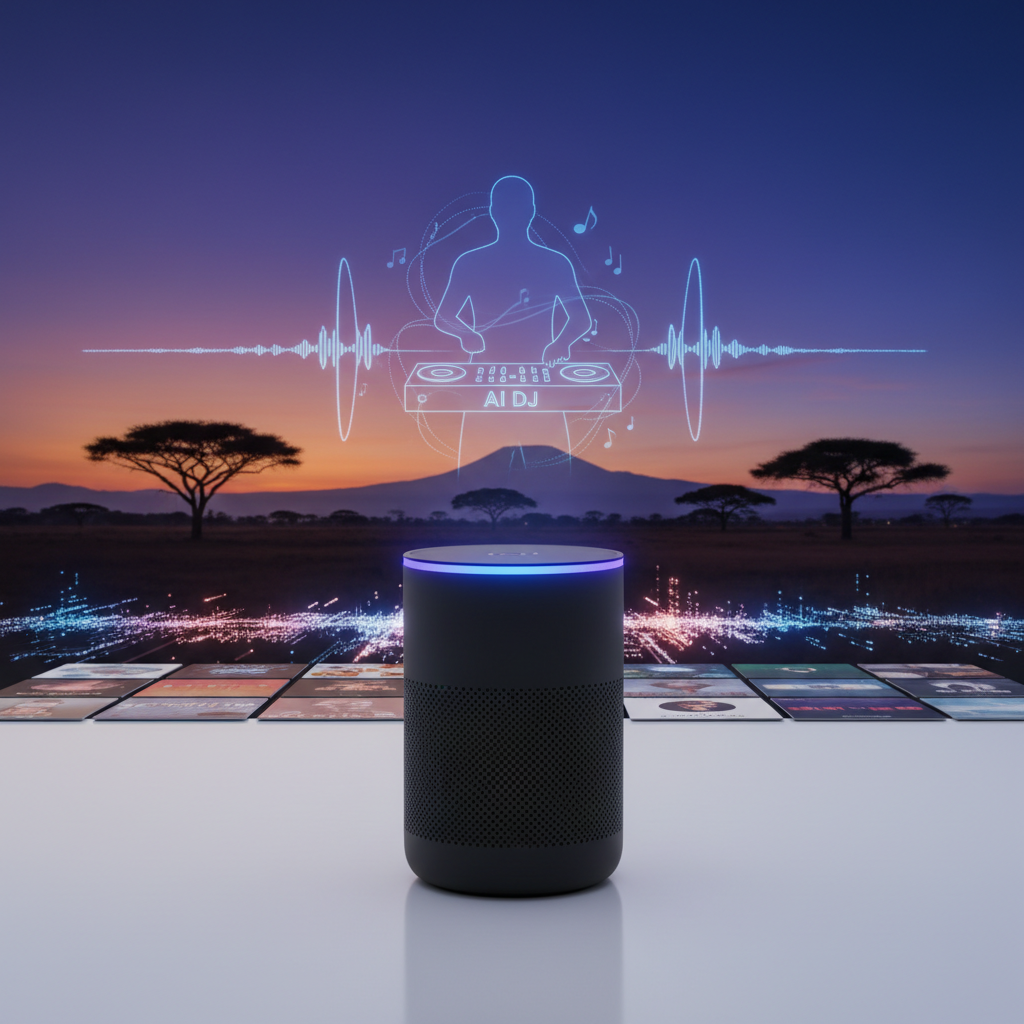

I remember the days, not so long ago, when discovering new music meant flipping through dusty cassette tapes at Kariakoo market, or maybe, if you were lucky, catching a fresh track on Radio One. The thrill was in the hunt, the unexpected gem found amidst the familiar. Fast forward to April 2026, and we're told that hunt is over, replaced by algorithms and artificial intelligence. Specifically, Spotify's AI DJ, which has been making waves globally, promising to be your personal, all-knowing music guru. But does it work for us, here in Tanzania, where our musical palate is as rich and varied as the spices in a Zanzibar market? I decided to put it to the test.
First Impressions: A Smooth Talker, But Does It Listen?
My first encounter with the AI DJ was, well, smooth. Too smooth, perhaps. The voice, a calm, American-accented male, introduced itself with a confidence that bordered on smug. It promised to play music it knew I'd love, based on my listening history. It started with some familiar Bongo Flava, then smoothly transitioned into some Afrobeats, which was a good start. It felt like that one friend who always knows the perfect song for the moment, but also that one friend who talks a bit too much about themselves. The interface is clean, integrated seamlessly into the Spotify app, just a tap away from your regular playlists. It’s an interesting concept, having a digital companion narrate your musical journey. For a moment, I thought, 'Welcome to the future, because it's weird.'
Key Features Deep Dive: Beyond the Voice
The core of the AI DJ experience is its ability to curate a personalized stream of music, interspersed with commentary. This isn't just a smart shuffle; it's designed to provide context, explain why certain songs are being played, and introduce new artists based on your taste profile. Spotify leverages its vast troves of user data, combined with OpenAI's voice generation technology and its own personalization algorithms. The DJ analyzes your listening habits, including genres, artists, moods, and even the time of day you listen, to craft a unique session. It can switch between themes, like 'throwback hits' or 'new releases from artists you like,' all while maintaining that conversational tone. It's an ambitious blend of recommendation engine and radio host, aiming to make music discovery feel less like an algorithm and more like a conversation.
One interesting aspect is its ability to adapt. If you skip a song, the DJ notices. If you give a thumbs up, it learns. This continuous feedback loop is supposed to refine its understanding of your preferences over time. It's like having a very patient, very digital apprentice learning your musical soul. The idea is to break you out of the 'playlist rut' and introduce you to new sounds without the effort of searching. For someone who spends too much time scrolling through endless options, this sounds like a godsend.
What Works Brilliantly: The Unexpected Gems and the Seamless Flow
When the AI DJ works, it's genuinely delightful. There were moments, especially during my morning commute through the bustling streets of Dar es Salaam, when it dropped a track I hadn't heard in years, a forgotten gem from the early 2000s Bongo Flava scene, then seamlessly blended it with a contemporary artist I'd been meaning to check out. The transitions were often impeccable, creating a flow that a human DJ would be proud of. It excels at finding connections between disparate artists and genres that you might not have considered yourself. For listeners who are open to exploration, it can be a fantastic tool.
Its strength lies in its access to Spotify's immense catalog and its ability to cross-reference millions of user preferences. This allows it to surface niche artists or tracks that might otherwise remain buried. For example, it introduced me to some incredible contemporary Taarab fusion that I would likely never have stumbled upon otherwise. The commentary, while sometimes a bit generic, occasionally offered interesting tidbits about artists or genres, adding a layer of engagement that a simple playlist lacks. According to a recent report by The Verge, Spotify's investment in AI for personalization has led to a significant increase in user engagement, suggesting that many find this feature compelling.
What Falls Short: The Cultural Nuances and the Monotone Monologue
Here’s where the rubber meets the road, or rather, where the algorithm meets the mdundo drum. While the AI DJ is good at recognizing popular genres globally, its understanding of the subtle, intricate nuances of East African music, or even specific Tanzanian sub-genres, is still quite shallow. It can play Bongo Flava, yes, but does it understand the difference between Singeli from Tandale and the more melodic sounds from other parts of the city? Not really. It struggles with context, with the cultural significance of certain songs, or with the rapid evolution of local slang and trends that define our music. It’s like trying to explain the taste of ugali to someone who’s only ever eaten mashed potatoes.
The commentary, while a nice idea, often feels robotic and lacks the personality and local flavor of a real radio presenter. It’s always the same voice, the same cadence, which can become monotonous. I found myself wishing for a Swahili-speaking DJ, or at least one with a bit more roho in its voice. It’s one thing to say, 'Here’s a track from an artist you’ve been listening to,' and quite another to say, 'Hii ngoma itakutoa jasho, ni moto kama jua la Dar!' The human element, the connection, is still missing. You can't make this stuff up, the difference is palpable.
Furthermore, while it's great at surfacing new music, it sometimes misses the mark entirely, throwing in a random Western pop song when I was clearly deep into an African groove. It’s a reminder that even the most advanced AI still operates on patterns and data points, not on intuition or cultural immersion. This lack of true cultural intelligence is a significant hurdle for its widespread adoption and genuine appreciation in diverse markets like ours. As Dr. Moustapha Cissé, head of Google AI Center in Accra, often emphasizes, building AI that truly understands and serves diverse communities requires deep local embedding and data, not just global models. His vision for Africa bridging the global AI governance divide also touches on the need for culturally aware AI, a point he often raises in discussions about ethical AI development, as reported by MIT Technology Review.
Comparison to Alternatives: Human DJs and Algorithmic Playlists
Before the AI DJ, Spotify's personalization engine already offered highly effective algorithmic playlists like 'Discover Weekly' and 'Daily Mixes.' These are still excellent for finding new music, and in many ways, they are less intrusive. They just present the music, allowing you to form your own opinions without a digital voice telling you what to think. The AI DJ adds the conversational layer, which is its unique selling proposition, but it’s also its Achilles' heel when the conversation feels forced or culturally tone-deaf.
Compared to human radio DJs, there's simply no contest. A human DJ, especially one who understands the local scene, brings personality, humor, local news, and a genuine connection to the audience. They can read the mood of the city, play requests, and offer insights that no algorithm can replicate. They are part of the community. The AI DJ, for all its technical prowess, is still an outsider. It feels like a very sophisticated jukebox with a pre-recorded monologue, rather than a genuine musical companion. This is particularly true in places like Tanzania, where radio remains a powerful, personal medium.
Verdict: A Promising Start, But Needs More 'Roho'
Spotify's AI DJ is a fascinating experiment, a glimpse into a future where our digital assistants are more conversational and integrated into our daily lives. For some, especially those in markets with more homogenous musical tastes, it might already be a game-changer. For us, here in Tanzania, it’s a promising start, but it needs a lot more work, a lot more 'roho', soul, spirit, to truly resonate. It needs to learn to speak Swahili, to understand the rhythm of our streets, and to appreciate the depth of our musical heritage beyond just genre tags.
It’s a powerful tool for discovery, certainly. It can push you out of your comfort zone and introduce you to artists you might love. But until it can truly understand the soul of the music, the story behind the beat, and the cultural context that gives it meaning, it will remain a novelty rather than a true companion. It's a testament to the fact that while AI can process vast amounts of data, the human touch, the cultural understanding, and the genuine connection are still irreplaceable. Only in East Africa, perhaps, do we truly appreciate the difference between a well-programmed algorithm and a truly soulful sound. Spotify, if you're listening, send your AI DJ to a bongo music academy, not just a data center. Give it some pilipili, some spice, some life. Then, we can talk.