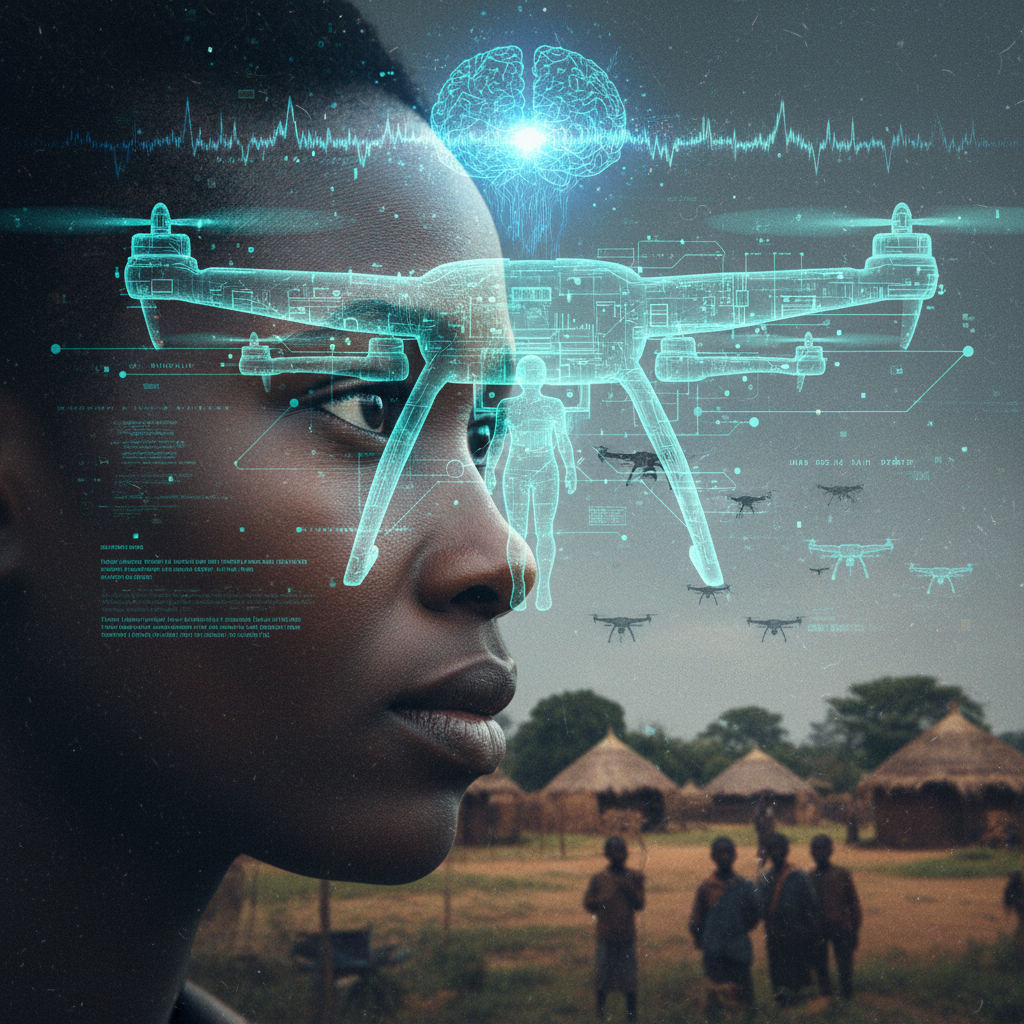

The sun was just beginning to dip below the horizon, painting the sky in hues of orange and purple, a familiar Zambian masterpiece. Mama Nkosi, a woman whose wisdom was as deep as the Zambezi River itself, was stirring nshima over a crackling fire. Her grandson, Chanda, usually glued to his phone, was unusually quiet, staring into the flames. “What troubles you, mwanangu?” she asked, her voice a soft melody. Chanda looked up, his young face etched with a worry far too old for his years. “Mama, my friend in Lusaka, his cousin, he works with the military. He says they are talking about machines that fight wars, machines that decide who lives and who dies, without a person telling them what to do. Is this true? Will our soldiers become like robots, or will the robots become our soldiers?”
Mama Nkosi paused, the rhythmic stirring of the nshima momentarily forgotten. Chanda's question, born from a casual conversation, cuts to the heart of a global dilemma that is increasingly pressing even in our part of the world. The advent of artificial intelligence in military applications, from sophisticated drone warfare to fully autonomous weapon systems, isn't just a geopolitical chess game played by distant powers; it's a psychological earthquake rumbling beneath the surface of human society, subtly altering our perceptions of conflict, responsibility, and even our own humanity.
For years, the discussions around AI in the military felt like something out of a science fiction novel, a distant concern for the technologically advanced nations. But the reality is, the technology is here, and its implications are far-reaching. We're talking about systems that can identify targets, make decisions, and execute actions without direct human intervention. This isn't just about faster, more efficient warfare; it's about fundamentally changing the human element in conflict. And in places like Zambia, where the scars of past conflicts and the fragility of peace are keenly felt, these developments carry a particularly heavy weight.
Research into the psychological impact of drone warfare, for instance, has already yielded concerning insights. While often framed as a way to reduce human casualties on the attacking side, it creates a significant psychological distance from the act of killing. Soldiers operating drones from thousands of kilometers away might not face the immediate, visceral trauma of ground combat, but they grapple with a different kind of burden: moral injury, feelings of detachment, and even a form of post traumatic stress related to the remote nature of their actions. This psychological buffer, while seemingly beneficial, can erode empathy and the very human understanding of the consequences of violence. When the enemy is a pixelated image on a screen, the act of taking a life becomes abstracted, almost gamified. This is a dangerous path, not just for the individuals involved, but for our collective consciousness.
“The psychological toll of remote warfare is often underestimated,” explains Dr. Evelyn Mwale, a clinical psychologist based in Lusaka, who has worked with returning peacekeepers. “When you remove the direct physical risk, you don't remove the moral weight. In fact, you can complicate it. Soldiers are trained to protect, to respond, to make split-second ethical decisions under immense pressure. When an AI system takes over parts of that decision-making, it can leave a human operator feeling like a mere button-pusher, disempowered and detached from the ultimate outcome. This can lead to profound existential distress.” Her words echo the anxieties of Chanda, and indeed, many in our communities.
The rise of fully autonomous weapon systems, often referred to as 'killer robots,' pushes these ethical and psychological boundaries even further. The debate is no longer about human-in-the-loop versus human-on-the-loop, but human-out-of-the-loop entirely. The idea of machines making life-or-death decisions without human oversight raises fundamental questions about accountability, morality, and the very definition of war crimes. If a fully autonomous drone makes a mistake, who is responsible? The programmer? The manufacturer? The military commander who deployed it? Or the machine itself? The irony is almost too perfect: in our quest for perfect efficiency, we risk creating a moral vacuum.
From a psychological perspective, the implications are staggering. How do human beings, wired for empathy and social connection, reconcile with the idea of an emotionless algorithm determining fate? This can lead to a pervasive sense of powerlessness and a deep erosion of trust in institutions that wield such technology. If the ultimate arbiter of violence is an algorithm, what does that say about the value of human life, particularly in regions already vulnerable to external pressures? This is not just a theoretical concern; it shapes how people view their governments, their security, and their place in a world increasingly dominated by technological might.
The global community is grappling with this. Organizations like the United Nations have held discussions on lethal autonomous weapon systems, with many nations, including Zambia, advocating for a ban or strict regulation on their development and deployment. Reuters has extensively covered these international efforts, highlighting the deep divisions among member states. Some argue that such systems are inevitable and offer strategic advantages, while others warn of a dangerous ethical slippery slope and a potential arms race that could destabilize global security even further.
Here in Zambia, while we may not be at the forefront of developing these technologies, we are certainly not immune to their effects. The mere knowledge that such systems exist, and could potentially be deployed in conflicts that affect our region, creates a subtle but profound shift in collective psychology. It can foster a sense of vulnerability, a feeling that our destiny might one day be decided by lines of code rather than human negotiation or diplomacy. This erodes the very foundations of trust and security that are essential for societal well-being.
Consider the impact on youth. Children like Chanda, growing up in an era where AI is increasingly ubiquitous, are already processing complex ethical dilemmas at an unprecedented age. They see AI in their games, their educational tools, and now, potentially, in the instruments of war. This constant exposure to advanced technology, particularly when it touches upon such profound moral questions, can shape their worldview in ways we are only beginning to understand. It might normalize the idea of automated violence, or conversely, instill a deep cynicism about humanity's capacity for ethical governance.
So, what can we do? The first step is awareness and open dialogue. We must continue to push for international treaties and robust ethical frameworks that ensure human control and accountability remain paramount in military AI. As Professor Stuart Russell, a leading AI researcher and author of Human Compatible, often argues, “We need to ensure that we retain meaningful human control over critical decisions, especially those involving the use of force.” His work, frequently cited in MIT Technology Review, emphasizes the urgent need for global cooperation on this issue.
Education is also key. We need to empower our communities, from Mama Nkosi's village to the bustling streets of Lusaka, with the knowledge to understand these technologies and their implications. This isn't about fear-mongering, but about informed engagement. We must encourage critical thinking, ethical reasoning, and a commitment to human values in an increasingly automated world. We must ensure that our soldiers, our leaders, and our citizens are equipped to navigate these complex moral landscapes.
The conversation Chanda had with Mama Nkosi is happening in countless homes across Zambia, across Africa, and across the globe. It is a conversation about what it means to be human in an age where machines can kill. It is a conversation about responsibility, about trust, and about the kind of future we want to build. The answers won't be simple, but ignoring the questions is a luxury we simply cannot afford. The psychological impact of AI warfare is not a distant threat; it is a present reality, subtly reshaping our minds, our relationships, and our very understanding of peace. It's time we faced it head-on, with the same warmth and wisdom that Mama Nkosi brings to her nshima, and the same sharp observation that defines our Zambian spirit. Perhaps, in understanding the human cost, we can still steer the machines toward a more humane future. For more on the broader implications of AI's societal shifts, you might find this article on Sam Altman's AGI Dreams and OpenAI's Tight Grip [blocked] thought-provoking.