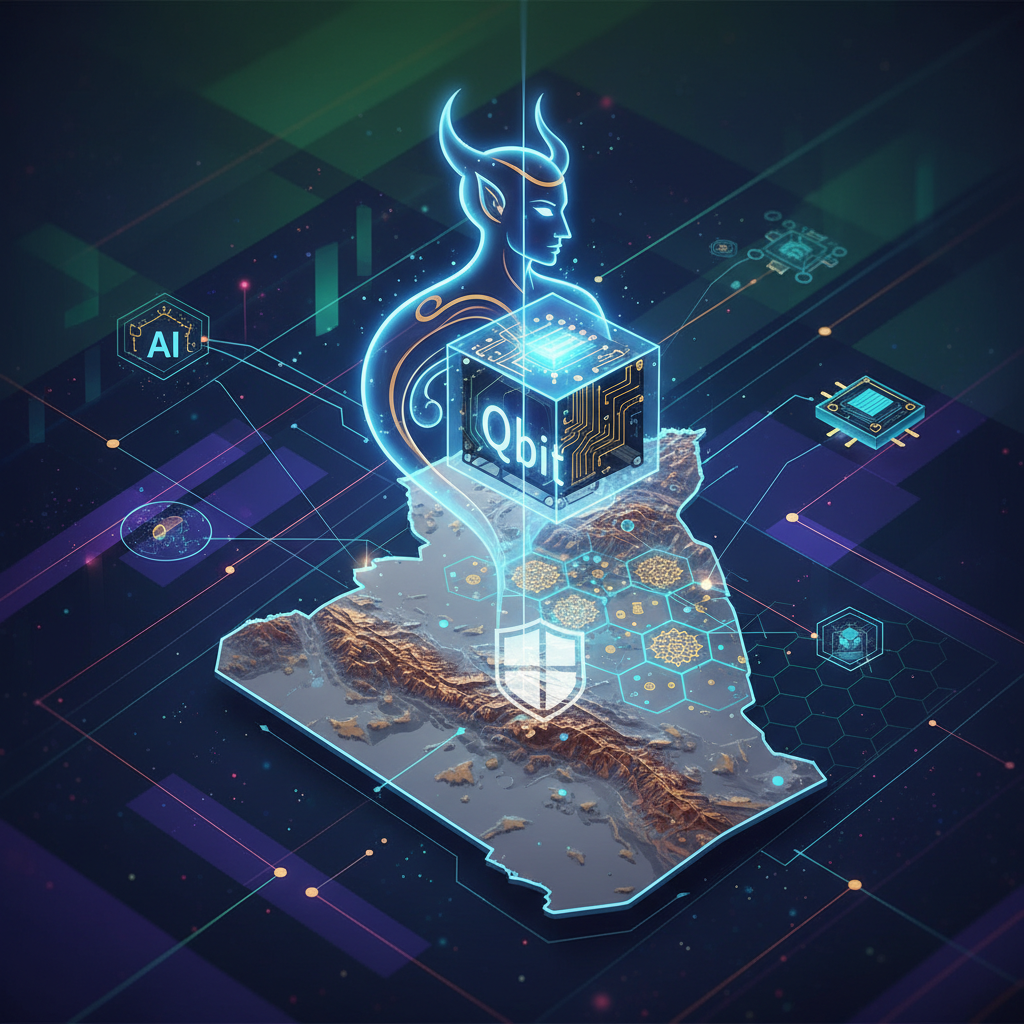
The digital landscape, much like the vast, shifting dunes of the Sahara, is in constant flux. Today, we stand at a precipice, gazing upon a horizon where two titans of computational power, quantum computing and artificial intelligence, are beginning to intertwine. This convergence, a phenomenon some liken to the mythical Djinn meeting the infinitesimal qubit, is not merely an academic curiosity; it is poised to redefine the very architecture of defense and security, challenging nations from Washington to Algiers to adapt or risk obsolescence.
Is this trend, this quantum-AI nexus, a fleeting fad, a transient whisper in the digital wind, or is it the new normal, a foundational shift that will irrevocably alter strategic advantage? From my vantage point here in Algeria, a nation with a rich history of strategic foresight and a keen awareness of geopolitical currents, the implications are profound and demand rigorous examination.
Historically, the pursuit of computational superiority has always been a cornerstone of military and intelligence dominance. From the early mechanical computers used in code-breaking during World War II to the supercomputers that power modern cyber warfare, each leap in processing capability has translated directly into a strategic edge. Artificial intelligence, with its ability to sift through petabytes of data, identify patterns, and predict outcomes, has already begun to revolutionize intelligence gathering, logistics, and autonomous systems. Consider the advancements in predictive maintenance for military hardware or the sophisticated threat detection systems employed by major powers. These are the fruits of classical AI, yet they hint at a much grander potential.
The current state of this convergence is exhilarating, if nascent. Major players like IBM, Google, and Microsoft are pouring billions into quantum research, recognizing its potential to break through computational barriers that even the most powerful classical supercomputers cannot surmount. IBM, for instance, has been a vocal proponent of quantum-AI integration, recently demonstrating how quantum machine learning algorithms could enhance the efficiency of classical AI models, particularly in complex optimization problems relevant to defense logistics and cryptography. Their 'Quantum Experience' platform, while still experimental, offers a glimpse into a future where quantum processors are not just theoretical constructs but accessible tools for advanced computation.
From a technical standpoint, the synergy is clear. Quantum computers, with their ability to process information in superposition and entanglement, can tackle problems of immense complexity. Imagine simulating molecular structures for novel materials development, optimizing logistical networks for troop deployment across vast territories like our own, or breaking currently unbreakable encryption methods. When paired with AI, these capabilities amplify exponentially. An AI trained on quantum-enhanced data could discern patterns in encrypted communications that are invisible to classical algorithms, or design new cryptographic protocols that are quantum-resistant. The mathematics behind this is elegant, drawing from the principles of quantum mechanics and information theory, pushing the boundaries of what we thought computable.
Dr. Amina Benali, a leading expert in quantum cryptography at the Centre de Développement des Technologies Avancées (cdta) in Algiers, articulates this urgency. "The race for quantum supremacy, particularly in its fusion with AI, is not merely about scientific prestige," she stated in a recent symposium. "It is a strategic imperative. Nations that master this convergence first will possess an asymmetric advantage in intelligence, defense, and economic security for decades to come. For Algeria, this means investing in the foundational research and talent development now, or risking a significant technological gap." Her words echo the sentiments of many across the continent, who recognize the need to build indigenous capabilities rather than relying solely on external technologies.
Indeed, the data supports this growing trend. A recent report by Reuters indicated a 35% increase in defense-related quantum-AI research grants globally in the last two years, with significant investment from the Pentagon's Defense Advanced Research Projects Agency (darpa) and similar bodies in Europe and Asia. Furthermore, venture capital funding for quantum computing startups with explicit AI applications surged by 48% in 2025, reaching an estimated $4.2 billion. This is not the behavior of an industry chasing a fad; it is the calculated investment in a transformative technology.
Let me walk you through the architecture of this potential revolution. Consider the problem of threat detection in a highly complex, dynamic environment, such as a contested airspace or a vast maritime zone. Classical AI systems, like those used in advanced radar, can identify known targets with impressive accuracy. However, they struggle with novel threats or subtle anomalies that deviate from their training data. A quantum-enhanced AI, leveraging quantum machine learning algorithms, could potentially process a far greater dimensionality of data, detecting these minute, emergent threats with unprecedented sensitivity. It is like moving from searching for a specific grain of sand in the desert to discerning the unique molecular structure of every single grain simultaneously.
Another critical area is cryptography. The advent of sufficiently powerful quantum computers poses an existential threat to current encryption standards, including those protecting sensitive military and government communications. This is the 'Q-Day' scenario, where quantum computers could break public-key cryptography in minutes. The response, known as post-quantum cryptography, involves developing new algorithms resistant to quantum attacks. Here, quantum-AI convergence offers a dual-edged sword: quantum computers could break existing codes, but quantum-AI could also be instrumental in designing and validating the next generation of quantum-resistant cryptographic systems. "The stakes could not be higher," explains Dr. Omar Cherif, a cybersecurity specialist advising the Algerian Ministry of Defense. "We are not just talking about protecting state secrets, but the very integrity of our national infrastructure, from energy grids to financial systems. The quantum threat is real, and the quantum-AI solution is our best defense."
Yet, the path is not without its challenges. The development of stable, scalable quantum computers remains a formidable engineering hurdle. Current quantum processors are prone to errors and require extremely low temperatures, making them impractical for widespread deployment. Moreover, the talent pool of quantum engineers and scientists is still relatively small, particularly in regions like North Africa. However, initiatives like the Algerian Quantum Computing Initiative, launched last year, aim to bridge this gap by fostering collaboration between universities and industry, mirroring efforts seen in nations like South Korea and Japan.
My verdict, after weighing the evidence and consulting with experts, is unequivocal: this quantum-AI convergence is far from a fad. It is the new normal, a technological tide that will reshape defense and security paradigms globally. The investments, the research trajectory, and the sheer computational potential point towards a future where quantum-enhanced AI will be as indispensable to national security as radar or satellite intelligence is today. For Algeria, and indeed for all nations, the imperative is clear: to invest wisely, cultivate talent, and strategically position ourselves within this emerging landscape. The future of defense may very well be decided not on battlefields, but in the intricate dance between the qubit and the algorithm, a dance that has only just begun.